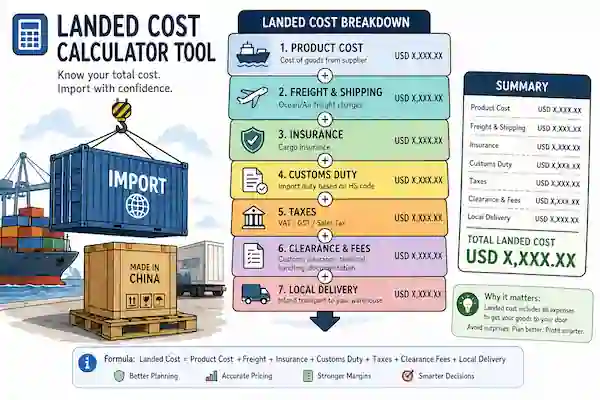
Many small import mistakes happen before the goods even leave the supplier. The seller quotes a low product price, the buyer calculates a hopeful margin, then freight, duty, VAT, clearing, storage and local delivery turn the shipment into a loss. A better import decision starts with a checklist, not a guess.
This guide is for African small businesses, online sellers, wholesalers, repair shops, boutique owners and side-hustle importers who need a practical planning workflow. It does not give official customs rates. Those change by country, product, classification, valuation and exchange-rate rule. Use it to collect the right inputs, estimate the landed cost, and know when to check the customs authority or a licensed clearing agent before paying.
Do not compare suppliers by product price alone. Build a landed-cost estimate that includes product value, freight, insurance, duty, VAT or sales tax, clearing, port or terminal charges, storage, local delivery and document costs. Use Landed Cost Calculator for the full stack, then confirm official duties and import rules before committing money.
Before You Order: Collect These Inputs
Start with the product itself. A vague description like "electronics" or "clothes" is not enough for customs planning. You need the commercial name, material, use, brand, model, quantity, unit price, country of origin and whether the item is new, used, refurbished, battery-powered, food-related, medical, cosmetic, chemical, agricultural or regulated.
Next, work on classification. The HS code or tariff heading drives duty estimates, import restrictions and required documents. You can use HS Code Lookup as a planning aid, but ambiguous products need confirmation from the destination customs authority, trade portal or clearing agent. Two products that look similar in a shop can sit under different headings if the material, use or technical specification differs.
Then collect the trade terms. Know whether the supplier quote includes freight or only covers goods at the supplier location. If you do not understand the Incoterm, ask the supplier to write plainly what is included: pickup, export handling, sea or air freight, insurance, destination charges and delivery to your city. A cheap invoice can become expensive when the quote leaves most movement costs for you.
The Import Cost Stack
Landed cost is the cost to put the goods where you can actually sell, use or deliver them. The exact formula depends on country rules, but the planning stack usually looks like this:
| Cost layer | What to capture | Planning note |
|---|---|---|
| Product value | Supplier invoice, quantity, currency, discounts and samples | Keep the invoice consistent with payment proof and packing details. |
| Freight | Sea, air, courier, road or consolidation charge | Cheap freight may have slower arrival or higher destination handling. |
| Insurance | Shipment insurance or declared coverage | Some valuation methods include insurance in the customs value. |
| Duty and levies | Duty rate, excise, levy or special charge where applicable | Confirm through official or licensed channels for the destination country. |
| VAT or sales tax | Import VAT, GST or sales-tax equivalent | Often calculated on a base that includes duty and other charges. |
| Clearing and handling | Agent fee, port charge, terminal charge, inspection, scanning or courier admin fee | Ask for a written estimate before the shipment arrives. |
| Local delivery | Transport from port, airport, border, warehouse or courier branch | Include loading, offloading and last-mile movement. |
| Delay risk | Storage, demurrage, exchange-rate movement and rework | Add a buffer for documents, inspection and payment delays. |
Once you have these layers, use Import Duty Calculator for a first duty estimate and Landed Cost Calculator for the full business number. The duty estimate helps you understand the tax side. The landed cost helps you decide whether the shipment makes commercial sense after all costs.
Documents to Prepare Before Arrival
Document gaps are expensive because they create delay. A buyer who has paid the supplier but cannot clear the goods may pay storage, demurrage, amendment fees or urgent transport costs. Prepare the document packet before the goods arrive.
- Commercial invoice: supplier, buyer, product description, quantity, unit price, currency, invoice number and payment terms.
- Packing list: cartons, weights, dimensions, marks and product counts.
- Transport document: bill of lading, airway bill, courier waybill or road consignment note.
- Certificate or permit: product-standard, health, origin, import permit or regulator document where required.
- Payment proof: transfer receipt, proforma, deposit evidence or bank document if requested.
- Tax or business identifiers: importer tax number, business registration, customs account or trader profile where required.
Use Packing List Generator, Bill of Lading Generator and Invoice Generator to prepare clean commercial documents for planning and internal handoff. Official forms, permits and customs submissions still depend on the destination authority and the appointed clearing process.
Common Costs Small Importers Miss
The first missed cost is exchange-rate movement. If you price the product today but pay duties or supplier balances later, the rate may move. Keep a buffer and record which rate you used in the estimate. The second missed cost is destination handling. A quote that says freight is paid may still leave terminal, port, agent, courier admin, inspection or storage charges unpaid.
The third missed cost is compliance rework. Some goods need product standards, health checks, labels, manuals, batch numbers, safety markings or import permits. If the product is food-related, cosmetic, medical, electrical, agricultural, chemical, telecom, branded, used, battery-powered or child-facing, do not treat it like a plain parcel. Ask before paying.
The fourth missed cost is sales channel friction. If you import stock for marketplaces, retailers, schools, offices or government buyers, they may ask for invoices, tax details, delivery notes, warranties or after-sales support. Your landed cost is not only the border cost. It is the cost to deliver something a customer can accept and pay for.
A Practical AfroTools Workflow
Use this sequence when comparing a supplier quote:
- Describe the product clearly and search the likely heading in HS Code Lookup.
- Estimate duty and taxes in Import Duty Calculator, then mark the result as planning only.
- Add product, freight, insurance, clearing, storage, local delivery and buffer in Landed Cost Calculator.
- Check freight timing and handling assumptions with Shipping Estimator, Customs Clearance Time Estimator and Demurrage Calculator.
- Prepare the document packet with Export Docs Checklist, Packing List Generator and Bill of Lading Generator.
- Only then decide whether the selling price, cash-flow timing and margin justify the order.
Keep your estimate in writing. If you later discover a duty, storage or local transport surprise, update the template instead of trusting memory next time. A simple repeatable worksheet is what turns importing from a gamble into an operating process.
Build Your Import Cost Stack
Estimate duty, freight, clearing, delivery and margin before you pay a supplier.
Open Landed Cost Calculator →Frequently Asked Questions
No. Treat any calculator output as a planning estimate. The final payable amount depends on the customs authority, classification, valuation, exchange rate, inspection result, exemptions, documents and clearing process.
Collect product description, likely HS code, supplier invoice, quantity, currency, freight, insurance, origin, destination, Incoterm, arrival timing, shipping documents and permit requirements.
Landed cost includes the product cost plus freight, insurance, duties, VAT or sales tax, port charges, clearing fees, local delivery, storage and other costs needed to put the goods where you can use or sell them.
Ask before paying a supplier when the product is regulated, high value, hard to classify, perishable, used, restricted, branded, battery-powered, medical, food-related or likely to need inspection, permits or standards approval.