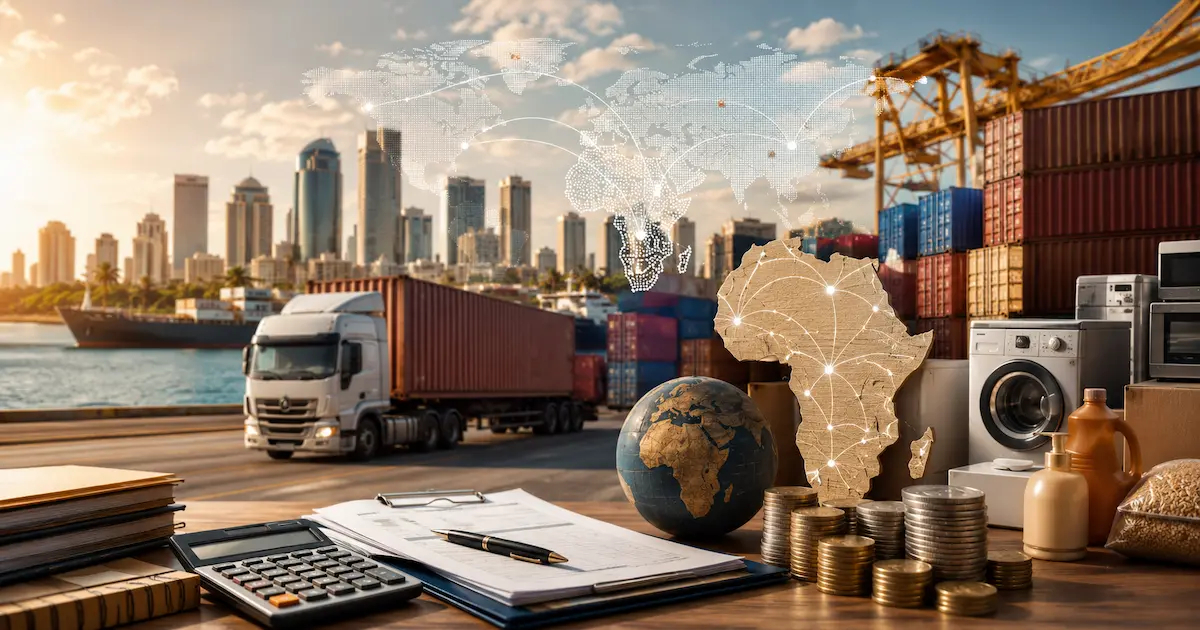
What Is AfCFTA and Why Does It Matter?
The African Continental Free Trade Area - AfCFTA - is the world's largest free trade area by number of participating countries. Signed in Kigali in March 2018 and operational since January 2021, it encompasses 54 of Africa's 55 nations, covering a combined GDP of over $3.4 trillion and a market of 1.4 billion people. By comparison, the WTO has 164 members, but AfCFTA's geographic concentration makes it uniquely powerful: every tariff reduction happens within a single continent, enabling supply chains that were previously fractured across dozens of competing customs regimes to be rebuilt as integrated networks.
For importers and exporters, AfCFTA's central promise is straightforward: progressively reduce, and eventually eliminate, the tariffs and non-tariff barriers that currently make intra-African trade disproportionately expensive. Today, African countries trade more with Europe, Asia, and North America than they do with each other - intra-African trade accounts for only about 15% of total African exports, compared to 65% for Europe and 58% for Asia. AfCFTA is designed to change that structural imbalance.
This guide explains how AfCFTA's tariff liberalisation schedule works, which countries are actually implementing it, which industries benefit most, and what practical steps businesses and traders should take right now to use it.
AfCFTA Basics
Membership and Ratification
As of 2026, all 55 African Union member states have been invited to sign AfCFTA, and 54 have done so - Eritrea being the sole non-signatory. However, signing the agreement and ratifying it are different steps. Ratification means a country's legislature or executive has formally adopted the treaty into domestic law, making it legally binding at home. As of early 2026, over 47 countries have ratified AfCFTA and deposited their instruments of ratification with the African Union Commission.
The AfCFTA Secretariat is headquartered in Accra, Ghana, and is led by the AfCFTA Secretary-General. The Secretariat coordinates the technical work of tariff offer negotiations, dispute resolution, and monitoring implementation.
Key Dates
- March 2018: Agreement signed at the AU Summit in Kigali, Rwanda.
- May 2019: Agreement entered into force after 22 countries ratified.
- July 2019: AfCFTA Secretariat formally established in Accra.
- January 2021: Trading under AfCFTA officially commenced (pilot phase).
- 2022: Pan-African Payment and Settlement System (PAPSS) launched for cross-border settlements.
- 2025–2030: Main tariff liberalisation phase for standard developing countries.
- 2030–2035: Extended phase for Least Developed Countries (LDCs).
Three Pillars of AfCFTA
Pillar 1 - Trade in Goods: Eliminates tariffs on 90% of tariff lines over 5 years for standard countries, 10 years for LDCs. A further 7% of sensitive products will be liberalised on longer timelines, and 3% may be excluded entirely.
Pillar 2 - Trade in Services: Liberalises services trade across five priority sectors: financial services, communications, transport, tourism, and business services. The services protocol is still being negotiated and implemented gradually.
Pillar 3 - Dispute Resolution: Establishes a formal mechanism for resolving trade disputes between member states, preventing the trade wars and retaliatory tariffs that have historically destabilised regional trade agreements in Africa.
How AfCFTA Affects Import Duties
The Tariff Liberalisation Schedule
AfCFTA's tariff reduction works through each country submitting a "tariff offer" - a list of all its tariff lines (typically 5,000–8,000 product categories) classified into three categories:
- Category A - Liberalised immediately (90%): Tariffs are eliminated over 5 years from the entry into force of the agreement for standard countries, 10 years for LDCs. The starting point is the MFN (Most Favoured Nation) rate each country charges the rest of the world.
- Category B - Sensitive products (7%): Products where import competition would cause significant domestic disruption. These tariffs are reduced more slowly over 10 years (standard) or 13 years (LDCs) but must eventually reach zero for most.
- Category C - Excluded (3%): Products permanently excluded from liberalisation for national security, public health, or critical industry protection reasons. Each country determines its own exclusion list.
Rules of Origin
The rules of origin are the critical technical requirement that determines whether a product qualifies for AfCFTA preferential tariff rates. A product "originates" in an AfCFTA country if it either:
- Is wholly obtained there - meaning it was grown, extracted, or born in that country with no imported inputs (applies to agricultural produce, minerals, livestock), OR
- Has undergone sufficient transformation - the most common test requires a change in HS tariff heading PLUS local value-added content of at least 30% of the ex-works price (35% for LDCs on some products).
Products that fail the rules of origin test - for example, goods simply transshipped through an AfCFTA country without transformation - do not qualify for preferential rates and must pay the standard MFN tariff.
Practical Example: Nigerian Manufacturer Exporting to Kenya
A Nigerian manufacturer produces textile garments using locally woven fabric (Nigerian cotton, Nigerian weaving). The garments fall under HS Chapter 62. Under AfCFTA, if Nigeria and Kenya have both liberalised Chapter 62 in their tariff offers:
- The manufacturer obtains a Certificate of Origin from the Nigeria Customs Service confirming the garments originate in Nigeria.
- At the Kenyan border, the importer presents the Certificate of Origin and claims the AfCFTA preferential tariff rate (e.g., 0% instead of the standard 25% MFN rate Kenya applies to garments).
- Kenyan customs verifies the certificate and applies the preferential rate, saving the importer 25% in tariff costs on the declared value.
On a shipment worth $100,000, this represents a $25,000 duty saving - which can be passed to consumers, absorbed as margin, or used to price more competitively against Asian garment imports.
Country-by-Country Implementation Status
| Country | Signed | Ratified | Tariff Offer Submitted | Implementation Level |
|---|---|---|---|---|
| Nigeria | Yes | Yes | Yes | Moderate - customs training ongoing |
| Kenya | Yes | Yes | Yes | Good - KRA has AfCFTA desk |
| South Africa | Yes | Yes | Yes | Good - SARS processing AfCFTA claims |
| Ghana | Yes | Yes | Yes | Good - GRA trained on AfCFTA rates |
| Egypt | Yes | Yes | Yes | Moderate - mainly active in North Africa corridors |
| Morocco | Yes | Yes | Yes | Moderate - active in West Africa trade |
| Côte d'Ivoire | Yes | Yes | Yes | Good - WAEMU framework supports AfCFTA |
| Senegal | Yes | Yes | Yes | Good - OHADA legal base facilitates implementation |
| Tanzania | Yes | Yes | Partial | Low - border capacity gaps |
| Ethiopia | Yes | Yes | Yes | Low - border systems upgrade underway |
| Rwanda | Yes | Yes | Yes | Strong - RDB actively promotes AfCFTA trade |
| Cameroon | Yes | Yes | Partial | Low - political challenges affect implementation |
| DRC | Yes | Yes | Partial | Very Low - customs infrastructure constraints |
| Angola | Yes | Yes | Yes | Low - oil-dependent economy, manufacturing limited |
| Mauritius | Yes | Yes | Yes | Strong - services and financial sector leading |
Implementation quality varies significantly. Countries with stronger customs administrations and higher intra-African trade volumes (Kenya, South Africa, Ghana, Rwanda, Mauritius) are implementing AfCFTA more consistently than countries with weaker customs infrastructure or primarily oil/resource-dependent trade profiles.
Winners and Losers Under AfCFTA
Industries That Benefit
Manufacturing - textiles and garments: African textile manufacturers have historically been undercut by cheap Asian imports. With AfCFTA reducing intra-African tariffs on finished garments to zero, Ethiopian garment factories (which have among the world's lowest labour costs), Nigerian textile mills, and South African apparel brands become far more competitive when selling to other African countries.
Agro-processing: Raw commodity exports (cocoa beans, coffee, groundnuts) leave Africa with minimal value added. AfCFTA incentivises intra-African trade in processed products - cocoa powder, instant coffee, groundnut oil - by eliminating the tariff penalty these products previously faced at African borders. Countries like Ghana, Côte d'Ivoire, and Ethiopia stand to gain significantly.
Pharmaceuticals: Africa imports over 70% of its pharmaceuticals. AfCFTA's tariff elimination creates a pan-continental market for African pharmaceutical manufacturers - companies in South Africa (Aspen), Egypt (Eva Pharma), and Nigeria (Emzor) - making it economically viable to produce at scale for the whole continent rather than just their domestic markets.
Services: AfCFTA's services protocol will eventually open markets for African banks, insurance companies, telecoms operators, and professional services firms to operate across borders without the current patchwork of bilateral licensing requirements.
Industries Under Pressure
Countries with less competitive manufacturing sectors - particularly those that relied on tariff walls to protect infant industries - face disruption. Nigeria's small-scale manufacturers, who competed with Asian imports protected by high import tariffs, may now also face competition from more efficient African manufacturers (Ethiopian, Rwandan, Ghanaian). Similarly, Egypt's automotive assembly industry faces potential competition from South African vehicle exports as tariffs fall.
Countries running persistent trade deficits with their African neighbours - importing more than they export - may see those deficits widen initially as tariffs fall before domestic manufacturing catches up to the opportunity. This is a concern for several LDCs in the SADC and ECOWAS regions.
How to Take Advantage of AfCFTA
Step 1: Check if Your Product Qualifies
Find your product's HS (Harmonised System) tariff code. Then check whether both the exporting and importing countries have listed that tariff line in their Category A (liberalised) or Category B (sensitive) schedules. The AfCFTA e-Tariff Book is the practical starting point for tariff offers by country and HS code, but the final border treatment still depends on local customs implementation and proof of origin.
Step 2: Confirm Rules of Origin Compliance
Document your value chain. Calculate what percentage of your product's value was added in the exporting country. If you use imported raw materials or components, calculate whether the finished product undergoes a change in HS tariff heading. If you meet the 30% local value-added threshold and/or the tariff heading change test, your product qualifies for preferential treatment.
Step 3: Obtain a Certificate of Origin
Apply to your national certificate of origin issuing authority. In Nigeria: the Nigeria Customs Service or MAN. In Kenya: the Kenya Revenue Authority (KRA). In Ghana: the Ghana Revenue Authority (GRA) or Ghana Export Promotion Authority (GEPA). In South Africa: the South African Revenue Service (SARS) or the International Trade Administration Commission (ITAC). Provide your value chain documentation, manufacturing records, and supplier invoices to support the application.
Step 4: Use PAPSS for Payment
The Pan-African Payment and Settlement System (PAPSS) allows direct settlement between African currencies without routing through US dollars. This eliminates the double forex conversion cost (sell local currency for USD, then buy destination currency) that previously added 3–8% to intra-African transaction costs. PAPSS is now connected to 14 African central banks and expanding.
Step 5: Find Buyers Through AfCFTA Trade Portals
The AfCFTA Secretariat, UNCTAD's eTradeForAfrica platform, and the African Export-Import Bank's trade directory all provide B2B matching services for AfCFTA-eligible products. The African Development Bank's digital trade portal connects verified African suppliers with corporate buyers across the continent.
Challenges and Criticisms
Infrastructure gaps: AfCFTA reduces tariff barriers on paper, but non-tariff barriers - poor roads, border delays, inadequate cold storage, unreliable power - remain the primary cost of intra-African trade for most traders. The AfDB estimates that Africa needs $130–170 billion annually in infrastructure investment to support the trade volumes AfCFTA envisions.
Inconsistent customs application: Border officials in many countries are not yet fully trained on AfCFTA procedures. Traders report that claiming AfCFTA rates at some borders requires lengthy negotiations, documentation demands beyond what the agreement requires, or simply doesn't work because the local system hasn't been updated. This is improving but remains a significant practical obstacle in 2026.
Currency and payment challenges: Despite PAPSS, most intra-African trade still settles in USD or EUR because African currencies lack sufficient liquidity for large bilateral transactions. Exchange rate volatility - particularly in Nigeria (naira), Ethiopia (birr), and Egypt (pound) - adds unpredictable cost to cross-border contracts priced in local currency.
Political resistance: Several countries have been slow to submit complete tariff offers or have strategically excluded large portions of their tariff schedules from liberalisation. Revenue concerns (import duties are a significant portion of government revenue in many African countries), lobbying from protected industries, and distrust of neighbours' commitment to reciprocity all slow implementation.
Rules of origin complexity: Small traders - market women, cross-border hawkers, artisans - who make up the majority of intra-African trade do not have the administrative capacity to document value chains, obtain certificates of origin, and navigate tariff schedules. The AfCFTA Simplified Trade Regime (STR) for goods valued under $2,000 was designed to address this, but it is not yet operational in most countries.
Calculate Import Duties and VAT for African Trade
Use AfroTools' suite of import duty calculators and VAT tools to understand the full landed cost of goods across African markets.
Open Import Duty Calculator →Frequently Asked Questions
Yes, AfCFTA has reduced duties on a subset of tariff lines for countries that have submitted and approved their tariff offers. Around 40 countries have submitted offers covering at least 90% of tariff lines. However, actual duty reductions vary by country pair and product. In practice, many traders report inconsistent implementation at border points - some border officials are not yet applying AfCFTA rates, making knowledge of the agreement essential when crossing borders.
As of 2026, Eritrea is the only AU member state that has not signed the AfCFTA agreement. All other 54 African Union member states have signed. However, signing differs from ratification - a small number of countries have signed but not yet deposited instruments of ratification, so they are signatories but not yet full state parties.
AfCFTA rules of origin determine which products qualify for preferential tariff treatment. Products must either be wholly obtained in an AfCFTA state party (e.g., raw agricultural produce) or undergo sufficient transformation - typically a change in HS tariff heading plus a minimum 30% local value-added content. Products that fail this test must pay the standard MFN tariff, not the AfCFTA preferential rate.
AfCFTA Certificates of Origin are issued by designated national authorities. In Nigeria: the Nigeria Customs Service or the Manufacturers Association of Nigeria (MAN). In Kenya: the Kenya Revenue Authority (KRA). In Ghana: the Ghana Revenue Authority (GRA) or the Ghana Export Promotion Authority (GEPA). In South Africa: SARS or ITAC. You will need to provide value chain documentation showing your product meets rules of origin requirements.
The industries with the most to gain from AfCFTA are manufacturing (especially textiles, garments, and light manufacturing), agro-processing (processed foods, beverages), pharmaceuticals, and services sectors including financial services, ICT, and professional services. Intra-African trade in manufactured goods currently faces average tariffs of 6–8% - AfCFTA's elimination of these tariffs will make African manufacturers significantly more competitive against imports from Asia and Europe within the continent.