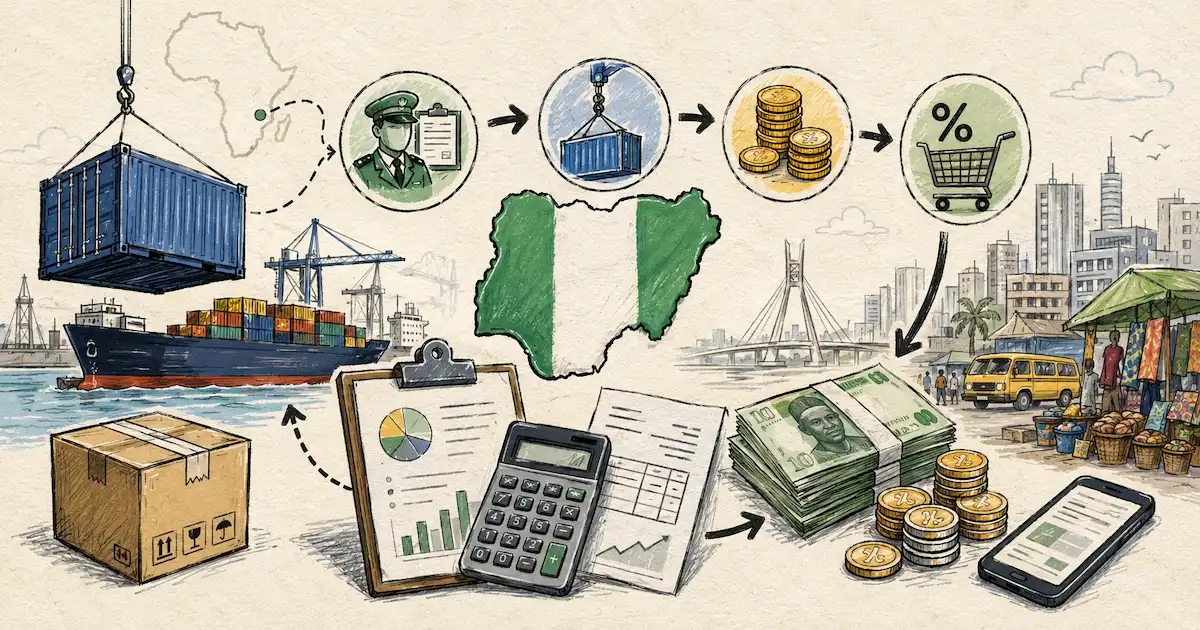
Importing into Nigeria can look simple right up until the charges start stacking up. A supplier gives you a price, freight adds another layer, and then customs valuation, duty, VAT, and product-specific charges can turn a "good deal" into an expensive surprise.
This guide is designed to help you think like a careful importer before the goods ship. We will show where Nigeria Customs starts the calculation, which charges are common, and which parts you should always confirm against the current tariff or with a licensed broker before you rely on the final number.
Nigeria import duty in 2026 usually starts with CIF value and HS code. Many finished goods sit around the 20% CET band, industrial machinery can be 0% to 5%, VAT can apply, and vehicle or product-specific charges can change the landed cost. Use the Nigeria import duty calculator before shipping to model the full cost.
How Nigerian Import Duty Works
The Nigeria Customs Service (NCS) is responsible for collecting duties on all goods entering the country. Import duty rates are based on the ECOWAS Common External Tariff (CET), which assigns every product a rate depending on its Harmonized System (HS) code.
The CET groups products into five duty bands:
- 0% duty, Essential social goods: basic pharmaceuticals, agricultural inputs, certain educational materials
- 5% duty, Raw materials and capital goods: industrial machinery, unprocessed minerals, essential spare parts
- 10% duty, Intermediate goods: semi-processed materials, certain chemicals, components for assembly
- 20% duty, Many finished goods such as consumer products, electronics, clothing, and processed items
- 35% duty, Sensitive or protected goods under the current tariff and fiscal policy measures
That tariff band is only the starting point. Nigeria Customs says duties are calculated from the customs value of the goods, usually on a CIF basis, and that other import-related taxes or levies may also apply depending on the goods. In practice, the applicable mix depends on the HS code, the current fiscal policy measures, and whether the shipment qualifies for a special regime.
Last reviewed: June 17, 2026. This refresh checked Nigeria Customs Service guidance, the Single Window tariff search, and NCS import-payment rules. Treat the worked examples below as planning estimates, not a customs assessment.
What Are All the Import Charges in Nigeria?
Use this as a landed-cost checklist rather than a universal formula. Some lines below apply broadly, while others only show up for certain products or trade regimes.
| Charge | Rate | Base | Notes |
|---|---|---|---|
| Import Duty | 0% – 35% | CIF value | Based on HS code and CET band |
| Product Levy | Varies | CIF value | Only applies to specific products or policy categories |
| VAT | 7.5% | Check current tariff line | VAT treatment depends on the applicable import tax line and exemptions |
| CISS | If applicable | Check current procedure | Confirm the current treatment for your shipment with NCS or your broker |
| ETLS Surcharge | If applicable | Trade-regime specific | Usually depends on ECOWAS treatment and supporting documentation |
| Shipping & Insurance | Varies | Supplier quote and freight terms | Usually 10-15% of FOB for sea freight |
| Terminal Handling | Varies | Port, terminal, and container type | NGN 150,000 – 500,000 per container |
| Customs Broker Fee | Varies | Broker quote | Typically NGN 50,000 – 200,000 |
Understanding CIF Value
CIF stands for Cost, Insurance, and Freight. It is the value of your goods at the Nigerian port, including the purchase price, shipping charges, and insurance. Nigerian customs calculates duty on the CIF value, not the FOB (Free on Board) price you paid the seller.
If your supplier quotes FOB, add approximately 10-15% for sea freight and 1-2% for marine insurance to estimate your CIF value. For air freight, the freight component may be 15-30% of the goods value depending on weight and volume.
How to Find Your HS Code
The Harmonized System code determines the duty band customs may apply. Getting it wrong can mean overpaying duty or facing penalties for under-declaration. Here is how to look it up:
- Visit the Nigeria Single Window tariff search or the NCS CET tariff page
- Search by product description or browse by chapter (e.g., Chapter 87 for vehicles, Chapter 84 for machinery)
- Note the full 10-digit HS code and corresponding duty rate
- Cross-reference with the ECOWAS CET schedule for any supplementary levies
If you are unsure, a licensed customs broker can classify your goods for a small fee. Misclassification is one of the top reasons shipments get delayed at Nigerian ports.
Vehicle Imports Need a Fresh Quote
Cars are where importers lose money most often, because vehicle treatment is especially sensitive to current automotive policy, customs valuation, age, and classification. A generic internet formula is not good enough when you are about to wire a large dollar payment.
That extra step feels slow. It is still cheaper than discovering at the port that your broker, supplier, and spreadsheet were all working from different assumptions.
Worked Example 1: Importing a Laptop
Let us calculate the cost of importing a single MacBook Pro valued at $1,600 FOB from the United States.
| Component | Calculation | Amount (USD) |
|---|---|---|
| FOB Value | Purchase price | $1,600 |
| Air Freight | Courier/DHL estimate | $120 |
| Insurance | ~1% | $16 |
| CIF Value | FOB + freight + insurance | $1,736 |
| Import Duty (20%) | 20% of CIF | $347 |
| VAT (7.5%) | 7.5% of (CIF + Duty) | $156 |
| NCS admin charge planning allowance (1%) | 1% of FOB, based on NCS import-payment guidance | $16 |
| Other line charges planning allowance | Confirm against tariff line | $9 |
| Total Landed Cost | Planning estimate | $2,264 |
The total cost adds roughly 41% on top of the purchase price in this planning example. If you use a courier service like DHL or FedEx, they handle customs clearance but add their own brokerage fee, so request the final duty and handling estimate before you approve delivery.
Worked Example 2: Importing a Container of Clothing
Suppose you are a trader importing a 20-foot container of ready-made clothing from China, with a total invoice value of $15,000 FOB.
| Component | Calculation | Amount (USD) |
|---|---|---|
| FOB Value | Invoice value | $15,000 |
| Sea Freight (20ft) | Estimated | $2,200 |
| Insurance | ~1.5% | $225 |
| CIF Value | FOB + freight + insurance | $17,425 |
| Import Duty (20%) | 20% of CIF | $3,485 |
| Textile Levy (10%) | 10% of CIF | $1,743 |
| VAT (7.5%) | 7.5% of (CIF + Duty + Levy) | $1,699 |
| NCS admin charge planning allowance (1%) | 1% of FOB, based on NCS import-payment guidance | $150 |
| Other line charges planning allowance | Confirm against tariff line | $87 |
| Terminal handling (20ft) | Estimated | $350 |
| Customs broker | Estimated | $150 |
| Haulage to warehouse | Estimated (Lagos) | $200 |
| Total Landed Cost | Planning estimate | $25,289 |
The total additional cost is about 69% on top of the FOB price in this planning model. The actual result depends on the precise textile HS line, fiscal-policy treatment, exchange rate used for assessment, and port timing. Factor in demurrage charges if your container is not cleared within the free storage period.
How Can You Reduce Your Import Costs?
1. Classify Your Goods Correctly
Some products fall into lower duty bands depending on their specific classification and specification. For example, industrial machinery parts may attract 5% instead of 20% if classified under the correct HS chapter. Work with an experienced customs broker who knows the tariff schedule.
2. Use ECOWAS Origin Advantages
Goods manufactured in ECOWAS member states may qualify for reduced or zero duty under the ECOWAS Trade Liberalisation Scheme (ETLS). You need a certificate of origin to claim this benefit.
3. Consider Free Trade Zone Options
Nigeria operates several free trade zones including the Lekki Free Zone, Calabar Free Trade Zone, and Onne Oil and Gas Free Zone. Goods imported for use within these zones attract reduced duties and can be re-exported without additional levies.
4. Consolidate Shipments
Terminal handling and broker fees are largely fixed per shipment. Consolidating multiple orders into a single container reduces the per-unit clearance cost significantly.
5. Avoid Demurrage
Prepare all documentation before your container arrives. Late clearance leads to storage charges of $50-150 per day after the free period. Ensure your Form M, Pre-Arrival Assessment Report (PAAR), and all permits are ready.
What Documentation Is Required for Nigerian Imports?
You will need the following documents to clear goods through Nigerian customs:
- Form M, Mandatory import declaration form obtained through your bank
- Pre-Arrival Assessment Report (PAAR), Issued by the NCS after submitting your shipping documents
- Bill of Lading / Airway Bill, Shipping document from your freight forwarder
- Commercial Invoice, Detailed invoice from the supplier showing quantities, unit prices, and HS codes
- Packing List, Breakdown of what is in each package or container
- Certificate of Origin, Required for ETLS benefits or certain product categories
- Insurance Certificate, Marine insurance covering the shipment
- Standards Organisation of Nigeria (SON) certificate, For regulated products like electronics, cables, and building materials
- NAFDAC import permit, For food, drugs, cosmetics, and medical devices
What Are Common Import Pitfalls to Avoid?
Across many import-cost calculation scenarios, here are the most frequent mistakes we see:
- Under-declaring the CIF value, NCS uses benchmark pricing. If your declared value is suspiciously low, they will use their reference price, which is often higher. This leads to a higher duty assessment and potential penalties.
- Forgetting the line-specific charges, some products carry additional levies or sector charges beyond the base duty rate. Always check the current tariff line instead of assuming the headline duty rate is the whole story.
- Not budgeting for port charges, Terminal handling, customs broker fees, haulage, and potential demurrage can add $500-1,500 to a single container clearance.
- Importing prohibited items, Nigeria maintains a list of items banned from import, including used refrigerators, used compressors, bagged cement, and certain textiles. Check the NCS prohibition list before placing orders.
How Do You Use the AfroTools Import Duty Calculator?
Instead of doing all these calculations manually, you can use our free Import Duty Calculator to get an instant estimate. Enter your product category, FOB value, and shipping details, and the tool calculates your total landed cost including all duties, levies, VAT, and estimated port charges.
The calculator covers major product categories as a planning estimate, with clear inputs, source notes where available, transparent assumptions, and practical, local guidance for Nigerian importers and business owners in 2026.
Calculate Your Import Duty
Get an instant estimate of your total landed cost including all duties, VAT, levies, and port charges.
Use Import Duty Calculator →