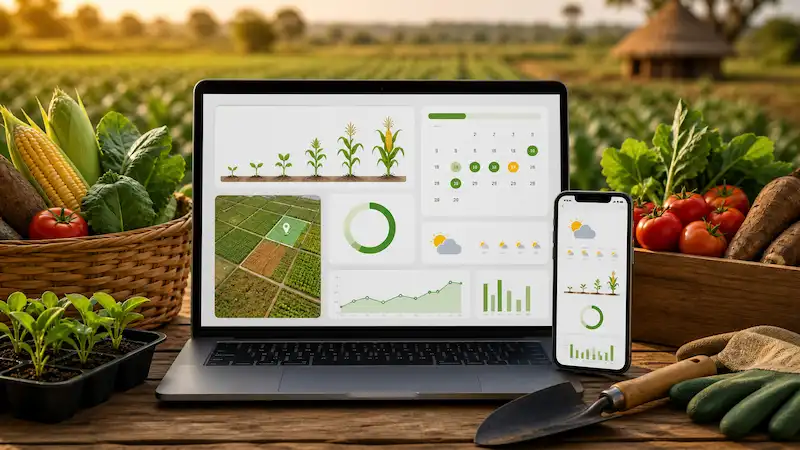
A harvest date is not just a number of days after planting. It is a controlled decision that joins the crop and variety, actual establishment date, maturity signs, intended market, labour, equipment, buyer timing, transport, drying and storage. If one link is missing, a crop can be ready in the field while the farm is not ready to handle it.
Start with the AfroTools Harvest Date Estimator to add a maturity duration you have verified to a recorded planting date. The tool performs local date arithmetic. It does not identify a variety, read live weather, inspect a field or certify maturity. Use its result to open a planning window, then confirm the crop with current local extension guidance and field observation.
Begin with a traceable planting record
The calculation is only as reliable as its starting point. Record the field or plot, crop, variety, seed or planting-material lot, planting date, area and the person who confirmed establishment. If planting took several days, record each block separately. If germination failed and part of the field was replanted, the replacement block needs its own date.
Do not quietly substitute the date seed was bought, land was prepared or rain first fell. For direct-seeded crops, use the actual sowing date and note emergence. For transplanted crops, keep nursery sowing and field transplanting dates separate because the maturity guide may be written from one or the other. For vegetatively propagated crops such as cassava, record the actual planting date and variety or material source.
FAO's Crop Calendar lets users search planting and harvesting periods by country, crop and agroecological zone. It is useful for checking whether a proposed schedule fits a recognised local season. FAO describes it as a living planning platform, not a field-level guarantee. A country result still needs to be narrowed to the farmer's zone, variety and current season.
| Planning input | Evidence to keep | Risk if guessed |
|---|---|---|
| Planting or transplanting date | Dated field log for each block | The whole forecast starts from the wrong day |
| Crop and variety | Seed label, supplier record or extension note | Early and late materials are treated as one crop |
| Maturity duration | Variety guidance with source and date checked | A generic internet number replaces local evidence |
| Intended use | Buyer specification or household processing plan | Fresh, processing, seed and dry-grain harvests are confused |
| Field condition | Scouting notes and dated observations | Stress, uneven establishment or damage remains invisible |
Use variety maturity as a planning duration
Find the maturity duration for the exact variety and production setting from a seed label, breeder, government extension service, research institute or agronomist. Note what the number means. It may describe days to physiological maturity, first fresh harvest, market maturity, dry grain, or a range observed under stated conditions. Those are not interchangeable.
Enter that verified duration into the estimator. If one block was planted on June 1 and the supported duration is 110 days, the tool adds 110 calendar days and returns September 19. That is formula demonstration, not a claim about a real field. The forecast should trigger inspections and operational preparation before that date, not automatic harvesting on it.
Keep the uncertainty visible. A single day can look more certain than the source supports. If the variety guidance gives a range, calculate the early and late dates separately and use them as a planning window. If different sources disagree, do not average them without understanding why. Check whether they describe different varieties, zones, water regimes or end uses.
The tool records a selected weather-risk label in the result, but the current calculation does not change the date for that label. It does not use a weather feed. Record actual rainfall, heat, flooding, dry spells, irrigation interruptions and crop stress in the field log, then ask a local adviser how those observations affect scouting and harvest readiness.
Separate crop maturity from harvest readiness
FAO's Agriculture Stress Index material distinguishes the observed end of a growing season from the harvest period. It says the end-of-season signal indicates physiological maturity in its vegetation model, but does not necessarily correspond to harvest. That is a useful warning against treating one satellite, calendar or calculator date as a dispatch order.
Readiness depends on the crop and intended use. KALRO's maize guidance describes dry-maize indicators such as dried leaves, non-green husks, yellow or brown stalks, drooping cobs, hard non-milky grain and a black layer where the kernel attaches. The same guidance treats green maize differently. A farmer selling fresh cobs cannot use the dry-grain endpoint as the market target.
Uganda's Ministry of Agriculture maize manual also places physiological maturity at the centre of the grain harvest decision, while warning that harvesting too early or too late can reduce quality and increase losses. It advises preparing the work that follows harvest and keeping cobs clean rather than placing them directly on soil.
Cassava follows a different logic. IITA's current harvest SOP is written for breeding trials, where it says trials should be ready around 9 to 12 months after planting, each plot should be harvested separately, the root system should be pulled carefully, and labels and harvest data must remain accurate. Those research controls do not set a universal farm date, but they show why planting identity, block separation and careful collection matter. A maize maturity checklist should never be copied into a cassava plan.
Open the operational window before the crop is ready
Count backwards from the earliest planning date. Decide when field inspections will intensify, when the buyer will confirm the specification, when labour will be booked, and when equipment, packaging and transport will be checked. The exact lead time depends on the crop, scale, location and service availability, so use actual supplier and worker commitments rather than a universal timetable.
Prepare a simple harvest readiness board:
- Field status: block, crop, variety, planting date, estimated window, latest maturity observations and decision owner.
- Market status: intended buyer or use, grade, moisture or quality requirement, unit, packaging, delivery point and current written quote.
- People status: required roles, confirmed workers, safe work briefing, supervision and payment basis.
- Equipment status: tools, machinery, fuel, spares, cleaning, maintenance and safe operating condition.
- Handling status: clean collection surfaces, containers, shade, sorting area, drying plan and quality checks.
- Movement status: route, vehicle, loading method, pickup time, delivery contact and delay alternative.
- Storage status: capacity, cleanliness, pest control, pallets or platforms, ventilation or sealed-container plan and stock records.
A verbal promise is not a confirmed resource. Record names, quantities, dates, prices, payment terms and alternatives. If a buyer changes the grade or pickup day, update the board and the crop decision together. Do not harvest a highly perishable crop into a transport or market gap that nobody owns.
Match the harvest to the buyer and end use
Ask the buyer how acceptance is measured. Relevant fields may include variety, size, colour, firmness, moisture, cleanliness, damage, residue compliance, packaging, traceability, delivery window and unit of sale. Keep the dated specification or message that supports the plan. Do not assume the requirement from last season still applies.
Separate price from acceptance. A strong quoted price is not useful if the buyer rejects the crop or changes the unit at delivery. Record whether the quote is per kilogram, bag, crate, bunch, cob, tray, tonne or another unit, and whether packaging, transport, weighing, grading or deductions are included. Confirm who owns loss or damage at each handoff.
When the crop is for household use, seed, animal feed or processing, define that route just as carefully. A processing unit needs capacity, power or fuel, water where applicable, operators, containers and storage for finished product. Harvesting more than the next step can handle creates a queue in which quality may fall.
Prepare drying and storage before dry-grain harvest
For maize and other grain, harvest is only the start of the post-harvest chain. The Uganda manual advises planning drying, using clean mats or tarpaulins, and ensuring grain is dry enough before storage. KALRO likewise tells farmers to prepare drying and threshing areas, clean stores and sacks, and keep a new harvest separate from old stock that may carry pests.
Use crop-specific current local guidance for moisture and storage. The Uganda maize manual gives a maximum storage moisture figure for maize, but one national training value should not be copied across every crop, market, measuring instrument or climate. Verify the buyer or extension standard, record the meter and sample method, and recheck after rain or additional drying.
Keep opening weight, authorized withdrawals, closing stock, damaged stock and sale evidence. The grain storage loss planning guide explains how to separate physical loss, moisture change, quality discount and normal stock movement. Use the Grain Storage Loss Calculator only after the quantities and storage method are supported.
Plan field labour, safety and equipment honestly
Estimate the area or quantity one person or machine can handle from the farm's own records or a witnessed test, not from an invented benchmark. Include cutting or picking, field collection, loading, transport, unloading, sorting, cleaning, drying and storage. The slowest safe stage controls the day's practical capacity.
Inspect tools and machinery before deployment. Replace or repair damaged handles, guards, belts, tyres, lights, brakes, couplings and electrical parts as applicable. Match protective equipment and training to the actual hazards. Provide drinking water, rest, first-aid arrangements and a way to report unsafe conditions. Do not use a calendar deadline to justify unsafe work or overloaded transport.
Record fuel, hired equipment, labour, bags, crates, tarpaulins, weighing, testing, transport, drying, storage and buyer deductions. These costs belong in the season result even when they are paid after the crop leaves the field. After harvest, move the actual quantities and costs into the Farm Profit and Loss Calculator rather than leaving the forecast unchanged.
Use a go, hold or split decision
A practical harvest meeting should end with one of three outcomes. Go means the specific block has the required field evidence and the next handling steps are confirmed. Hold means a material crop, weather, safety, buyer, labour, transport, drying or storage issue remains unresolved. Split means only the ready area or quantity will move while the rest remains under observation.
For each decision, record the date, block, observations, intended use, people present and next review. Photographs can support a farm record, but they should not replace measurements or expose workers' identities without need. If the crop is stressed or uneven, divide the field into real management blocks instead of forcing one answer across it.
Update the estimate when evidence changes. A replanted block, corrected variety, revised duration or changed buyer target deserves a new version. Preserve the earlier version so the farm can learn whether the difference came from the input, the season, the field or the operation.
Close the harvest with evidence for the next season
Record the actual first and final harvest dates, quantity by block, grade, rejected or damaged quantity, destination, price, deductions and full harvest-to-storage cost. Note the maturity signs that were useful and the services that arrived late. A plan improves only when the estimate is compared with what happened.
Do not describe the gap between estimated and actual date as calculator error until the inputs are reviewed. Check the recorded planting date, maturity definition, variety, emergence, replanting, weather, crop health, field decision and buyer requirement. The calculator adds the stated number of days. The agricultural judgment comes from the evidence around that arithmetic.
The farm record-keeping guide gives a structure for inputs, labour, production, stock and sales. Link the harvest record to those season records, then carry a small set of verified lessons into the next plan instead of copying every assumption forward.
If bagged or packaged produce becomes sale stock, the local-first Inventory Calculator and Tracker can record the item, quantity and low-stock threshold. Keep that business stock record separate from field-yield and grading evidence so normal sales are not mistaken for harvest loss.
Open a Field-Checked Harvest Plan
Add a verified maturity duration to the recorded planting date, then use field evidence to schedule labour, buyer, transport, drying and storage checks.
Open Harvest Date Estimator →Harvest Date Planning Questions
Can a planting date predict the exact harvest day?
No. It creates a planning date when combined with a supported maturity duration. Variety, emergence, weather, soil, crop health, field conditions, end use and buyer requirements can change the real window.
What should be checked before harvesting maize?
Confirm the intended use, maturity signs, grain condition and current local guidance. Prepare clean harvesting, drying, testing, transport and storage equipment before work begins.
Why can physiological maturity differ from harvest date?
Physiological development can finish before a crop is suitable for the intended fresh market, processing, dry-grain handling or storage route. The decision must match the crop and end use.
Does the AfroTools estimator use live weather?
No. It adds user-entered maturity days to a planting date. The selected weather-risk label is retained in the summary but does not alter the arithmetic. Confirm actual conditions and maturity in the field.
Primary Sources Reviewed
These primary sources were checked on September 9, 2026:
- FAO Crop Calendar, a country, crop and agroecological-zone planning resource for planting and harvesting periods.
- FAO Agriculture Stress Index System methodology, distinguishing its end-of-season signal from the actual harvest period.
- Uganda Ministry of Agriculture, Animal Industry and Fisheries Maize Manual, published January 7, 2026, covering maturity, harvest preparation, handling, drying and storage.
- KALRO maize post-harvest guidance, including field maturity indicators and preparation of drying, threshing and storage resources.
- IITA cassava harvesting and harvest-evaluation SOP, reviewed in 2024 and published as a public resource in 2025, covering research-trial timing, plot separation, careful uprooting, labels and harvest data.
Frequently Asked Questions
Can a planting date predict the exact harvest day?
No. A planting date plus a supported maturity duration produces a planning date. Field and market evidence decide the actual harvest window.
What should be checked before harvesting maize?
Confirm the end use, maturity signs, grain condition and current local guidance, then prepare clean harvesting, drying, testing, transport and storage resources.
Why can physiological maturity differ from the harvest date?
A crop can complete physiological development before it is right for the chosen market or safe post-harvest route. Calendar and field decisions are related but not identical.
Does the AfroTools estimator use live weather or identify maturity?
No. It adds a user-entered duration to a planting date. Its weather-risk label does not change the result, and crop maturity must be confirmed locally.