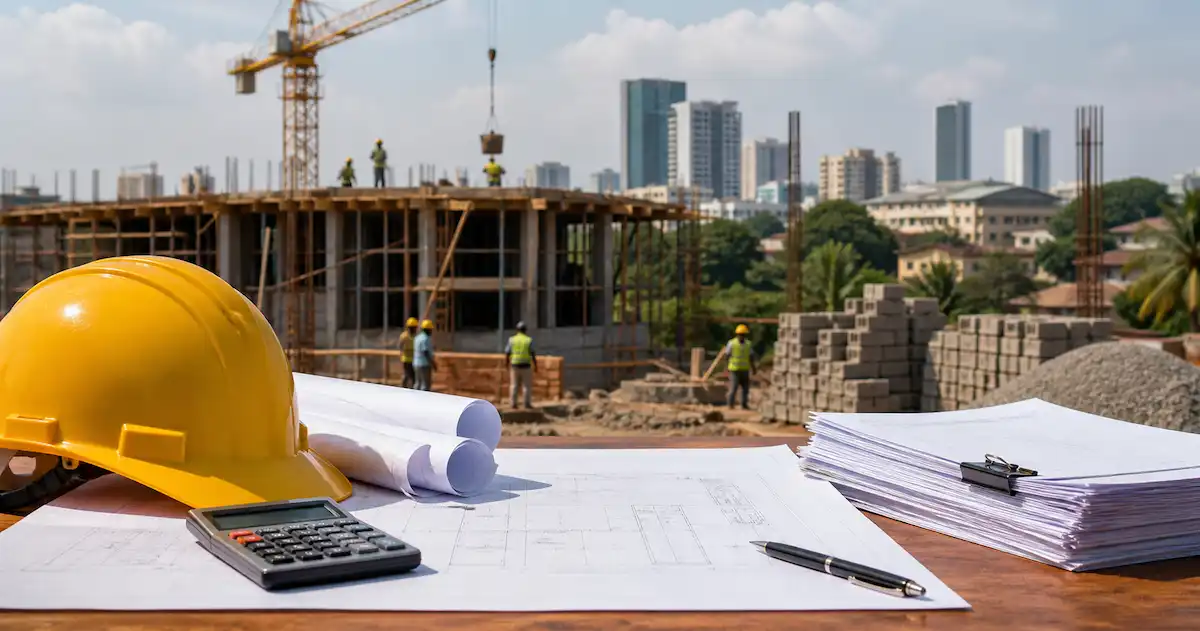
Why Every Nigerian Building Project Needs a BOQ
A Bill of Quantities (BOQ) is the single most important document in a Nigerian construction project that most self-builders choose to skip - and that decision costs them dearly. Across Nigeria, cost overruns of 40–80% above original estimates are so common they are almost expected. Contractors quote low to win jobs, then present "variation orders" once construction is underway and the client is financially and emotionally committed. Without a BOQ, you have no contractual baseline against which to measure those variations.
A properly prepared BOQ specifies every item of work to be done - the exact quantity of cement bags, blocks, rods, roofing sheets, tiles, and paint - and attaches a unit rate and total cost to each. When a contractor tells you halfway through construction that they need ₦2 million extra for "more reinforcement," your BOQ will tell you whether that claim is legitimate or a shakedown.
Beyond dispute prevention, a BOQ serves as your project budget, your procurement schedule, and your progress payment mechanism. It enables competitive tendering (multiple contractors pricing the same scope), bank loan applications (banks require a BOQ for construction finance), and insurance valuations. Skipping it is not saving money - it is mortgaging your project's future.
What Is a Bill of Quantities - and What It Is Not
Understanding the difference between a BOQ, a cost estimate, and a project budget prevents common confusion:
A BOQ is a detailed, itemised schedule of all the materials, labour, and sundry items required to complete a construction project, with quantities measured from architectural and structural drawings, and rates applied to each item. It is prepared after detailed design drawings are available and is the most precise cost document in construction.
A cost estimate is a preliminary assessment of project cost prepared before detailed drawings exist, typically using cost-per-square-metre benchmarks. In Nigeria, 2026 construction cost benchmarks range from ₦250,000–₦450,000/m² for standard residential construction to ₦500,000–₦800,000/m² for higher-specification finishes. Estimates are useful for feasibility decisions but not for tendering or financial planning.
A project budget is the total money allocated for the project, including the BOQ cost, professional fees (architect, engineer, quantity surveyor), land cost, statutory fees, and the owner's contingency reserve. The BOQ is the largest component of the budget but not the only one.
Who Prepares a BOQ?
A BOQ should ideally be prepared by a registered Quantity Surveyor (QS), a professional whose entire training is in construction cost management. In Nigeria, QSs are regulated by the Quantity Surveyors Registration Board of Nigeria (QSRBN) and the Nigerian Institute of Quantity Surveyors (NIQS). For self-builders without a QS, working with an architect or structural engineer who also performs quantity take-off services is the next best option. This guide provides the methodology to understand and verify any BOQ you receive.
When Is the BOQ Prepared?
The BOQ is prepared at the end of the detailed design stage, after architectural drawings (floor plans, elevations, sections) and structural drawings (foundation, column, beam, slab reinforcement details) are complete. Preparing a BOQ from sketch designs or incomplete drawings will produce an inaccurate document. Insist on complete drawings before any BOQ work begins.
BOQ Structure Explained
A standard Nigerian residential construction BOQ is divided into the following sections, following the NIQS standard method of measurement:
Section 1: Preliminaries
All costs related to running the project site that cannot be allocated to a specific work item. Includes: site mobilisation, temporary site office and toilet, site security, scaffolding, project insurance, site signage, and contractor's supervision overhead. Typically 5–10% of the measured works total.
Section 2: Substructure
Everything below and including the oversite (ground) slab. Includes: site clearing and setting out, excavation (topsoil stripping, bulk excavation, trench excavation for foundations), concrete strip or pad foundations, blinding concrete, hardcore filling and compaction, damp-proof course (DPC) membrane, and oversite concrete slab.
Section 3: Superstructure
Everything above the ground slab up to and including the roof plate. Includes: sandcrete block walling (9-inch external, 6-inch internal), concrete lintels over openings, reinforced concrete columns and beams (if applicable - most common in Nigeria for added structural rigidity), concrete ring beam at roof level, and door/window frames.
Section 4: Roofing
Includes: timber roof structure (king post trusses or cut roof rafters), purlins, fascia boards, soffit boarding, roofing sheets (long span aluminium or stone-coated tiles), ridge cap, valley flashing, gutter and downpipe installation.
Section 5: Finishes
Internal and external wall plastering, floor screeding, wall and floor tiling, ceiling works (POP or board), painting (external and internal), and decorative finishes.
Section 6: Mechanical and Electrical (M&E)
Plumbing (water supply piping, sanitary wares, sewage/septic system), electrical installation (wiring, distribution board, sockets, lights, conduit), and any HVAC if specified.
Section 7: External Works
Perimeter fencing and gate, driveway and parking, landscaping, external lighting, borehole if applicable, and external drainage channels.
Step-by-Step: Creating Your BOQ
Step 1: Get Complete Architectural and Structural Drawings
You cannot produce an accurate BOQ without complete drawings. At minimum, you need: site plan, floor plan(s), all four elevations, at least two cross-sections, foundation plan, column/beam schedule, roof plan, and electrical/plumbing schematics. Ensure drawings are dimensioned and drawn to scale. Incomplete drawings are the single biggest cause of BOQ inaccuracy.
Step 2: Take Off Quantities
"Taking off" is the process of measuring quantities from drawings and recording them in a standard format. For each BOQ item, you calculate:
- Length (L) × Width (W) × Height (H) for volumes (concrete, excavation, fill)
- L × H or L × W for areas (plastering, tiling, painting, formwork)
- L for linear items (gutters, pipes, reinforcement bars)
- Number (Nr) for countable items (doors, windows, sanitary fittings, light points)
- Tonnes or bags for bulk materials (cement, sand, granite)
Always work systematically - take off the entire substructure before moving to the superstructure. Use a taking-off sheet that shows your dimension calculations so errors can be traced and corrected.
Step 3: Apply Unit Rates
Each measured quantity gets a unit rate - the cost per unit of that item. Unit rates in Nigerian construction include both materials and labour for the operation. For example, the rate for "laying 9-inch sandcrete blocks" per m² would include: the cost of blocks, sand, and cement for mortar, plus the bricklayer's and labourer's daily rates allocated per m² of completed walling. Current 2026 unit rates are discussed in the material and labour sections below.
Step 4: Add Preliminaries and Contingency
Sum all measured work sections to get the Measured Works Total. Add Preliminaries (5–10% depending on project complexity). Add a Contingency of 10–15% for unforeseen works and design changes. The sum of Measured Works + Preliminaries + Contingency is the Contract Sum - the total construction budget.
Step 5: Review and Validate
Cross-check the BOQ total against the cost-per-square-metre benchmark for your building type and location. If the BOQ total divided by the floor area gives ₦200,000/m² but the market benchmark is ₦350,000/m², something has been missed. If it gives ₦700,000/m² for a standard residential project, rates may have been over-estimated. This sanity check catches systemic errors before you commit to a contract sum.
Worked Example: 3-Bedroom Bungalow BOQ Summary
| BOQ Section | Approximate Cost (Lagos, 2026) |
|---|---|
| Preliminaries (8% of measured works) | ₦3,200,000 |
| Substructure (foundation, DPC, oversite) | ₦7,500,000 |
| Superstructure (walls, columns, lintels, ring beam) | ₦9,800,000 |
| Roofing (timber structure + long span sheets) | ₦6,200,000 |
| Finishes (plastering, tiling, ceiling, painting) | ₦8,500,000 |
| Mechanical & Electrical | ₦4,800,000 |
| External Works (fence, gate, driveway) | ₦3,500,000 |
| Measured Works Total | ₦40,000,000 |
| Contingency (12.5%) | ₦5,000,000 |
| Total Contract Sum | ₦45,000,000 |
Note: These are approximate 2026 Lagos figures for a 3-bedroom bungalow of approximately 120m² floor area with medium-specification finishes. Abuja costs are typically 15–25% higher. Port Harcourt is broadly similar to Lagos. Secondary cities (Ibadan, Kano, Enugu) are typically 10–20% lower.
2026 Construction Material Prices in Nigeria
| Material | Unit | Lagos | Abuja | Port Harcourt |
|---|---|---|---|---|
| Cement (Dangote, BUA, Lafarge) | Per 50kg bag | ₦8,500–₦10,000 | ₦9,000–₦11,000 | ₦8,800–₦10,500 |
| Iron rods (Y16, Y12 - Reinforcement) | Per tonne | ₦600,000–₦750,000 | ₦650,000–₦800,000 | ₦620,000–₦780,000 |
| Sandcrete blocks (9-inch) | Per unit | ₦500–₦650 | ₦550–₦700 | ₦480–₦620 |
| Sandcrete blocks (6-inch) | Per unit | ₦400–₦500 | ₦450–₦550 | ₦380–₦480 |
| Long-span aluminium roofing sheets (0.55mm) | Per bundle (10 sheets) | ₦150,000–₦200,000 | ₦165,000–₦220,000 | ₦155,000–₦210,000 |
| River sand (sharp/plaster) | Per 5-ton tipper | ₦35,000–₦55,000 | ₦50,000–₦75,000 | ₦40,000–₦60,000 |
| Granite (3/4 inch crushed stone) | Per 5-ton tipper | ₦45,000–₦65,000 | ₦55,000–₦80,000 | ₦50,000–₦70,000 |
| Floor tiles (60×60 ceramic - standard) | Per carton (4 tiles) | ₦4,500–₦8,000 | ₦4,800–₦9,000 | ₦4,500–₦8,500 |
| Floor tiles (60×60 vitrified - premium) | Per carton (4 tiles) | ₦9,000–₦18,000 | ₦10,000–₦20,000 | ₦9,500–₦18,000 |
| Emulsion paint (Dulux, Berger - 20L) | Per bucket | ₦22,000–₦40,000 | ₦24,000–₦42,000 | ₦22,000–₦38,000 |
| POP ceiling (Plaster of Paris, 40kg) | Per carton | ₦5,500–₦8,000 | ₦6,000–₦9,000 | ₦5,500–₦8,500 |
| Timber (2×4 inch hardwood - per foot) | Per foot run | ₦600–₦1,000 | ₦700–₦1,200 | ₦650–₦1,100 |
| PVC pipes (4-inch drainage) | Per 6m length | ₦4,500–₦7,000 | ₦5,000–₦7,500 | ₦4,800–₦7,200 |
Prices as of Q1 2026. Material prices in Nigeria are volatile and tied closely to the naira-dollar exchange rate, particularly for imported items (roofing sheets, some tiles, electrical fittings). Update your BOQ unit rates at the time of tendering rather than using prices from design-stage BOQs prepared months earlier.
Labour Costs in Nigerian Construction (2026)
| Trade | Lagos (per day) | Abuja (per day) | Secondary Cities (per day) |
|---|---|---|---|
| Bricklayer (skilled) | ₦10,000–₦18,000 | ₦12,000–₦20,000 | ₦7,000–₦12,000 |
| Carpenter (formwork/roof frame) | ₦12,000–₦20,000 | ₦14,000–₦22,000 | ₦8,000–₦15,000 |
| Electrician (certified) | ₦15,000–₦25,000 | ₦18,000–₦28,000 | ₦10,000–₦18,000 |
| Plumber (skilled) | ₦12,000–₦22,000 | ₦15,000–₦25,000 | ₦9,000–₦16,000 |
| Tiler (skilled) | ₦10,000–₦18,000 | ₦12,000–₦20,000 | ₦7,000–₦13,000 |
| Painter | ₦8,000–₦15,000 | ₦10,000–₦17,000 | ₦6,000–₦11,000 |
| Iron bender (reinforcement) | ₦10,000–₦16,000 | ₦12,000–₦18,000 | ₦7,000–₦12,000 |
| General labourer | ₦5,000–₦9,000 | ₦6,000–₦10,000 | ₦3,500–₦7,000 |
Labour rates vary significantly based on project location within a city (island vs mainland in Lagos), project reputation (workers accept lower rates on prestigious projects or from regular clients), and the individual's experience. Rates above are for direct-hire daily workers. Subcontracted gang rates (where a gang foreman quotes for a complete operation, e.g., "block laying at ₦2,500 per m²") bundle in all labour including labourers and are often more cost-predictable for the client.
Common BOQ Mistakes in Nigerian Construction
1. Under-measuring wall quantities. The most common error is failing to correctly deduct door and window openings from wall areas. Each opening must be deducted as a void and the lintels over openings must be separately measured. This error causes underestimation of block quantities by 10–20%.
2. Forgetting preliminaries. Clients who prepare their own BOQs frequently omit the preliminaries section entirely. A project without site security costs (the watchman runs off with materials), without scaffolding costs (workers do dangerous improvised work), and without site water and power provision will overspend on these items and have no contractual basis to recover costs.
3. Using outdated material prices. Nigeria's construction material prices are highly volatile, particularly for imported items. A BOQ prepared when cement was ₦7,000/bag becomes dangerously inaccurate if cement rises to ₦10,000/bag before construction begins. Always refresh rates at the time of issuing tender documents, and consider including a price fluctuation clause in the construction contract for projects lasting more than 6 months.
4. Not accounting for waste. The standard waste factors for common materials are: blocks - 5–10%, sand and granite - 10–15% (spillage and segregation), reinforcement - 5–8% (off-cuts and laps), tiles - 8–12% (cutting waste), and paint - 5% (roller absorption and spillage). Omitting waste means you will run out of materials before the work is complete, causing delays and requiring emergency top-up purchases at potentially higher prices.
Digital BOQ Tools
Manual BOQ preparation in Excel is time-consuming and error-prone. Dedicated digital tools automate quantity calculations, apply current unit rates, and produce formatted BOQ documents.
AfroTools BOQ Generator (/tools/boq-generator) is purpose-built for Nigerian residential and light commercial construction. It allows you to input floor area, number of storeys, specification level (standard/medium/premium), and location (Lagos/Abuja/Port Harcourt/other), and generates a complete BOQ with 2026 unit rates, section totals, and a printable PDF. It is the fastest way to produce a preliminary BOQ for feasibility assessment or bank loan applications.
For full professional QS practice, CostX and Buildsoft are the industry standard quantity surveying software packages used by registered QS firms in Nigeria. These are subscription-based tools designed for professional use. For self-builders and small contractors, AfroTools BOQ Generator covers the most common residential construction scenarios at no cost.
Generate Your Construction BOQ Instantly
Use AfroTools BOQ Generator to produce a complete Bill of Quantities with current 2026 Nigerian material prices - in under 5 minutes, free.
BOQ Generator →Frequently Asked Questions
Preliminaries cover all site costs not tied to a specific work item: site mobilisation and demobilisation, temporary site office and toilet facilities, site security, scaffolding and temporary works, project insurance and performance bonds, site signage, site clearing and setting out, water supply for construction, and temporary power connection. Preliminaries typically represent 5–10% of the total project cost and must never be omitted from the BOQ.
Quantity surveyor fees in Nigeria are regulated by the NIQS fee scale at approximately 2–3% of total project cost for full services. For BOQ preparation only, expect 0.75–1.5% of construction cost, or a flat fee of ₦150,000–₦500,000 for a standard residential BOQ. These fees are a fraction of the cost overruns a good QS prevents.
The standard waste factor for sandcrete blocks in Nigerian construction is 5–10%. Use 5% for well-managed sites with experienced bricklayers and quality blocks. Use 10% for sites with less experienced workers or lower-quality blocks that have higher breakage rates. Always add your chosen waste factor to the net quantity before ordering materials.
Calculate total wall area in square metres (perimeter of all walls × wall height, minus door and window openings), then divide by 0.09 m² (the face area of a standard 9-inch block, 450mm × 225mm), then add 5–10% for waste. A typical 3-bedroom bungalow of 100–120 m² requires approximately 2,500–3,500 blocks for the walls, depending on ceiling height, number of openings, and design complexity.
Nigerian construction BOQs should include a contingency allowance of 10–15%. Use 10% for straightforward residential projects with good soil conditions, complete drawings, and a reliable supply chain. Use 15% for complex designs, uncertain soil conditions, or sites in areas with volatile material prices. The contingency is a client-side reserve for unforeseen works - it is not contractor's profit or a buffer for poor estimation.
Turn price research into a usable BOQ
Construction budgets fail when material pricing, labour, contingency, and scope changes are separated. A BOQ-style tool works best when cost research is translated into line items early.
Build a cleaner quantity and cost estimate
Translate material and scope assumptions into a more structured bill of quantities.
Open BOQ Generator