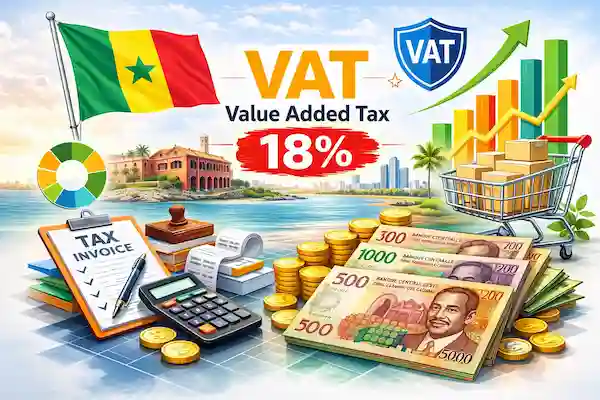
Senegal VAT
Calculator 2026

Standard 18% VAT. Calculate VAT-inclusive, VAT-exclusive, reverse VAT extraction, and multi-item invoice totals. Accurate 2026 DGID rates.

DGID 2026 Standard 18% Zero-Rated Exports XOF · West African CFA Franc

Last verified: 2026 · Source: DGID (impotsetdomaines.gouv.sn)

2026 Rates: Standard VAT rate is 18%. Zero-rated: Export goods, Export services. Exempt: Unprocessed food, Medical services, Agricultural inputs. Registration threshold: XOF 50M/year. Tax authority: DGID.

VAT Calculator XOF · West African CFA Franc
Calculation DirectionWhich amount do you have?
Pre-Tax Amount (XOF) CFA10,000
CFA100CFA10M
AmountOr type exact value
CFA
VAT RateSelect applicable rate
Total (VAT Inclusive)
CFA0
Pre-Tax Amount
VAT Amount
Applied Rate 18%
VAT as % of Total 0%
Annual projection (×12)
Formula Used

Calculate how much VAT the buyer withholds and remits to the tax authority on this transaction.

FAQ

Senegal VAT — Common Questions

What is the standard VAT rate in Senegal?
The standard VAT rate in Senegal is 18% as of 2026. This is levied on most goods and services sold within Senegal.
How do I add VAT to a price in Senegal?
Multiply the pre-tax price by 1.1800 (i.e., price × (1 + 0.18)). Example: CFA10,000 × 1.1800 = CFA11,800 including VAT.
How do I remove VAT from a price in Senegal?
Divide the VAT-inclusive price by 1.1800. Example: CFA11,800 ÷ 1.1800 = CFA10,000 pre-tax.
What goods are VAT exempt in Senegal?
VAT-exempt goods and services in Senegal include: Unprocessed food, Medical services, Agricultural inputs, Educational services. Zero-rated (taxable at 0%) include: Export goods, Export services.

VAT in Senegal: Key Facts

Senegal applies a value-added tax known as Taxe sur la Valeur Ajoutée (TVA) at a standard rate of 18%. As a founding member of the West African Economic and Monetary Union (WAEMU/UEMOA), Senegal follows the harmonized 18% TVA rate established for the economic zone. The TVA has been a cornerstone of Senegal's tax system for decades. A reduced rate of 10% applies to certain tourism and hospitality services. Exports are zero-rated, including emerging oil and gas exports. Exempt supplies include basic food items (rice, bread, milk, sugar), medical and pharmaceutical products, educational services, financial transactions, and agricultural inputs. The Direction Générale des Impôts et des Domaines (DGID) administers TVA. Businesses with annual turnover exceeding XOF 100 million fall under the régime réel normal. Monthly TVA returns are due by the 15th of the following month. Senegal has one of the most modernized tax administrations in West Africa, with electronic filing and payment systems. The country's growing oil and gas sector is bringing new TVA considerations. Input TVA can be deducted against output TVA, with refund mechanisms for businesses in credit positions. Senegal's TVA system is considered a model within the WAEMU zone.

Common Questions About Senegal TVA

Does Senegal have a reduced TVA rate?

Yes, Senegal applies a reduced TVA rate of 10% on certain tourism and hospitality services. The standard rate of 18% applies to most other taxable goods and services.

What is the TVA registration threshold in Senegal?

Businesses with annual turnover exceeding XOF 100 million fall under the régime réel normal and must fully comply with TVA obligations. Those between XOF 50–100 million may fall under the régime réel simplifié.

Which items are exempt from TVA in Senegal?

Exempt items include basic food staples (rice, bread, milk, sugar), medical and pharmaceutical products, educational services, financial transactions, agricultural inputs, and certain imports under investment incentive codes.

How are TVA returns filed in Senegal?

Monthly TVA returns are due by the 15th of the following month. Senegal's DGID provides electronic filing and payment through its online platform, making it one of the most modernized tax systems in West Africa.

How does oil and gas affect Senegal's TVA?

Senegal's emerging oil and gas sector brings new TVA considerations. Exports are zero-rated, while domestic supply may be taxable. Companies operating in the sector must navigate TVA provisions in their production-sharing agreements.

More African Tax Tools