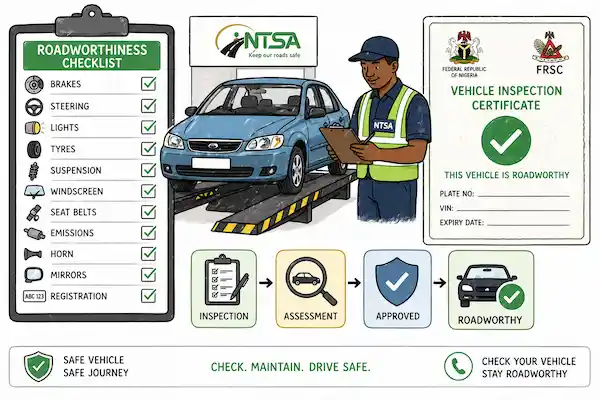
A roadworthiness inspection asks whether a vehicle meets the safety and legal standard that applies to its country, class and use. It is not a promise that the vehicle will never break down, and it is not a full used-car condition report. A careful owner prepares for the formal test while continuing normal maintenance, defect reporting and independent mechanical checks.
Use the AfroTools Roadworthiness Checklist to record a walk-around and workshop pre-check. Then verify the official authority, testing station, documents, fees, test interval and booking method for the exact country and vehicle. The primary sources in this guide were checked on August 12, 2026. They include government and transport-authority guidance from Ghana, Kenya, South Africa and Uganda.
Start with the legal route, not the spanner
Before arranging repairs, identify why the vehicle needs a test. The trigger may be a change of ownership, licence renewal, import registration, reconstruction, change of use, public-service operation, commercial operation, age threshold or periodic fleet requirement. The answer determines the documents, station type and inspection interval.
South Africa's national government says a vehicle must be tested before it is registered in a new owner's name. Public-transport and heavy-load vehicles, excluding buses, require annual roadworthiness testing before licence renewal, while buses require testing every six months. Its process requires the registration certificate, identification, the prescribed fee and an Application for Certification of Roadworthiness form at a public or private testing station.
Ghana's DVLA service page lists the vehicle, Vehicle Registration Certificate, other vehicle documents and road-use fee for roadworthiness certification. It directs the owner to present the vehicle and VRC at a designated Private Vehicle Testing Station. A sticker is issued after a satisfactory inspection result, and the DVLA says renewal can begin one month before expiry.
Uganda's Ministry of Works and Transport describes roadworthiness and environmental-compliance inspection as a transport-regulation service. Kenya's system is evolving: the Ministry presented Traffic (Motor Vehicle Inspection) Rules, 2026 to the National Assembly committee in May 2026, and NTSA issued a June 2026 clarification about selected inspection requirements for commercial and school-transport operators. Treat current NTSA notices and the live service route as the source of truth, rather than turning a proposal, screenshot or social-media message into a universal rule.
| Check before booking | Evidence to keep | Why it matters |
|---|---|---|
| Country and authority | Official agency page or notice checked on a recorded date | A similarly named certificate can follow a different process elsewhere |
| Vehicle class and use | Registration class, gross vehicle mass and private or commercial use | Test frequency and station eligibility can change by class |
| Inspection trigger | Transfer, renewal, import, periodic test or change of use | The trigger controls forms and supporting documents |
| Authorized station | Current station listing, booking reference and contact details | An informal workshop check cannot issue the official certificate |
| Fee and payment channel | Dated official fee notice or station quote and receipt | Old fee tables and unofficial payment requests create avoidable risk |
Build a clean vehicle and document identity file
The inspection should begin with a vehicle that can be identified without ambiguity. Compare the registration document with the registration plate, chassis or vehicle identification number, engine details where recorded, make, model, colour, body type and use class. Do not scrape, repaint or alter an identifier. If a number is unreadable, damaged or inconsistent, stop and ask the registration authority for the correct process.
Collect the original or accepted version of every required document before travel. Depending on the jurisdiction and transaction, the file may include the registration certificate, owner identification, licence record, import or customs documents, proof of acquisition, police clearance, prior certificate, change-of-use approval, vehicle modifications evidence or a prescribed form. A workshop invoice proves that work was billed; it does not replace a registration document or official certificate.
Photographing the vehicle for an internal fleet record can help connect repairs to the correct unit, but protect personal information. Do not place identity documents, home addresses, full registration records or owner contact details into public links, analytics or casual messaging groups. Keep the operational checklist and the sensitive ownership file separate.
Inspect tyres, wheels and visible running gear
Check every fitted tyre, including paired tyres where relevant, for tread condition, exposed cords, bulges, cuts, cracking, embedded objects, uneven wear and unsuitable repairs. Confirm that sizes, construction and load or speed specifications are appropriate for the axle and vehicle. Use the vehicle maker's or competent tyre professional's pressure guidance, not a number copied from another vehicle.
Inspect wheels for missing or loose fasteners, cracks, distortion, heavy corrosion and contact with brake, suspension or body parts. Look for leaks around hubs and evidence that a tyre rubs when steering or suspension moves. A spare wheel, jack and tools should be checked when they are required equipment or part of the operator's own breakdown plan, but their presence does not excuse a defective road wheel.
Uneven wear is evidence, not only a cosmetic problem. It can point to pressure, alignment, steering, bearing or suspension issues. Record the position and condition, correct the cause through a competent workshop, and keep the tyre replacement or alignment receipt with the vehicle maintenance record.
Check brakes with workshop evidence
A driveway check cannot measure the full braking performance, axle balance or parking-brake result used by a testing station. The owner can still identify warning signs before the formal test: a brake warning lamp, low or contaminated fluid, leaks, damaged hoses or pipes, an abnormal pedal, pulling, vibration, grinding, excessive travel or a parking brake that does not hold as intended.
Have a competent technician inspect friction material, discs or drums, hydraulic or air components, parking-brake operation and electronic warning systems as appropriate to the vehicle. For trailers and heavy vehicles, include couplings, breakaway systems, air lines and load-sensitive equipment. Do not clear a warning lamp merely to make the dashboard look normal. Diagnose the fault and record the repair.
After brake work, keep the job card, parts record and test result. If the formal station issues a failure sheet, give the workshop the exact measured defect rather than asking for a general service. Recheck the repair before returning for a retest.
Test lights, glass, mirrors and driver visibility
Operate every required lamp from the driver's position and inspect it from outside: headlamps on each beam, tail lamps, brake lamps, indicators, hazard lamps, number-plate illumination, reversing lamps and marker lamps that apply to the vehicle. Check lenses, mounting, colour and aim. A lamp that works only after tapping the housing is still a fault.
Inspect the windscreen and other required glazing for cracks, severe chips, illegal tint, poor repairs or damage in the driver's critical view. Test wipers and washers across the swept area. Confirm that mirrors are secure, correctly positioned and provide the intended field of view. Remove stickers, cargo or accessories that obstruct visibility.
The South African Western Cape roadworthiness guidance expressly lists electrical systems, windows, mirrors and safety belts among the inspected areas. It also lists braking, wheels, suspension, steering, engine, exhaust, transmission, instruments and vehicle dimensions. Use that list as a preparation structure, while remembering that the pass standard and test process must come from the authority where the vehicle is registered.
Check seats, restraints, doors and required equipment
Every occupied seat should be securely mounted. Pull each safety belt fully out, inspect it for cuts or severe fraying, allow it to retract, and confirm that the tongue locks into the correct buckle and releases normally. Do not hide a damaged belt behind a seat cover. Check head restraints where fitted and make sure seat adjustment locks securely.
Open and close each door from the intended side, then verify latches, hinges, handles and locks. Check bonnet and boot or load-door retention. Inspect steps, grab handles, passenger exits and emergency exits where the vehicle class requires them. Commercial passenger vehicles may have additional obligations for fire extinguishers, warning devices, emergency equipment, signs, seating layout and accessibility. Confirm those items from the current operator rules.
Secure batteries, tools, spare wheels, load barriers and equipment. Loose objects can injure occupants and can interfere with pedals, steering or emergency exits. The inspection day should not be the first time a fleet discovers that emergency equipment is expired, inaccessible or assigned to the wrong vehicle.
Inspect steering, suspension, underbody and structure
With the vehicle safely supported by competent personnel, check steering joints, wheel bearings, suspension bushes, springs, dampers, mountings and chassis points. Record excessive play, unusual movement, leaks, broken components and unsafe repairs. On the ground, note steering that binds, wanders, knocks or fails to return normally.
Inspect the underbody for structural corrosion, cracks, collision damage, loose panels, leaking fluids and components that are poorly secured. Pay particular attention to load-bearing and restraint points. Welding or modification should be assessed against the applicable approval and construction rules, not accepted merely because it looks neat.
For a truck, trailer, bus or converted vehicle, verify dimensions, mass information, body mounting, coupling equipment, load restraints and any plates or markings required for the class. The official test may evaluate items beyond a private-car checklist. Use the correct vehicle profile in the AfroTools checklist and add authority-specific fields to the maintenance record.
Review engine, exhaust, emissions and warnings
Look for fuel, oil, coolant, hydraulic and exhaust leaks. Confirm that hoses, wiring and components are secured away from heat and moving parts. The accelerator should operate normally, the engine should idle without an unsafe fault, and the exhaust system should be complete, supported and free from obvious leaks.
Environmental checks differ by jurisdiction and vehicle type. Uganda's transport department explicitly pairs roadworthiness with environmental compliance, while Kenya's inspection framework has discussed emissions as part of its safety objective. Do not assume that a visible-smoke check, dashboard scan or workshop emissions reading is the official test. Ask the authorized station what standard and equipment apply.
Turn the ignition on and confirm that warning lamps perform their normal self-check. Investigate lamps that remain on, fail to illuminate when expected or return after repair. Record diagnostic findings and completed work. Deleting a stored code without fixing the underlying defect is not a safety process.
Keep public-service and fleet controls continuous
A certificate records the result at a point in time. It cannot keep a vehicle safe until the next test. Drivers should complete a short pre-use check and report new defects. Fleet managers should control repair authorization, vehicle release, tyre and brake records, inspection due dates, licence dates and unresolved defects. A vehicle with a safety-critical defect should not remain in service because its certificate has not expired.
Use one defect register with a unique vehicle identifier, date, odometer, reporter, defect description, risk decision, repair owner, completion evidence and release approval. Close a defect only when the evidence supports closure. Repeated tyre, brake, light or suspension faults should trigger a review of routes, loads, driving conditions, parts quality and maintenance intervals.
Schedule formal testing early enough to allow repairs and retesting without creating pressure to bypass a control. Ghana DVLA says roadworthiness renewal can begin one month before expiry. That is a useful local planning rule for Ghana, but it should not be copied into another country's calendar without verification.
Use roadworthiness evidence carefully when buying a used car
A valid roadworthiness result can be one part of a used-vehicle file. It does not prove clear ownership, genuine mileage, complete service history, freedom from finance, absence of crash damage or long-term mechanical reliability. Confirm the seller's authority to sell, compare identifiers with official records and obtain an independent inspection that matches the purchase risk.
South Africa's Western Cape government explains that a roadworthiness test is a safety examination, not a comprehensive technical examination. Its used-vehicle registration guidance separately asks for proof of acquisition, the seller's registration certificate and other transaction documents. Keep these questions separate: Is the vehicle legally transferable? Did it meet the formal safety test? What is its mechanical condition? What will ownership and repair cost?
Use the Vehicle Running Cost per Kilometre guide to build an operating-cost record after the safety checks, and use the Used Car Import Checklist when customs, pre-export inspection and registration are also involved.
Turn the checklist into an auditable handoff
Open the AfroTools Roadworthiness Checklist, choose the closest vehicle profile and record each result as pass, attention required or not applicable. Do not mark an item passed because repair is planned. Add the workshop action, responsible person and evidence reference, then perform a separate recheck after the work is complete.
Before presenting the vehicle, confirm the booking, station authorization, route, documents, accepted payment method and vehicle cleanliness. Carry the required originals or accepted digital records. After the test, retain the receipt, official result, certificate or sticker details, failure sheet, repair evidence and retest result. Check that the vehicle identity and expiry information are accurate before leaving.
The useful outcome is not a screen full of ticks. It is a traceable decision: the correct authority and vehicle class were identified, visible defects were recorded, competent repairs were verified, the formal test was completed through an authorized route, and continuous maintenance continues after certification.
Frequently Asked Questions
Does a roadworthiness certificate prove that a used vehicle is mechanically reliable?
No. A roadworthiness test is a safety and legal compliance check. It does not replace an independent mechanical inspection, service-history review, ownership check or finance and accident-history checks.
Which documents should I take to a roadworthiness test?
Requirements differ. South African guidance lists the registration certificate, identity document, fee and ACR form. Ghana DVLA lists the vehicle, Vehicle Registration Certificate, supporting vehicle documents and road-use fee. Verify the current local list.
Can the AfroTools checklist certify a vehicle as roadworthy?
No. It is a preparation and record-keeping aid. Only the authorized authority or testing station can inspect and certify a vehicle under the applicable rules.
Should a fleet wait for certificate expiry before checking vehicles?
No. A fleet should use scheduled driver checks, defect reports and preventive maintenance throughout the certificate period.