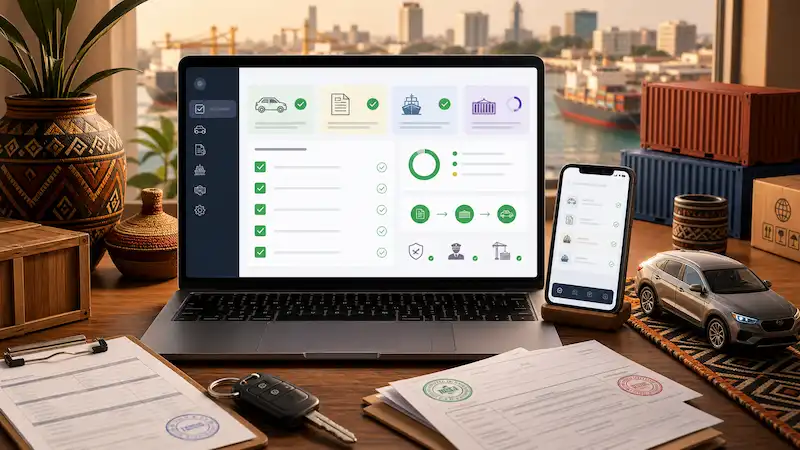
A used car can look ready to drive while its ownership file, finance status, vehicle identifiers and repair needs are still unresolved. A plate number, roadworthiness sticker, service booklet or payment receipt answers only one part of the purchase. The buyer needs one record that connects the seller, the exact vehicle, its condition, the agreed money and the official transfer.
This guide was verified on August 22, 2026 against current official transport and government sources from Kenya, Ghana, South Africa and Nigeria. The country procedures are not interchangeable. Use the examples to structure the evidence, then confirm the current forms, fees, deadlines, identity rules and payment channel with the authority where the vehicle is registered.
Start with the AfroTools Roadworthiness Checklist for a private pre-check. Add the Vehicle Depreciation Calculator, Vehicle Operating Cost Calculator and Car Loan Cost Planner before accepting the advertised price as the real cost. These tools plan and record. They do not verify ownership, clear finance, certify roadworthiness, approve a loan or submit a transfer.
Use Four Gates Before Treating Payment As Final
| Gate | Evidence to reconcile | What it does not prove |
|---|---|---|
| Vehicle identity | Plate, chassis or VIN, engine details where recorded, make, model, colour and registration record | Seller authority, condition or clear finance |
| Seller authority | Seller identity, registered owner or title holder, authority to act and sale document | Mechanical quality or total running cost |
| Condition | Independent inspection, formal roadworthiness result where required, service and repair evidence | Ownership, mileage history or freedom from claims |
| Transfer and money | Written price, payment references, fees, official application and new ownership record | Future reliability or resale value |
Build a pause point after every gate. If the chassis number does not match, the registered owner cannot participate, a lender still holds title, an inspection is refused, or the official portal shows a different record, do not explain the discrepancy away with a phone message. Record it, ask the responsible authority for the correct resolution, and continue only when the evidence agrees.
Match The Physical Vehicle To The Official Record
Inspect the vehicle in daylight and record the registration plate, chassis or vehicle identification number, engine number where the authority records it, make, model, body type, colour and odometer reading. Compare each field with the registration document and the official digital service available in the country. Do not rely on a photograph of a document when the original or official electronic record can be checked.
Look closely at the chassis or VIN location. The characters should be legible and consistent with the document. Do not scrape paint, alter a marking or accept a seller's interpretation of an unreadable identifier. If an identifier is damaged, duplicated or inconsistent, use the transport authority or police examination route that applies. Kenya's Directorate of Criminal Investigations, for example, describes motor-vehicle examination for matters including verification and forced transfer, but that specialist process is not a substitute for an ordinary buyer check.
Kenya's current NTSA service portal includes a logbook verification function that uses the code generated from the logbook QR code together with the chassis number. NTSA also announced that its eLogbook would be integrated into registration, ownership transfer and change-of-particulars transactions from June 10, 2026. That makes an old screenshot or detached PDF especially weak evidence. Use the live official route and make sure the vehicle is visible in the seller's correct account before beginning the transfer.
Nigeria's FRSC National Vehicle Identification System provides an official number-plate verification starting point. A successful plate lookup is not a complete title search. Reconcile it with the physical chassis, registration documents, seller identity, finance evidence, inspection and the state or federal process that applies to the transaction.
Confirm Who Can Sell And Whether Another Party Has Title
The person showing the car may be the registered owner, a dealer, an employee, a relative, an estate representative or an agent. Record which role applies. Compare the seller's accepted identification with the name on the official registration record. When an organization, estate or representative is involved, confirm the authority document and ask the registering authority what form of representation it accepts.
Owner and title holder can be different. A bank or finance provider may remain the title holder while another person possesses and uses the vehicle. Ask for current written settlement or release evidence when finance may exist, then confirm the transfer route with the provider and registration authority. A verbal statement that the loan is nearly paid is not a release.
Create a sale record that identifies the buyer, seller, vehicle, agreed price, payment stages, included items, known defects, document handover and date. Record plate and chassis identifiers, not only the make and model. If the authority requires its own sale or change-of-ownership form, the private agreement supports the transaction but does not replace that form.
South African government guidance separates the roles clearly. The seller completes and submits the NCO change-of-ownership notice and hands the registration certificate to the buyer. The buyer submits the RLV registration application, the registration certificate and the required roadworthiness evidence within the stated 21-day process. The same guidance says the authority may require an invoice or sales agreement as proof of the right to be registered as title holder.
Use Independent Condition Evidence, Not One Sticker
A formal roadworthiness result addresses the applicable safety test at a point in time. It does not prove genuine mileage, complete service history, absence of crash or flood damage, clear ownership, fuel economy or long-term reliability. Arrange an independent mechanical and body inspection that is appropriate to the vehicle's value, age, use and complexity.
Give the inspector the exact vehicle identity and ask for a written result. The check may cover diagnostic warnings, engine and transmission operation, cooling, leaks, brakes, steering, suspension, tyres, wheels, lights, glass, restraints, underbody, corrosion, structural repairs and a road test where lawful and safe. Electric and hybrid vehicles need competent high-voltage and battery checks. A general workshop invoice without findings is not the same as an inspection report.
Compare the odometer with dated service, inspection and repair records. An inconsistency is a reason to investigate, not automatic proof of tampering. Record the dates and readings that can be supported. Check recall or manufacturer service information using the exact VIN when the manufacturer provides that service. Keep the source and check date because records can change.
Photograph existing body damage and the displayed odometer for the transaction file without exposing identity documents or home addresses. Do not upload the complete ownership file into a public link or casual group chat. Store only what is needed, restrict access, and provide the buyer and seller with the agreed signed copies.
Calculate The Total Acquisition Budget
The advertised price is only one line. Build a dated budget from written quotes and official fee information:
Total acquisition budget = agreed price + transfer and registration + inspection + insurance + finance cost + immediate repairs + initial service + delivery or storage.
Keep current costs separate from future running costs. A worn tyre, overdue service, broken lamp or expiring licence belongs in the immediate acquisition file. Fuel, routine maintenance, parking, tolls and annual insurance belong in the operating plan. Depreciation is not a cash bill on purchase day, but it affects the cost of owning the vehicle and the risk of overpaying.
If finance is involved, compare the written cash price, deposit, amount financed, interest method, fees, insurance, residual or balloon, repayment dates, late-payment terms and total payable. Use the Car Loan Cost Planner with the lender's current document. Do not enter a promotional rate copied from another customer or treat a calculator result as approval.
Run at least three decision views: the agreed deal, the deal plus every inspection item requiring prompt repair, and the deal if a major quoted repair is needed. This is a sensitivity check, not a prediction. It shows whether the purchase still fits the buyer's cash and transport needs when the optimistic assumption is removed.
Country Handoffs Checked On August 22, 2026
| Country | Official starting point | Current fact to preserve |
|---|---|---|
| Kenya | NTSA service portal, eCitizen, eLogbook notice and Kenya Law | Use the live logbook verification and transfer service. NTSA integrated eLogbooks into transfer processes from June 10, 2026. Kenya Law's Traffic Act text states that the registered owner must inform the authority within seven days of transfer. |
| Ghana | DVLA Change of Ownership service | DVLA lists a signed transfer letter, the vehicle, vehicle documents, both parties in person, photographs and valid national IDs, followed by verification and physical inspection. |
| South Africa | Registering authority, gov.za and eNaTIS forms | The seller submits NCO and hands over the registration certificate. The buyer uses RLV and the required supporting evidence within the 21-day process. |
| Nigeria | FRSC National Vehicle Identification System | The official NVIS page provides number-plate verification. Treat that as one identity check, then confirm the complete registration and transfer process for the vehicle and location. |
Do not copy a fee, deadline or list from one row into another country. Even within a country, private cars, commercial vehicles, imported vehicles, estates, repossessions, organizations and vehicles with changed particulars may follow different routes. Ask the authority for the exact path before money or documents become difficult to recover.
Run A Controlled Transfer-Day Workflow
- Recheck the file. Confirm buyer and seller identity, registered owner or title holder, vehicle identifiers, inspection evidence, price and the official transfer route.
- Record the handover state. Note the date, time, odometer, keys, accessories, registration document, service records and visible condition.
- Use the official channel. Initiate and accept the transfer through the correct portal or registering authority. Type the official address yourself and do not share passwords or one-time codes with an agent.
- Link payment to evidence. Use the written payment sequence agreed by the parties and retain bank, mobile-money or other traceable references. A payment screenshot alone does not prove settlement.
- Confirm the new record. Check that the authority has registered or issued the ownership evidence in the buyer's correct name. Preserve the receipt and application reference.
- Complete road-use requirements. Confirm insurance, licensing, roadworthiness and any local tax or inspection requirement before driving.
If the transfer stalls, preserve the pending application, payment record and every message from the authority. Do not submit conflicting duplicate applications merely because one screen is slow. Escalate through the official support channel and record the case reference.
After completion, store a compact purchase pack: signed sale document, payment evidence, authority receipt, new registration evidence, inspection report, insurance, immediate repair invoices and the first service record. Set reminders for licence, insurance, inspection and maintenance dates. Remove unnecessary copies of seller identity when there is no lawful or operational reason to retain them.
Turn The Purchase Into An AfroTools Workflow
- Use the Roadworthiness Checklist for a private pre-check, then obtain the formal authority result where required.
- Estimate value loss with the Vehicle Depreciation Calculator using an assumption you can explain.
- Build annual fuel, maintenance, insurance, registration and parking costs with the Vehicle Operating Cost Calculator.
- Model only the lender's written terms in the Car Loan Cost Planner.
- Use the Vehicle Import Checklist when the car is imported or still needs country-specific registration documents.
Keep the outputs as planning records, not official confirmations. The useful decision file connects each estimate to its source and date, separates unresolved questions, and ends with authority-issued transfer evidence.
Frequently Asked Questions
Does a roadworthiness certificate prove that a used car is safe to buy?
No. It records a formal safety result for the applicable test. It does not by itself prove ownership, clear finance, genuine mileage, complete service history, absence of crash damage or future reliability.
Should the plate number be the only vehicle identity check?
No. Compare the plate, chassis or VIN, engine details where recorded, make, model, colour and registration document, then use the official verification route available in the country.
When is a used-car purchase complete?
Treat it as complete only after the agreed payment evidence, signed sale record, official ownership transfer, registration record, insurance and physical handover have been reconciled for the buyer and vehicle.
Can AfroTools verify a seller or transfer ownership?
No. AfroTools provides planning checklists and calculators. Identity, title, finance, inspection, payment and transfer must be verified through the relevant authority, provider and professional.
What costs should be added to the advertised used-car price?
Add verified transfer and registration charges, inspection, insurance, finance costs, taxes where applicable, immediate repairs, tyres, fluids, initial service and any delivery or storage costs.