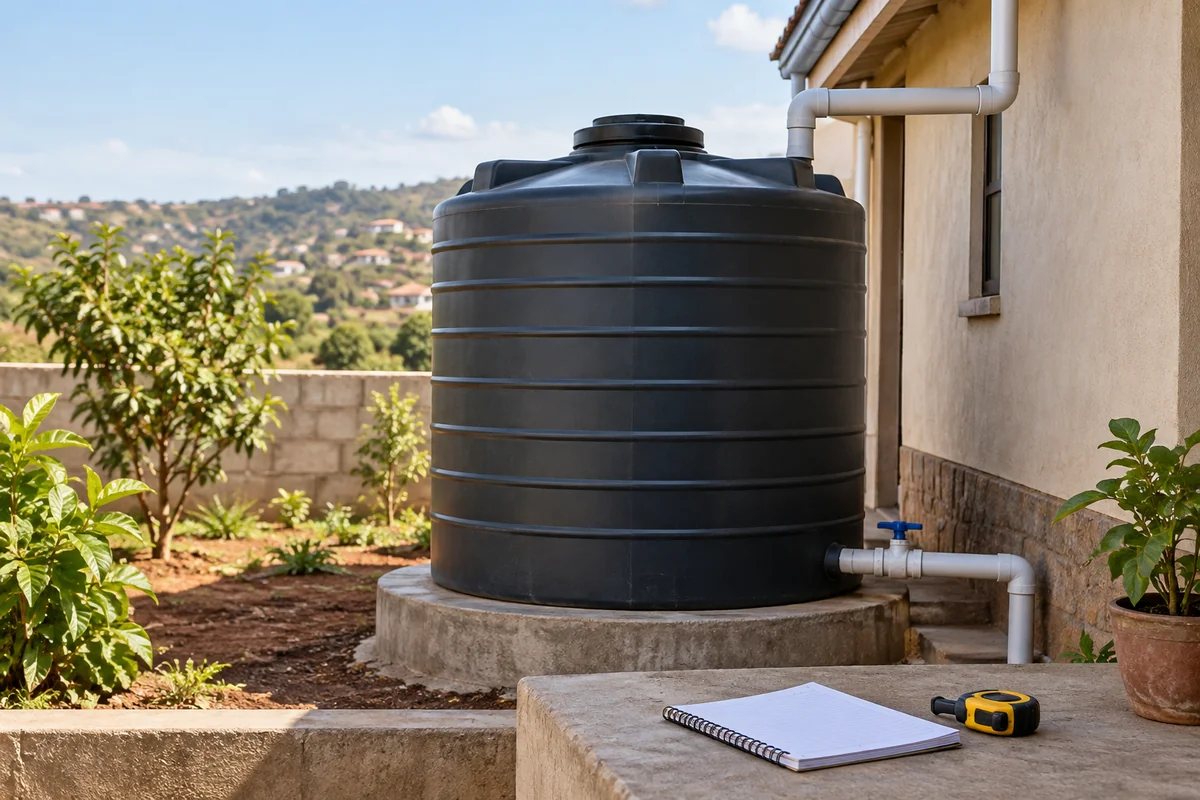
A household water tank needs an operating record as well as a capacity label. Once installed, the useful questions change: where does the water come from, which fittings protect it, what has changed since the last inspection, and who will resolve a fault? A full tank and a clean-looking lid do not answer all of those questions.
Use the Water Tank Sizing Calculator to organise household demand and the backup period while planning a maintenance interruption. Its result is a planning estimate. It does not inspect the tank, analyse a sample, approve a support structure or certify drinking water. This guide focuses on maintaining an existing installation; the water-tank sizing guide covers the earlier capacity decision.
Sources reviewed: October 4, 2026. WHO's current inspection resources, Kenyan manufacturer instructions and the public-health references linked below inform the technical boundaries. Publication dates and this review date are different. Local water-authority advice, the actual equipment manual and a qualified site assessment take precedence over a general household checklist.
Create a short tank identity record
Start with details that another person can use without guessing. Record the tank location, manufacturer and model where readable, labelled capacity, installation date if known, water source and intended uses. Mark missing information as unknown. Photograph equipment labels and visible fittings without including household members, addresses or private documents in a public post.
Sketch the route from supply to use. Identify the inlet, outlet, overflow, drain, inspection hatch, any pump and the taps supplied. If several tanks are connected, name each one separately. This is a practical record for a plumber or caretaker, not a substitute for an installation drawing. Ask the installer to explain any connection that you cannot identify safely.
Keep the original invoice, installation instructions, previous repair notes and relevant water-test reports together. A new cleaning invoice should not overwrite the previous inspection record. The sequence matters when a problem returns: the reviewer needs to know what was observed, what was changed and whether the same issue was checked afterward.
Separate the source from the storage system
Write down whether the tank receives piped utility water, delivered water, borehole water or roof runoff. If the source changes, update the record rather than assuming the old review still applies. Keep the supplier's delivery or service information alongside your own observations. A storage inspection cannot establish the quality of an undocumented incoming supply.
WHO's 2024 small-water-supply guidelines place preventive risk management and independent surveillance alongside water-quality standards. For household planning, this means keeping three questions visible: the condition of the source, the condition of the storage and distribution system, and the evidence needed to assess the water used.
For a Kenyan equipment handoff, Kentainers' FAQ says installation services can be discussed with its sales team and directs users to its installation guidelines. Ask the actual manufacturer or installer for the documents that apply to your model. Use the Kenya country hub for related planning tools, then contact the relevant supplier or public-health office about your source and sampling arrangements. Equipment support does not establish water quality.
Record a source change as a review trigger. Do not convert a receipt, a brand name or a supplier's general assurance into a household laboratory result. Ask which document describes the supply you received and which questions remain for the stored water.
Inspect from a safe position outside the tank
WHO's storage-tank inspection package identifies damaged covers, unsecured inspection hatches, unprotected vents and overflow defects as risk factors. Its maintenance advice calls for site-specific schedules. Check accessible components from ground level; record what cannot be seen rather than climbing or removing unsafe covers.
For a Kenyan product example, Kentainers' installation instructions require a flat, fully supporting base, a base larger than the tank diameter and an overflow draining away from the base. They also specify fittings and drilling practices. These are manufacturer instructions for that product, not a structural design for every tank.
| Accessible observation | What to record | Who reviews the finding |
|---|---|---|
| Lid or hatch | Visible damage, fit and closure; inaccessible areas | Tank supplier or qualified maintenance provider |
| Vents and overflow | Missing or damaged protective screens, visible blockage | Installer or plumber familiar with the system |
| Base and supports | Visible changes, settlement, cracks or lost support | Qualified installer or structural professional as appropriate |
| Pipework and taps | Drips, damaged fittings and the exact location | Qualified plumber |
| Surrounding area | Standing water, rubbish and drainage problems | Property caretaker, with specialist review where needed |
Use observed, not checked and action needed as separate entries. A tick beside “tank inspected” is too broad when the underside, roof or buried connections were inaccessible. Include the date and the person responsible for obtaining that missing assessment.
Add a separate roof-runoff inspection
If the tank collects rainwater, inspect the collection route as a separate system. WHO's rainwater collection package covers roof and gutter condition, filter boxes, first-flush devices, tank protection and drainage. It explains that a first-flush device diverts the initial runoff, which can carry contamination accumulated between rain events. A debris screen does not effectively remove harmful microorganisms.
List the installed components and retain their manuals. Ask the installer how the first-flush arrangement is checked and reset, what cleaning it requires and where diverted water goes. Record absent or blocked components as unresolved findings. Do not label roof runoff as potable merely because leaves have been filtered out.
Plan any roof or gutter work with suitable access and trained help. A photograph from ground level can document a visible blockage; it does not establish that the whole catchment has been inspected. Keep rainfall observations separate from maintenance evidence. The amount collected does not show whether the collection route is suitable for drinking-water use.
Build a schedule around the actual installation
WHO's sanitary-inspection resource page describes inspection as a complement to water-quality monitoring. Its packages distinguish routine observations, periodic work and action when a problem arises. They are resources for trained use; this article does not reproduce a WHO form or provide WHO approval.
Make your household schedule a record of agreed tasks rather than a universal cleaning interval. Ask the supplier and relevant water or health professional which activities apply to your tank, source and uses. Note the next due date, who can perform the work and what evidence will close it. “Every few months” is difficult to audit unless the actual dates are recorded.
Add event-triggered reviews after repairs, an unexpected source change, flood exposure, a damaged lid or a reported water-quality concern. Keep those reviews separate from a routine visual check. If a task is delayed, retain its original due date and record the reason and temporary arrangements; do not change the date to make the record look current.
Review the list when household circumstances change. A caretaker handover, a new pump or an additional connected tank may require updated instructions. Give the incoming caretaker the latest record and the outstanding findings, not just the date of the last service.
Define the cleaning job before requesting a quote
Send providers the same description: tank type and location, access restrictions, source, uses, connected equipment and observed problem. Ask for a written scope covering isolation, safe access, sediment removal, cleaning, any disinfection, rinsing, waste handling and return to service where applicable. Ask which parts are included and which require another specialist.
For entry hazards, the UK's HSE confined-space guidance says to avoid entry where possible and requires a safe system and emergency arrangements when entry is necessary. It is a safety reference, not an African legal rule. Do not enter a household tank or ask an untrained person to climb inside. Tank entry, electrical isolation, elevated work and structural repairs belong with appropriately qualified personnel under local requirements.
Ask the provider to identify the method and equipment instructions they will follow. A generic bleach recipe copied from a small-container guide does not specify a safe process for an unknown large installation. Keep chemical concentration, compatibility, contact time, disposal and return-to-use decisions with the responsible professional and applicable guidance.
Compare complete offers. Separate labour, access equipment, replacement parts, testing if required and refill arrangements. Keep missing prices as clarification needed. A low quoted total that excludes the identified fault cannot yet be compared with a complete repair offer.
Plan water access during maintenance
Use your own household-demand record and the calculator to identify the services affected by isolation. Ask the provider how long the quoted work and any specified waiting period will interrupt those services. Keep that estimate attached to the quote. The calculator's backup-days field is your planning assumption, not a provider's completion promise.
The CDC's emergency-water storage guidance recommends suitable storage containers, secure closures and labelling, and warns against containers previously used for toxic chemicals. Prepare an alternative safe drinking-water supply before isolating the tank, following relevant local advice. Keep containers away from contamination and identify the storage date.
Write a simple household notice covering the affected taps, the intended work period and the alternative supply. Confirm who will explain changes if the job takes longer than expected. Keep drinking and cooking needs explicit rather than treating every available container or connected tap as interchangeable.
Treat flood or chemical exposure as an incident
The CDC's cistern disaster guidance warns that floods can introduce germs and chemicals. It advises health-department review for untreated catchment systems affected by storm debris or floodwater. Water containing fuel or toxic chemicals cannot be made safe by ordinary treatment. Do not attempt to resolve suspected chemical exposure by adding more disinfectant.
Stop using suspect water for drinking and cooking, arrange an alternative safe supply and contact the relevant water or public-health authority. Record the incident date, affected source, visible damage and advice received. Give those details to the maintenance provider. A routine cleaning booking should not conceal an unresolved contamination incident.
Keep the authority's return-to-use conditions visible. Photographs, clear appearance, absence of odour and a contractor's invoice are different evidence from a water-quality assessment. If samples are required, ask the laboratory or authority how and where to collect them, which analyses apply and how results will be interpreted for the intended use.
Close the work with evidence and an owner
Request a dated service record identifying the tank, work performed, parts replaced, unresolved issues and any conditions before use. Keep provider-issued test results separately from photographs and payment records. Confirm that the document describes your installation and the actual visit; a general brochure is not a job record.
Use a small action register with finding, responsible person, agreed action, due date and closure evidence. Mark a repair complete only after the specified check is recorded. Mark a water-quality question unresolved until the required assessment is available. If the work could not reach a component, carry that limitation into the handover.
The pump quotation checklist offers a related way to separate installed scope, acceptance evidence and commercial terms. For a household tank, retain the same discipline without importing irrigation design assumptions. Your final maintenance packet should let the next caretaker see the current arrangement and the exact next action.
Frequently asked questions
Does a clean tank prove that its water is safe to drink?
No. Source quality, system condition, handling and relevant water-quality assessment remain separate questions. Follow local water and public-health advice.
How often should every household tank be cleaned?
There is no single interval stated here. Agree a site-specific schedule using manufacturer instructions, inspection findings, source conditions and local professional advice.
Can I enter the tank to inspect or clean it?
Do not enter a household tank. Confined-space work requires trained personnel, a safe system and appropriate emergency arrangements under local requirements.
What does the Water Tank Sizing Calculator verify?
It calculates a planning estimate from entered demand and backup assumptions. It does not test water, approve structure or certify a maintenance job.
Plan the interruption before the service visit
Record your household demand and backup assumptions, then confirm the work period and alternative safe supply with the responsible provider.
Open Water Tank Sizing CalculatorSources and verification date
Primary references checked on October 4, 2026: WHO's 2024 small-water-supply guidelines and current storage-tank, rainwater and household-practices packages; Kentainers' installation instructions and FAQ; CDC emergency-water and cistern guidance; and HSE confined-space guidance. The older publication dates do not imply new rules in 2026. This is a maintenance-planning guide, not a laboratory result, engineering approval, treatment prescription or compliance certificate.