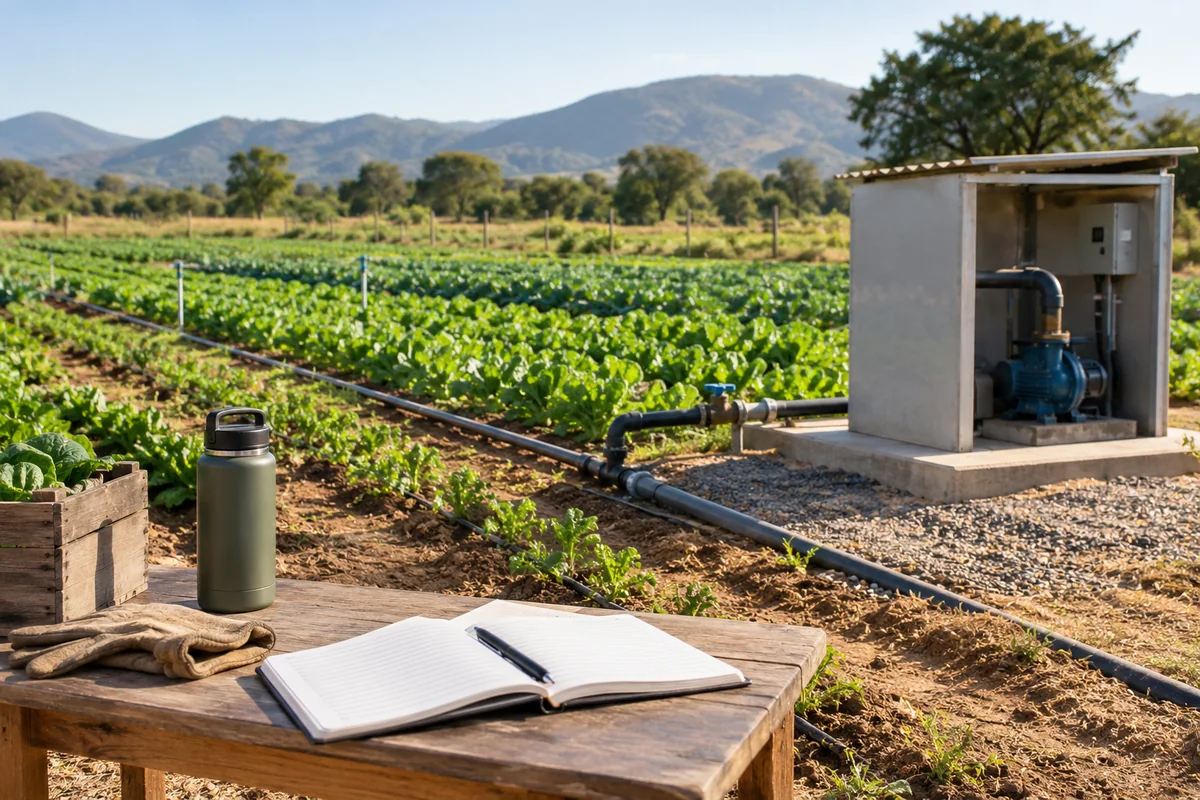
An irrigation pump quotation is useful only when it describes the water the farm needs and the conditions under which the equipment will deliver it. Horsepower, a pipe connection size and a price do not establish that a pump will fill the storage tank, run the intended irrigation zones or keep working when the source level falls.
Use the Irrigation Water Calculator to organise field area, net water depth, assumed system efficiency and planned cycles. Keep the result as a planning estimate. It does not select a pump, test a borehole, produce a hydraulic design or grant permission to abstract water. This guide explains how to turn that initial water budget into a quotation request that a qualified irrigation designer and supplier can review.
Sources reviewed: October 1, 2026. The technical references below include established FAO guidance and current regulator and supplier pages. Their original publication dates are not new equipment specifications. Obtain a current site assessment, model-specific documentation and written commercial terms before ordering.
Start with one shared quotation brief
Send every bidder the same brief rather than asking each to guess the farm's requirements. Describe the existing equipment, proposed irrigated area, water source and intended operating period. Mark a value as measured, estimated or awaiting investigation. A blank measurement should remain visible instead of becoming an unexplained allowance in the supplier's total.
| Part of the brief | Evidence to attach | Question for the supplier |
|---|---|---|
| Water demand | Crop, area, growing stage and dated water budget | What volume and delivery schedule does this quotation serve? |
| Source | Source description, seasonal observations and available test reports | What source limitations were used in selecting the pump? |
| Delivery route | Site sketch, levels, pipe lengths and existing components | Which losses and outlet pressures are included? |
| Energy | Available supply, operating hours and current cost evidence | What complete power package is included? |
| Acceptance | Proposed measurements and handover responsibilities | How will installed performance be demonstrated? |
Give the brief a version and date. If a site visit changes the area, pipeline or source assumptions, issue the revised brief to all bidders. Keep alternatives separate: a tank-filling system and a pump serving sprinklers directly may solve different jobs, even when both quotations mention the same farm.
Separate crop demand from pump flow
FAO's crop evapotranspiration guidance distinguishes reference evapotranspiration from crop evapotranspiration. The crop-coefficient approach multiplies reference demand by a coefficient reflecting crop characteristics and growth stage. A supplier should know which crop and period the proposed system is intended to serve, rather than receiving only a farm's total land area.
Net irrigation represents the water required after accounting for useful rainfall and the relevant field conditions. Gross supply also allows for system losses. Keep those quantities distinct. One millimetre over one square metre equals one litre; one millimetre over one hectare equals ten cubic metres. Those are unit conversions, not recommendations for a particular crop.
Record the time basis beside each result. A daily volume, a per-cycle application and a monthly total answer different questions. The calculator's entered efficiency is an assumption unless field evidence supports it. It should not become a guarantee that a quoted irrigation installation will achieve that efficiency.
The Uganda tomato irrigation guide covers crop-water inputs in more detail. Use it for that earlier calculation step; this quotation checklist begins where a water budget must be handed to the equipment designer.
Agree when the water must arrive
Volume divided by available pumping time gives a starting delivery-rate requirement. Specify whether that time includes interruptions, shared-source access, power availability and irrigation-zone changes. Do not silently treat twenty-four hours as usable pumping time when the actual operating arrangement is shorter.
FAO's matching water needs and supply chapter contains a useful published example. A scheme with a continuous gross requirement of 100 litres per second needs about 420 litres per second when pumping eight hours a day, five days a week. Its illustrated 315-litre-per-second pump cannot meet that schedule. Changing the schedule to nine hours a day, six days a week reduces the required operating discharge to about 311 litres per second.
These are FAO's teaching figures, not an African farm quotation or a suggested operating schedule. The lesson is that an agreed time window changes the required discharge. Ask the designer to document the timetable used in the selection, including which zones operate together and which are sequential.
Establish what the source can supply
For a borehole, attach the available drilling, completion and pumping-test records. For a surface source, describe its observed seasonal levels and intake position. Separate an observation made during the rainy season from evidence supporting dry-season operation. An installation drawing based on an untested source remains conditional.
FAO's water-lifting guidance explains that water levels change seasonally and during abstraction. Pumping can lower the level in a well, increasing the lift required. It identifies pumping tests as a way to establish drawdown at different extraction rates. Ask a competent specialist to interpret the test for the proposed duty.
Do not approve an increased pump capacity as the automatic answer to a water shortage. A quotation should identify whether the limiting factor is source availability, delivery infrastructure, pumping time or crop demand. Record any outstanding source assessment as a condition before purchase, with a named person responsible for closing it.
Ask for flow and head together
The supplier's selection should state a required flow at a required total head, with consistent units. FAO's farm water-supply pump chapter separates lifting head, discharge elevation, working pressure at the point of use and losses through pipes and fittings. The route from source to field belongs in the calculation.
Send a sketch identifying the source, pump, tank, highest delivery point and pipeline route. Include existing pipe sizes and materials where known. Ask the designer to state which measurements were verified on site, which were supplied by you and which remain assumptions.
The South African Pedrollo distributor's pump enquiry guide asks buyers for information about flow, suction, delivery and pipework. It is a supplier's information checklist, not an independent endorsement of its products. Use the same principle with any bidder: supply the site data and require an explicit selection against it.
Request the exact model's performance curve with the proposed operating point identified. Keep the pump model, motor and any controller references together. A brochure showing a maximum flow and a maximum head does not explain whether both are available at the same operating point. Ask for written clarification when the quotation lists only headline maxima.
Price the complete energy arrangement
Ask the installer to confirm the available electrical supply and the full control and protection arrangement. For an engine-driven offer, request operating information for the quoted duty. For solar, request the array, controller, pump and any storage design as one specified package, including the conditions under which the promised daily delivery is calculated.
The US Department of Energy pumping sourcebook treats performance and energy use as system questions. Running cost depends on power, operating duration, load and the applicable electricity cost. A motor nameplate alone is not a field measurement of energy consumed at every operating condition.
For a cost comparison, put the supplier's estimated energy consumption and your dated tariff or fuel quotation in separate columns. Ask which figures are measured and which are estimates. Leave unverified consumption blank rather than inventing a daily fuel bill. Add installation, servicing and replacement costs from written offers to the Smallholder Farm Budget Planner.
FAO's 2018 solar irrigation review highlights groundwater-management risks as well as potential benefits. Solar energy does not make source water unlimited. Do not use an equipment purchase to justify expanded abstraction without reviewing the water budget and local permissions.
Compare installed scope before comparing totals
Turn each quotation into a line-item comparison. Keep the supplier's offered price unchanged and add a separate list of exclusions and questions. This preserves the original commercial record while making differences visible.
- Equipment: exact pump, motor or engine, controller and specified accessories.
- Water path: intake, delivery pipework, valves, filters and tank connections.
- Installation: transport, mounting, civil works, electrical work and site labour.
- Handover: testing, manuals, operator training and the final installation drawing.
- Commercial terms: currency, tax treatment, quote validity, payment stages and delivery conditions.
- Support: warranty conditions, service contact, spares availability and response arrangements.
Use inclusion, exclusion or clarification-needed labels. Avoid assigning a zero cost to missing work. If one offer excludes pipework, the total cannot yet be compared with an offer that includes it. Ask for the missing scope or retain that uncertainty in the decision record.
Confirm which organisation is responsible for faults spanning components. A pump supplier, solar installer and irrigation contractor may each cover only part of the installation. Ask who will investigate if the finished system fails the agreed delivery test and which written terms govern remedial work.
Keep the local water-permission check separate
Equipment ownership does not establish water-use permission. Verify the current process with the authority for the actual source and jurisdiction. Keep approvals and conditions beside the design brief so permitted use and proposed operation can be reviewed together.
Kenya's Water Resources Authority permitting page, checked on October 1, 2026, describes an application, technical evaluation and authorisation process. It lists completion documentation, borehole completion records where applicable and water-quality analysis among requirements for issuing permits. It also instructs users to stay within allocated abstraction thresholds.
This Kenyan example is a country handoff, not a shared African licensing rule. Start from the Kenya country hub for related tools, then use the authority's current instructions for the permit itself. Elsewhere, ask the relevant authority which abstraction, construction, environmental or land-use permissions apply. Do not copy another country's fees or validity period into the quotation.
Write the performance test before ordering
Agree what the installed system must demonstrate, where measurements will be taken and who will witness them. Put the relevant irrigation zone or tank-filling arrangement in the test record. Testing with a different arrangement should be identified and explained rather than accepted as equivalent by assumption.
Netafim South Africa's irrigation-room checklist compares measured flow with design specifications and includes source conditions, pump delivery, pressure, filtration and water-meter readings. It calls for suitable safety precautions and expert involvement. Use it as a manufacturer's reference, with the actual design and equipment instructions taking precedence.
Your acceptance sheet should record the equipment identifiers, test date, measurement locations, observed delivery, relevant pressures and any exceptions. Attach the installer-issued readings and test documentation. Keep outstanding corrections visible, with an owner and a proposed recheck. Electrical or mechanical adjustments belong with qualified personnel.
Retain the quotation, approved design, installation drawing, manuals, warranties, commissioning record and support contacts in one farm equipment file. Record future changes to pipework or irrigation zones so later troubleshooting can distinguish the original tested arrangement from subsequent alterations.
Use three clear purchase outcomes
Ready to compare: the bidders have priced the same job, documented their operating assumptions and identified installed scope. Compare the commercial terms alongside the technical review.
Conditional: the offer depends on a source test, site measurement, permission or missing component price. Keep that condition explicit and obtain the evidence before committing to the affected work.
Needs revision: the proposal does not state its delivery duty, conflicts with the supplied evidence or lacks an agreed acceptance method. Return specific questions to the bidder. Buying a larger motor does not resolve an undocumented design.
For storage questions, the water-tank sizing guide explains how demand and reserve assumptions affect a storage estimate. A household tank calculation does not certify an irrigation structure, but it helps keep storage volume separate from pump delivery.
Frequently asked questions
Can I choose an irrigation pump by horsepower?
Horsepower alone is insufficient. Obtain a model-specific selection showing the required flow and head, source conditions and complete installation scope.
Does the AfroTools calculator select a pump?
No. It estimates water quantities from entered planning assumptions. A qualified designer must assess the source, hydraulic duty, equipment and installation.
Is solar pumping permission to use more groundwater?
No. Check source capacity, the water budget and applicable permissions. The energy source does not remove water-use restrictions.
What should I request before final handover?
Request the agreed performance record, installation drawing, equipment manuals, warranty terms, training and a clear list of outstanding corrections.
Build the water budget before requesting equipment
Use your measured area and documented assumptions, then hand the result to the designer with your source records and site sketch.
Open Irrigation Water Calculator