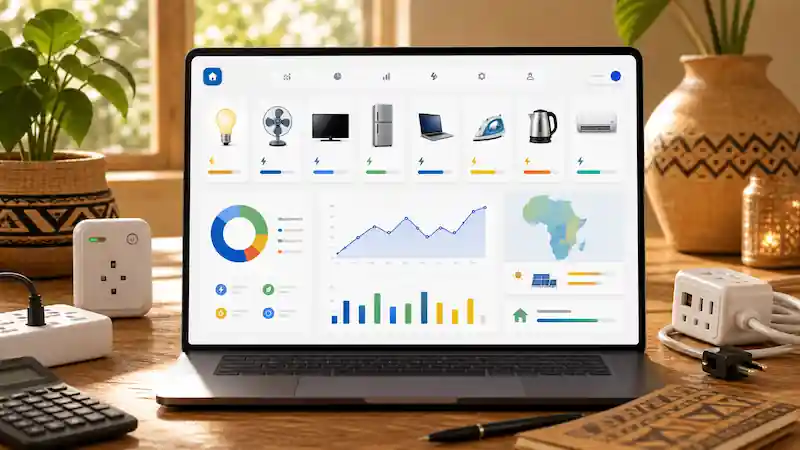
An electricity bill gives a household total, not a reliable answer to which appliance deserves attention first. A prepaid purchase records a transaction, while a nameplate records an equipment rating. Neither alone measures the energy used by your fridge, fan, kettle, water heater or home-office equipment over a normal week.
A useful household appliance electricity audit connects three records: what equipment you have, how it operates, and what the meter records. Start with the Appliance Power Calculator to organise watts, hours, quantities and standby assumptions. Then replace uncertain inputs with observations before making a spending decision. This guide is an original measurement checklist, not a certified electrical inspection or a promise to reduce your bill.
1. Decide what you are trying to explain
Write one question at the top of the record. Are you investigating higher consumption, a bigger payment despite similar consumption, or the equipment that should be measured before a backup-power purchase? These are different jobs. A consumption audit cannot settle a disputed charge, and a monthly kWh total cannot establish an inverter's required starting capacity.
Choose the same physical boundary for every comparison: your dwelling, your separately metered shop, or a clearly identified circuit measured by a qualified person. A shared compound meter cannot identify one household's use without additional information. Record shared pumps, corridor lights and other communal loads separately rather than assigning the entire difference to your own appliances.
Keep a simple audit folder with the observation dates, meter unit, appliance list and a note of anything outside the boundary. Use generic labels such as kitchen fridge or bedroom fan. Account numbers, addresses and personal billing documents are not needed in the calculator.
2. Establish a meter baseline before changing habits
Record readings at consistent times for a practical observation period that includes ordinary weekday and weekend use. A seven-day log is a manageable starting routine, not a technical standard or a guarantee of seasonal representativeness. Keep the opening reading, closing reading, elapsed hours and unit together.
For a cumulative import-energy register, the closing reading minus the opening reading gives imported kWh for that interval, provided you used the same register and there was no reset or meter replacement. A prepaid remaining-credit display works differently. Do not subtract a currency balance as though it were a cumulative kWh reading. Record top-ups and identify exactly what the display measures.
Eskom's self-read guidance distinguishes meter formats and explains submission windows. It also identifies additional charges and corrections from estimated to actual readings as possible reasons for a larger bill. Those instructions belong to Eskom customers; use your own supplier's meter guide and reporting channel elsewhere.
Alongside each reading, note outages, visitors, laundry days, unusual cooling use and battery charging. These notes let you interpret a difference without inventing an explanation afterwards. A lower grid reading during a long outage is not evidence that the home became more efficient.
3. Inventory appliances using evidence, not a generic list
Walk through the rooms and record the model, quantity, rated watts, usual operating pattern and evidence quality. Read accessible labels without opening equipment or touching wiring. If a label is inaccessible, use the exact model's manufacturer documentation or mark the input unknown. An unknown wattage is a measurement task, not a reason to borrow an unrelated appliance's rating.
Separate appliances that look similar but operate differently. Two fans may use different settings; an electric iron cycles its heating element; a washing machine's energy depends on the programme. A quantity field is appropriate only when the grouped items share the same relevant watts and hours.
| Record | What it tells you | What it does not prove |
|---|---|---|
| Nameplate watts | A rated power input for the model | Continuous consumption at that rating |
| Energy-label kWh per year or cycle | Consumption under a stated test basis | Your household's actual operating pattern |
| Plug-in meter kWh over an interval | Energy measured through that device | Whole-house use or a full year's behaviour |
| Utility meter kWh | Energy through the selected meter register | Which appliance used it |
Keep evidence labels beside the inputs: nameplate, manufacturer test figure, measured, or estimated. This is more useful than displaying several decimal places on an uncertain number. Preserve the observation period whenever you copy a measured result.
4. Understand the watts-to-kWh calculation
For a constant load, energy in kWh equals watts multiplied by hours and quantity, divided by 1,000. The conversion is a unit relationship, not a household example or a savings forecast. Where power changes during operation, use the average over the relevant interval or measure energy directly.
The AfroTools appliance engine models each day's active use and then adds entered standby watts for the hours remaining outside active use. Its monthly projection uses 30 days, while its annual projection uses 365 days. Monthly totals and displayed costs are rounded, so copying a rounded daily result and multiplying it yourself may produce a small difference.
Enter operating hours supported by your records. Do not confuse the time an appliance is plugged in with the time it draws its full nameplate power. For an appliance used only on certain days, derive an average daily run time from the observation period and retain the original schedule in your notes.
The tool does not provide a separate input for every possible duty-cycle model. If your strongest evidence is measured kWh rather than watts and active hours, keep that measurement beside the calculator output. Do not manufacture an exact-looking input merely to make the screen reproduce a meter result.
5. Measure cycling and variable loads carefully
Fridges, freezers, air conditioners and water heaters do not necessarily draw their rated power continuously. Eskom's residential-calculator notes explicitly discuss thermostatic cycling and the use of assumptions. They also warn that approximate appliance calculations do not predict the bill accurately.
Use a suitable plug-in energy meter only where the appliance, socket and meter ratings are compatible, following their instructions. Have a qualified electrician assess fixed-wired, high-load or otherwise unsuitable equipment. Do not remove meter seals, open a distribution board, improvise adapters or interrupt medically essential equipment to collect data.
Measure long enough to include the appliance's normal operating pattern, and record the conditions. A brief reading while a compressor is running cannot represent all-day energy. Likewise, an observation during unusual heat, an empty-house period or a different programme should not be silently treated as typical.
For comparison, divide measured kWh by the recorded number of days, then label any monthly projection as conditional on similar use. Retain the actual measured total as the primary result. The projection is useful for planning, but the measurement should remain recoverable.
6. Read standby and bill-share results correctly
The appliance breakdown ranks entered rows by modeled monthly kWh. Its cost column allocates the rounded household estimate in proportion to those modeled shares; it is not an individual meter charge for each device. The row rounding is reconciled to the displayed household cost.
Standby has two presentations. Entered standby watts already contribute to each row during hours outside active use. The separate Standby Upper-Bound / Month metric assumes those standby watts run for 24 hours a day. Do not add that upper bound to the monthly total or call the entire amount achievable savings.
Measure standby where practical and do not assume that every connected device can be disconnected without consequences. Refrigeration, security, communications and medical equipment can have continuing service needs. The task is to understand use and decide deliberately, not to chase the smallest possible reading.
After changing an appliance or country input, recalculate before copying. The page marks the old breakdown stale and disables its copy action until a new calculation is available. Use that refreshed copy as a planning record, not as proof of payment or utility approval.
7. Separate energy use from the price of energy
The calculator's selector offers 13 countries, not every African tariff or supplier. Its engine uses the selected country's bundled residential rate for this estimate. It does not expose a custom-tariff input on this page, and a country choice is not enough to identify your actual service band, municipal tariff or customer class.
Compare kWh first. Then use your current supplier schedule and bill to price the relevant period outside the appliance estimate. Distinguish usage charges from fixed charges, taxes, debt recovery or other items that actually appear on your account. A proportional appliance cost allocation cannot determine which charge would disappear after using less electricity.
Even an official calculator can carry dated assumptions. The Eskom calculator explanation reviewed for this guide still cites an August 2022 tariff assumption. That is useful evidence of why dates matter, not a current rate recommendation. For South African pricing context, continue to the electricity tariff guide and recheck the issuing supplier before relying on a number.
8. Reconcile the appliance list with household reality
Compare totals over the same number of days. If the appliance model and meter differ substantially, check missing loads, duplicated rows, quantities, hours and the meter boundary before blaming equipment. Keep rounding differences separate from meaningful gaps. Do not force the model to balance by entering an unexplained extra appliance.
Homes using solar, batteries or generators need a second boundary: energy used by appliances versus electricity imported from the grid. The utility meter may not capture energy supplied directly by solar or a generator. Battery charging and conversion losses also make a simple appliance-sum comparison incomplete.
Record which source supplied the load during the observation period. If the aim is backup-power planning, take the measured-use record into the battery backup runtime guide. Keep running energy, simultaneous power and starting requirements separate; this appliance audit does not approve electrical sizing.
9. Test one change before buying replacement equipment
Choose a measurable action that preserves the service your household needs. Write down what will change, when it starts, what meter or appliance reading you will compare, and what would count as useful evidence. Changing several things together may lower the total but makes their individual effects harder to separate.
The Home Energy Audit tool offers a household-level planning score and a copyable action plan. It does not measure individual appliances. Its recommendations are overlapping heuristics, so do not add their savings percentages together or treat the displayed potential as guaranteed cash available for a purchase.
Repeat the observation under reasonably comparable occupancy, weather and supply conditions. Record maintenance, changed settings and any loss of comfort or service. If conditions differ too much, keep the result as an observation and measure again rather than declaring a verified saving.
When considering a replacement, compare the same equipment function and useful capacity. Keep purchase, installation, maintenance and any financing costs separate from the estimated energy reduction. A sales claim should not replace a model-specific specification or a measured baseline.
10. Use local energy labels and official support routes
In Ghana, the Energy Commission's standards-and-labelling FAQ explains the programme and the roles of the Commission, Ghana Standards Authority and Customs. Its energy-efficiency resource directory lists consumer material and appliance reports. Use those official routes to locate relevant guidance, rather than treating a seller's star graphic as sufficient evidence.
A label belongs to a particular model and testing basis. Compare like-for-like capacity and use, and ask what the stated consumption represents. A label does not guarantee the same consumption in every climate or household. Keep the model identifier with the evidence so a later purchase discussion concerns the equipment you actually checked.
Elsewhere, start with your national energy regulator, electricity supplier and the manufacturer's local support channel. This guide does not transfer Ghana's requirements or Eskom's customer procedures to another country. Where qualified electrical work is needed, verify local credentials and obtain a written scope.
Finish with a small, usable audit record
Your completed record should contain the meter boundary, dated readings, appliance inventory, evidence labels, unresolved gaps and one proposed test. Include a short note distinguishing measured consumption from projections and bundled tariff estimates. That is enough to support a focused conversation with a household member, landlord, electrician or supplier.
The appliance calculator does not automatically save the list as a durable household ledger. Copy the current breakdown and keep a private record before leaving the page. Share only what the recipient needs, particularly when a bill or meter photograph contains identifying details.
Return to the Appliance Power Calculator when new measurements improve an input. The result worth keeping is not a dramatic savings claim. It is a clear account of what you measured, what remains uncertain and which next action the evidence supports.
Frequently Asked Questions
Does an appliance's wattage tell me its monthly consumption?
No. You also need quantity and operating time. Cycling appliances need measured consumption or a supported estimate of their duty cycle.
Can I use the displayed cost as my utility bill?
No. The tool uses a country residential tariff assumption and allocates its modeled total. Your supplier, tariff class, billing period and additional charges may differ.
Should I add the standby upper bound to the monthly total?
No. Appliance rows already include entered standby watts outside active hours. The separate upper bound assumes standby for 24 hours and is not an extra bill line.
Does the audit save my appliance list automatically?
No. The appliance calculator keeps the entries in the current browser page and provides a copy action. Save a private copy yourself before leaving the page.
Does a lower weekly reading prove an efficiency improvement?
Not by itself. Compare occupancy, weather, supply interruptions and appliance use. Reduced service or a different energy source can also lower a grid-meter reading.