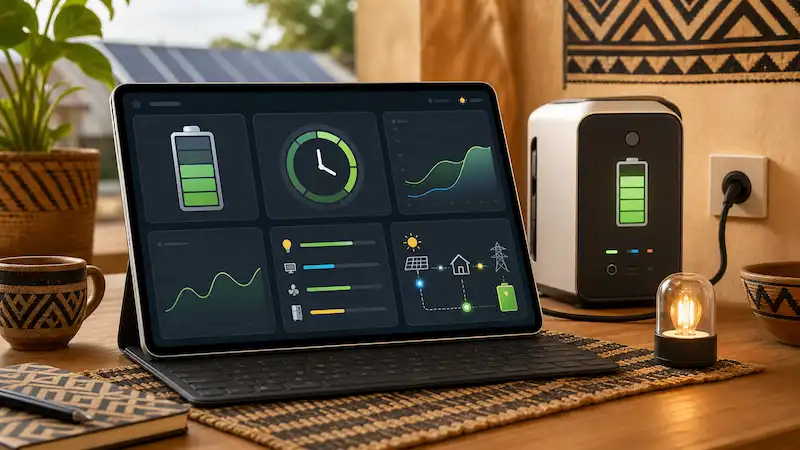
Decision rule: define the essential load first, calculate runtime from usable energy and system losses, verify surge capacity, and confirm protection, conductors and installation with qualified local expertise.
Turn the guide into a working forecast
Estimate inverter and battery backup runtime from appliance watts, usable battery energy, depth of discharge, efficiency and startup loads.
Open the Backup Duration Calculator →Power and energy are different
Power, measured in watts or kilowatts, is the rate at which appliances use electricity. Energy, measured in watt-hours or kilowatt-hours, is power used over time. A 100-watt load running for five hours uses roughly 500 watt-hours before losses.
An inverter must handle the combined running power and relevant startup surges. A battery must provide enough usable energy for the desired hours. Treating a kVA label as stored energy is a fundamental sizing error.
Build an essential-load list
List every appliance that must stay on during an outage, its measured or rated watts, quantity and expected hours. Separate critical loads such as lights, router, laptop, security and refrigeration from discretionary loads such as kettles, irons, water heaters and air conditioners.
Use a plug-in meter or reliable product data where possible. Nameplate maximum power may differ from normal consumption, while motors and compressors can draw a short startup surge.
Convert battery ratings to usable energy
For a battery rated in amp-hours, a rough nominal-energy conversion is volts × amp-hours = watt-hours. Series and parallel arrangements change voltage and capacity differently. Battery-management limits, age, temperature and manufacturer rules affect usable energy.
Apply the allowed depth of discharge and system efficiency. A nominal 5 kWh battery is not automatically 5 kWh delivered to appliances. Keep a reserve if the system must avoid unexpected shutdown.
Estimate runtime
A planning formula is: runtime hours = usable battery watt-hours × system efficiency ÷ average load watts. If loads cycle, use a defensible average or model the duty cycle. Refrigerators, pumps and some office equipment do not draw the same power continuously.
Run at least three scenarios: essential load, normal backup load and accidental high load. The gap shows which appliances require control during an outage.
Size the inverter for running and surge load
Add simultaneous running watts and check the startup requirement for motors, compressors and pumps. Compare both figures with the inverter’s continuous and surge ratings, power factor guidance and manufacturer limits.
Leave engineering margin, but do not use a huge inverter to compensate for an undefined load. Oversizing can increase idle consumption and cost. Undersizing creates trips, overheating or failure to start appliances.
Battery chemistry changes the plan
Lithium and lead-acid systems differ in usable depth, cycle behaviour, charging, weight, maintenance and cost. Do not transfer one chemistry’s assumptions to another. Follow the battery and inverter compatibility list, protection requirements and charging profile.
Age and temperature matter. A system that met runtime when new may deliver less later. Record commissioning performance and compare it periodically with the planning model.
Account for charging
Runtime is only half the operating question. The system must recharge before the next outage. Check grid availability, charger power, solar input, generator use and any load that continues while charging. A large battery with insufficient charging can remain chronically undercharged.
For solar-backed systems, use local solar-resource and shading analysis, not panel wattage alone. The daily energy balance should include household use, charging losses and seasonal variation.
Safety and installation
Batteries store substantial energy. Use qualified design for conductors, fuses, breakers, isolation, earthing, ventilation, enclosures and fire risk. Follow manufacturer instructions and local electrical requirements. Do not improvise cable sizes or mix incompatible battery modules.
Keep equipment away from flooding, children, heat sources and obstructed ventilation. Provide safe maintenance access and clear shutdown procedures.
Common runtime mistakes
- Using battery amp-hours without voltage.
- Using nominal energy without depth-of-discharge and efficiency limits.
- Ignoring inverter idle consumption and conversion loss.
- Adding appliance watts without startup surge.
- Assuming every appliance runs continuously at one fixed load.
- Ignoring battery age, temperature and recharge time.
Source and engineering boundary
U.S. Department of Energy, battery fundamentals. This guide explains planning concepts, not an approved electrical design or product recommendation. Confirm specifications, protection, compatibility, code requirements and installation with manufacturers and qualified professionals.
How to validate the energy model
Start with the manufacturer-supported usable watt-hours, apply a documented efficiency assumption, and divide by the measured average essential load. Compare that estimate with a controlled runtime test after commissioning. Real performance may differ with cycling loads, temperature, age and inverter behaviour.
Test high-power appliances separately against the inverter’s continuous and surge limits. Even brief use can sharply reduce runtime or exceed the equipment’s operating range. This is why load discipline is part of backup design.
Separate autonomy from resilience
Autonomy is how long stored energy can support a defined load. Resilience also includes the ability to recharge, obtain service, replace components and operate safely during repeated outages. A system with long theoretical runtime but slow recharge may perform poorly through consecutive outages.
Document the outage pattern, not just the longest event. Several short outages with limited grid return can be more demanding than one long outage followed by a full recharge window.
Commissioning and performance checks
At commissioning, record battery state, load, runtime, charging time and protective settings. Label circuits and agree which appliances are excluded. Test a controlled outage so users understand alarms, shutdown and restart behaviour.
Review performance periodically. Rising runtime error can point to battery ageing, an added load, weak connections, ventilation problems or a changed setting. A qualified technician should investigate faults and protection trips.
Questions for an installer or supplier
- What usable energy is warranted, at what conditions?
- What continuous and surge load can the inverter support?
- Which battery models and quantities are approved?
- How long will recharge take under the available source?
- Which protections, conductor sizes and isolators are specified?
- What monitoring, warranty and service process applies locally?
- What capacity remains at the end of the warranty condition?
A household load-audit routine
For seven days, record when each essential appliance runs and whether it is needed throughout an outage. Measure uncertain plug loads and identify equipment that can be moved to daylight or grid hours. Group loads into always-on, scheduled and prohibited-on-backup categories.
Use the highest credible simultaneous load for inverter review and total energy for runtime review. Share the final list with everyone using the property. A technically adequate system can still disappoint if users expect high-power appliances that were never included in the design.
Frequently asked questions
How do I estimate how long an inverter battery will last?
Divide usable battery energy after depth-of-discharge and efficiency allowances by the average appliance load.
Why is actual runtime lower than the battery label suggests?
The label is nominal capacity. Usable energy is reduced by protection limits, conversion losses, temperature, age and reserve.
Should inverter size match battery size?
They solve different constraints. The inverter handles running and surge power; the battery provides energy over time.
Can I include a refrigerator in a backup system?
Yes, but account for compressor startup, cycling behaviour and the manufacturer’s power requirements.