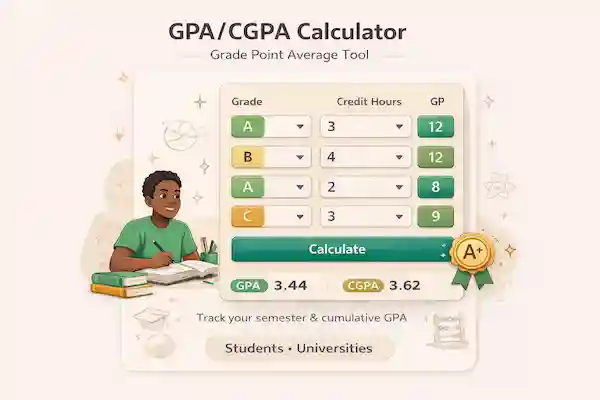
GPA is not calculated from marks alone. Course credits, grade points, repeated courses, failed courses and the institution's own policy determine the result.
Copy the official grade-point table, multiply each course grade point by its credit value, add the quality points and divide by counted credits. For CGPA, follow the institution's rules for all included semesters and repeats.
GPA and CGPA Worksheet supports private credit-weighted calculations with a grading table you verify.
Quick answer
Do not borrow a 4-point or 5-point scale from another university. Use the current handbook for your programme and compare the worksheet with the official transcript.
Start with the exact job you need to complete. A useful result is tied to a real application, meeting, agreement, trip, electricity purchase, job application, image export or academic record. Write down the destination, deadline and acceptance rule before changing any settings.
Inputs to verify
| Input or decision | Evidence to keep |
|---|---|
| Course | Exact course code and title |
| Credits | Credit hours or units counted |
| Grade | Official letter or result |
| Grade point | Value from the institution's scale |
| Policy | Rules for repeats, fails, exemptions and rounding |
A simple average of course marks is not the same as a credit-weighted GPA unless the institution explicitly defines it that way.
Step-by-step workflow
- Find the current official grading and progression policy.
- List every counted course with its credit and grade.
- Map each grade to the correct grade point.
- Multiply grade point by credit, total both columns and divide.
- Compare with the official result and ask the registrar about differences.
Keep the original file or record unchanged. Work on a copy, label the output with the date and purpose, and compare it with the source before sending or uploading it. This makes mistakes reversible and gives another person enough context to review the decision.
Handle repeats, exclusions and conversion carefully
Institutions differ on whether a repeated course replaces the old result, adds another attempt or affects progression separately. Follow the written policy rather than deleting an inconvenient grade.
Rounding only at the end avoids cumulative error. Keep enough decimal places in the worksheet and display the number of places used by the institution.
Converting GPA between systems is not a universal arithmetic operation. Scholarship and admissions bodies may use their own evaluation, so submit the official transcript and scale when requested.
Checks before you rely on the result
- The scale belongs to the correct institution and programme year.
- Credits and grade points are in separate columns.
- All counted courses are included once according to policy.
- Rounding is applied only as the institution specifies.
- The worksheet is labelled unofficial until matched to the transcript.
Treat any estimate as a planning aid. Fees, entry rules, grading scales, document clauses, upload limits and utility deductions can vary by provider, country and date. The receiving institution or official authority remains the final source of truth.
Create a review trail
Record the source, date and version beside the result. If another person reviews the work, ask them to check the inputs and acceptance rule rather than only the final appearance. Save their correction separately so the original decision remains traceable.
When the receiving portal, authority, employer, utility or institution rejects the output, keep the rejection message and compare it with the rule you recorded. Correct the identified mismatch first. Repeating the same export with random settings makes the problem harder to diagnose and can create conflicting copies.
Privacy and safety
Use the minimum information needed. Do not paste identity numbers, private commercial terms, academic records or personal contact details into an untrusted service. AfroTools workflows described here are designed for practical preparation, but you should still review the page notice and export before sharing it.
Academic records are personal data. Keep the worksheet private, avoid publishing student numbers and use the registrar's official process for corrections.
Open the AfroTools workflow
Save the grading scale beside the calculation so the result can be reproduced when a policy or application asks for evidence.
The tool organises your inputs and produces a planning output. It does not guarantee acceptance, legal enforceability, admission, visa approval, electricity supply, employment or a particular grade.
Sources and verification
These sources explain the underlying standard or decision process. Reopen the live source and the relevant authority or institution before acting because requirements can change.
- University of Ghana handbook example of a published grading system
- UNESCO higher-education qualification recognition framework
Related AfroTools guides
Frequently asked questions
Usually not. GPA commonly weights grade points by course credits, but the institution's policy controls.
Rules differ. Some replace, retain or separately flag attempts. Use the current academic handbook.
A simple proportion may not match the receiving institution's evaluation. Provide the official scale and follow its stated method.