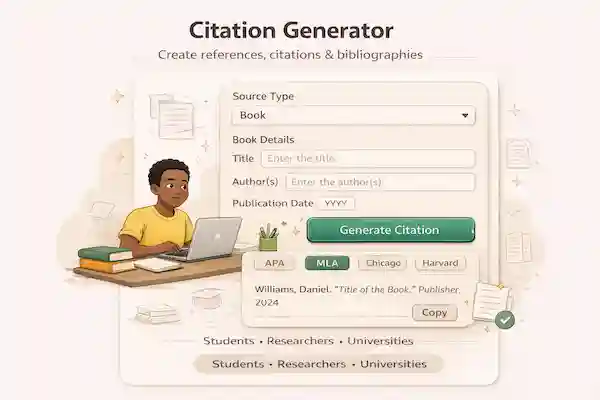
A citation generator can arrange source details, but it cannot recover an author, date or edition you never checked. Good referencing begins with the source itself.
Capture the source type and complete publication details, choose the style required by the institution, generate the reference, then compare it with the official style guide.
Citation Generator opens the practical workflow in your browser.
Practical answer
Start with the receiving decision, not the calculator. Write down who will use the result, which document or workflow it supports, the date it is needed and the rule that decides whether it is acceptable. A technically correct number or file can still fail when it answers the wrong question, uses the wrong period or arrives in a format the recipient cannot use.
Inputs to verify
| Input | What to verify |
|---|---|
| Required style | APA 7, MLA 9, Chicago author-date or another guide |
| Source type | Book, journal article, webpage, report or chapter |
| Creator details | Author, organisation, editor or translator |
| Publication details | Title, date, publisher, journal, volume and pages |
| Locator | DOI, stable URL, page or access date when required |
Keep the source evidence beside the inputs. That may be a contract, calendar, design token, source document, account rule, style guide, price list or measurement note. Record the date and version where a rule can change. If an input is an estimate, label it as an estimate instead of presenting it as an observed fact.
Step-by-step workflow
- Open the original source rather than a copied bibliography.
- Choose the correct source type and style.
- Enter every available field exactly.
- Generate the reference and in-text form if supported.
- Compare punctuation, capitalisation, italics and order with the official guide.
Run the first result as a baseline, then change one important assumption at a time. This makes the sensitivity visible and helps another person understand why the answer moved. Do not silently adjust several inputs until the output looks convenient. Save the rejected scenario too when it explains a risk or boundary.
How to make the result dependable
A missing date, corporate author or edition changes the reference. Do not invent a value to make the output look complete.
Different institutions can modify a standard style. The assignment brief or library guide takes priority for submission.
A reference list does not replace in-text attribution. Every borrowed idea, quotation or dataset still needs the citation required by the style.
Reopen every downloaded file and recalculate any high-impact result independently. Check labels, units, page order, dates, signs, rounding and the intended destination. A browser preview or successful download proves only that an action completed. It does not prove that the result is complete, accepted or suitable for the next step.
Common mistakes
- Citing a search-results page instead of the source
- Guessing publication dates or author names
- Mixing APA and MLA punctuation
- Submitting generated references without proofreading
Verification and decision record
Create a short decision record with the source, inputs, assumptions, result, reviewer and next action. When the situation changes, make a new dated version rather than overwriting the only record. This gives teams, students and households a practical audit trail without turning an everyday tool into a claim of official approval.
Before closing the task, compare the result with the real-world constraint it is supposed to satisfy. Ask whether a different country, institution, device, unit, document version or audience would change the answer. When two reasonable interpretations exist, record both and explain which one you selected. A good handoff includes enough context for a colleague, client, lecturer or family member to challenge the assumptions without repeating the whole exercise. If an external rule matters, reopen the official source on the day of action. If the source is unavailable or unclear, pause the irreversible step and seek confirmation rather than presenting the draft as final.
Finally, distinguish the calculation or file from the decision made with it. The output is evidence for a conversation, approval or next action. It is not the approval itself.
This guide and tool support planning and checking. They do not guarantee acceptance, compliance, profit, security, accessibility, academic marks or a particular operational outcome.
Privacy and safe use
Use the minimum personal or confidential information needed. Prefer local processing for identity, financial, employment, academic and business documents. Never place passwords, identity numbers, private contracts or raw personal records into an untrusted service. The relevant authority, institution, employer, client or qualified professional remains the final decision maker.
Open the AfroTools tool
Open the tool with the verified inputs already beside you. Complete one baseline run, name or download the result clearly, and compare it with the acceptance rule you recorded at the start. If the tool exposes optional settings, change them deliberately and document why. Keep the original source material available so a reviewer can reproduce the result without guessing which values or version you used.
Sources and further verification
- MLA Style Center, citations by format
- APA Style, reference examples
- Chicago Manual of Style, citation quick guide
Related AfroTools guides
Frequently asked questions
Treat automatic lookups as a draft. Compare every field with the original source.
Use the style named by your lecturer, department, journal or institution.
It depends on the style and source. Follow the current guide and the institution's instructions.