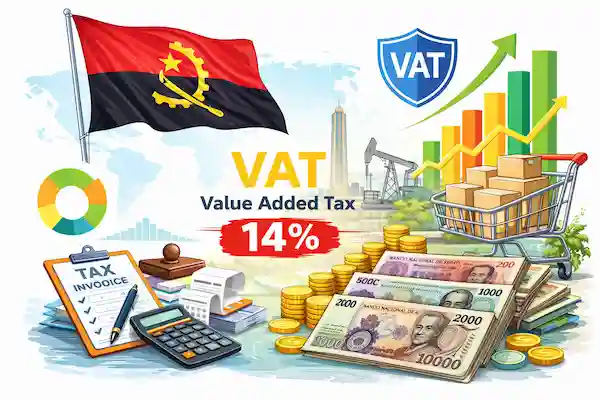
Angola's republished VAT Code sets a 14% general rate, monthly electronic returns and turnover-based regimes. AGT's April 2026 notice also confirms that businesses should preserve accounting records capable of producing the SAF-T accounting file for the 2026 year.
Check the IVA calculation first
Add or extract Angola VAT in kwanzas and keep the lower-rate options behind an explicit legal-treatment check.
Open the Angola VAT Calculator →This guide uses Angola's VAT Code, approved by Lei 7/19 and amended and republished by Lei 14/23 of December 28, 2023, together with current Administração Geral Tributária IVA guidance. Invoice and SAF-T points use Decreto Presidencial 71/25 and AGT's 2026 notices. The sources were checked on August 21, 2026.
Article numbers below refer to the republished VAT Code unless another instrument is named. This is a planning guide, not a filing service or a classification decision. A lower rate, exemption, deduction or regime change needs the exact transaction and taxpayer evidence required by the law.
Angola IVA snapshot for 2026
| Control | Current position | Primary reference |
|---|---|---|
| General IVA rate | 14% | VAT Code, Article 19 |
| Exclusion regime | Turnover or imports below AOA 25 million | Article 60 |
| Simplified regime | AOA 25 million to below AOA 350 million | Article 69-A |
| General regime | AOA 350 million or more, plus specified manufacturing and voluntary routes | Article 62 |
| General return | Monthly electronic periodic return and annexes | Articles 32 and 44 |
| Normal deadline | Last business day of the following month | Articles 30 and 44 |
| General-regime form | Modelo 7 | AGT forms and quick guides |
| 2026 accounting SAF-T | Records should support the file due in 2027 | DP 71/25, Article 24, and AGT notice |
The turnover test is an entry point, not the whole regime decision. Manufacturing status, an approved voluntary option, a change notified by AGT, the start-of-activity forecast and connected-entity facts can affect the result. Record the evidence used for the regime before applying a rate or choosing a return.
Choose the right IVA regime before calculating
Regime de exclusão
Article 60 places taxpayers with annual turnover or import operations below AOA 25 million in the exclusion regime. These taxpayers do not charge IVA under the ordinary system, but they can bear IVA charged by suppliers. Article 64 requires invoices issued under this regime to state "IVA - Regime de Exclusão".
The exclusion regime is not a no-records category. Taxpayers must retain purchase documents and evidence of turnover. They must also submit a monthly supplier map electronically whenever they acquire goods or services from general-regime taxpayers. If the turnover threshold is crossed, AGT can change the regime and notify the taxpayer, with effect from the following month.
Regime simplificado
Article 69-A covers taxpayers with prior-year turnover or imports of at least AOA 25 million and below AOA 350 million. The start-of-activity test uses the forecast for the current year, annualized where activity begins during the year. Article 69-B requires a monthly simplified declaration and annexes for the previous month's operations, and simplified-regime invoices must carry the required regime wording.
The simplified regime is not the same calculation as general IVA. Article 69-C applies the 7% rate to turnover effectively received from covered operations and provides a limited input-tax deduction mechanism. Do not use the ordinary output-minus-input method until the regime and its exact rules have been confirmed.
Regime geral
Article 62 puts prior-year turnover or imports of at least AOA 350 million in the general regime. It also covers manufacturing taxpayers whose turnover or imports exceeded AOA 25 million in the preceding 12 months, and taxpayers approved for voluntary entry. General-regime taxpayers must have organized accounting, an up-to-date AGT registration, a validated invoicing system and the means to transmit declarations, invoices and accounting data electronically.
A voluntary move from the simplified or exclusion regime takes effect from the first day of the month after AGT approval. Article 61 also imposes a minimum period in the general regime. A submitted request is therefore not proof that general-regime charging has already started.
Angola IVA rates and factual calculations
Article 19 sets the 14% general rate for imports, supplies of goods and services. It also contains several conditional treatments: 7% for the simplified regime, 7% for qualifying hotel and restaurant services, 5% for listed broad-consumption foods and agricultural inputs, and 1% for eligible Cabinda imports and supplies except goods assigned to the general rate.
Those lower rates are not product-name shortcuts. The hospitality rate requires the cumulative conditions in Article 19. The 5% treatment depends on the exact goods in the statutory annexes. The Cabinda rate depends on place, transaction and excluded-goods rules. Keep an invoice at 14% unless the lower treatment is supported by the current provision and retained evidence.
For a price that already includes 14% IVA, divide the gross amount by 1.14 to recover the tax-exclusive base, or multiply the gross amount by 14/114 to isolate IVA.
These examples prove only the arithmetic. They do not establish that a supply is taxable, choose a regime, identify the tax point or decide whether the customer will retain imposto cativo.
Input IVA and imposto cativo need separate controls
In the general regime, Article 22 allows qualifying input IVA to be deducted from output IVA. Article 23 ties that deduction to specific documents held in the taxpayer's name and carrying its tax identification number. Domestic input IVA generally needs an invoice issued by a general-regime taxpayer under the invoicing rules. Import IVA needs the payment receipt, and other categories have their own evidence.
Article 23 normally places the deduction in the reporting period or the following period. It allows a later claim within 12 months of the invoice or import receipt when the return is submitted within that period. Article 24 excludes or limits specified expenditure. A cost being real, paid and recorded does not by itself prove that its IVA is deductible.
Build the purchase ledger around supplier regime, NIF, invoice number, date, taxable base, rate, IVA, business purpose, receipt status and any exclusion review. Match imports to customs evidence. Keep blocked or incomplete documents outside the deductible total until the legal condition is resolved.
Imposto cativo is not a lower VAT rate
Article 21 requires specified customers to retain all or part of the IVA shown on eligible supplier invoices. It specifically requires the Banco Nacional de Angola, commercial banks, insurers, reinsurers and qualifying telecommunications operators to retain 50% in covered cases. Other public and sector rules can apply.
The supplier still records the invoice under the correct IVA rate. The retained amount is then reconciled separately using the customer's evidence and the periodic return. Treating a 50% retention as a 7% tax rate corrupts the invoice, sales ledger and return at the same time.
Monthly return, Modelo 7 and payment deadline
Article 32 requires general-regime taxpayers to submit a periodic return and annexes every month for the previous month's operations. The obligation continues even when there were no taxable operations. Article 44 sets the normal electronic filing deadline at the last business day of the following month. The system generates a Nota de Liquidação when tax is payable.
Article 30 uses the same normal timing for payment of IVA due. The AGT forms page lists Modelo 7 for the general-regime periodic return, while the IVA quick-guide page provides filing guides for Modelo 7, the simplified declaration, supplier annexes, adjustments and refunds.
Use the statutory date as the recurring control. AGT can issue a specific extension for a named reporting period. For example, an official 2026 notice moved obligations due on April 15 to April 30 after severe weather affected access. That notice did not replace the normal rule for every later month. Preserve the exact notice when relying on an extension.
What belongs in the filing file
- The submitted return, all required annexes and AGT acceptance evidence.
- The Nota de Liquidação and payment receipt when tax is due.
- Sales and purchase reconciliations tied to invoice sequences and the ledger.
- Import documents, input-tax support and any exclusion decision.
- Imposto cativo certificates or customer evidence matched to the affected invoices.
- Credit notes, corrections and the approval trail for changes after close.
A saved draft or generated payment reference is not proof of a completed filing. Confirm the return status and archive the final receipt.
Invoice controls under Decreto Presidencial 71/25
Decreto Presidencial 71/25 governs the issue, correction, cancellation, retention and archiving of invoices and other fiscally relevant documents. Article 10 requires core supplier and customer identity, NIF, sequential numbering, date, detailed goods or services, quantities, unit and total prices, applicable rate and tax, or the legal reason for no tax. It also requires the validated invoicing software identification and related control information.
Where goods or services carry different rates, Article 10 requires separate descriptions. This supports the VAT return and prevents a mixed invoice from being pushed through one rate. Invoice series should be reviewed for gaps, duplicates, cancellations and credit-note links before the monthly return is prepared.
Article 25 requires simplified and general-regime taxpayers to communicate invoices, receipts and other covered documents electronically in SAF-T format. Article 26 requires the relevant documents and system records to be archived for the legal retention period, with digital backups available for immediate consultation. Use validated software and preserve readable backups rather than relying only on exported PDFs.
The AfroTools Invoice Generator can structure a commercial draft, but it does not certify software, transmit SAF-T, validate a tax treatment or replace an AGT-compliant fiscal invoice.
What the 2026 SAF-T notice means
Article 24 of Decreto Presidencial 71/25 requires electronic communication of establishment details, software, invoice series, the prior December 31 inventory file by February 15, and the prior-year accounting SAF-T file by April 10. The technical data structure refers back to the prescribed SAF-T specification.
AGT issued an important transition notice in April 2026. Because the invoicing regime entered during 2025, AGT said submission of the accounting SAF-T file for the 2025 year was optional and would not be penalized for non-submission or late submission. AGT then told taxpayers to keep records capable of extracting the accounting SAF-T file for the 2026 year, to be submitted in 2027.
This is a record-readiness requirement now, not a task to postpone until April 2027. Check whether the accounting system can export the required header, master tables and accounting movements. Reconcile customer, supplier, item, tax-code and account identifiers each month. A year-end conversion cannot reliably repair missing invoice links or inconsistent master data after the fact.
The transition notice addresses the accounting file. It should not be read as a blanket waiver for invoice communication, inventory files, monthly IVA returns or other obligations. Apply each AGT notice only to the file and reporting period it names.
A practical Angola IVA month-end workflow
- Confirm the taxpayer's AGT regime and any effective-date notice before using a rate or return.
- Close the invoice sequence and investigate gaps, duplicates, cancellations and credit notes.
- Separate general-rate operations from each lower-rate, exempt or out-of-scope category using retained legal evidence.
- Reconcile sales, receipts, output IVA and SAF-T invoice data to the general ledger.
- Validate supplier regime, NIF, invoice fields, business purpose and Article 24 exclusions before claiming input IVA.
- Match import IVA to customs payment evidence and keep incomplete records outside the deduction.
- Reconcile imposto cativo by customer, invoice and retention evidence without changing the invoice rate.
- Prepare Modelo 7 or the correct simplified declaration with every required annex.
- Submit and pay by the normal deadline unless a specific AGT notice grants an extension for that period.
- Archive the accepted return, Nota de Liquidação, payment receipt, reconciliations and SAF-T exports together.
Assign a named owner and reviewer to the filing pack. Resolve data errors while the underlying invoices and bank records are still available. This makes the same monthly controls support both the current return and the 2026 accounting SAF-T file due in 2027.
Official sources and confidence boundary
- AGT Portal do Contribuinte: Imposto sobre o Valor Acrescentado.
- AGT legislation index, including the 2026 state budget law and IVA declaration instruments.
- AGT IVA quick guides for Modelo 7, simplified declarations, supplier annexes and adjustments.
- AGT forms page, including Modelo 6 and Modelo 7.
- AGT April 2026 accounting SAF-T notice.
- Ministry of Finance legislative review for Decreto Presidencial 71/25.
- Lei 14/23 consolidated VAT Code text, identified as Diário da República I Series No. 246 of December 28, 2023.
The AGT portal and Ministry of Finance materials are the primary operational sources. The consolidated legal text supplies the article-level regime, rate and filing provisions and identifies the underlying Diário da República publication. All were reviewed on August 21, 2026. Any later Finance Law, AGT circular or taxpayer-specific notice can change the application, so verify before filing.
This article is general information and a planning checklist. It is not a tax return, legal opinion, invoice certification, AGT approval or guarantee that a deduction or lower rate applies.
Frequently asked questions
What is Angola's general VAT rate in 2026?
Article 19 sets the general IVA rate at 14%. The 7%, 5% and eligible Cabinda 1% treatments have separate statutory conditions and should not be selected from a product name alone.
When is Angola's monthly VAT return due?
Article 44 requires the periodic return and annexes by electronic transmission by the last business day of the month following the reporting month. A specific AGT extension applies only to the period named in that notice.
Which IVA regime applies?
The basic turnover bands are below AOA 25 million for exclusion, AOA 25 million to below AOA 350 million for simplified, and AOA 350 million or more for general. Manufacturing, voluntary entry, start-of-activity and AGT-notification rules can change the result.
Must a general-regime taxpayer file a nil return?
Article 32 says the monthly periodic-return obligation continues even when the period had no taxable operations.
What changed for the 2026 accounting SAF-T file?
AGT made the 2025 accounting file optional without penalties because of the transition to DP 71/25, then directed taxpayers to maintain records capable of producing the 2026 accounting file for submission in 2027.