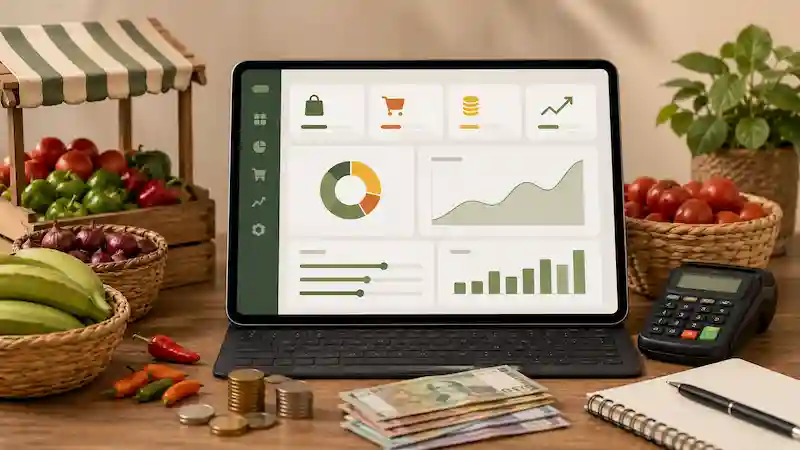
Track your daily sales, costs, and expenses. Know exactly how much profit your market stall is making.
Running a market stall is one of the most common forms of entrepreneurship across Africa. From the sprawling markets of Onitsha and Makola to the bustling stalls of Kariakoo and Marabastad, millions of traders buy and sell goods daily. Knowing your exact profit margin is the difference between a thriving business and one that slowly bleeds money.
Many market traders operate on intuition — buying stock, selling throughout the day, and counting whatever cash remains. But without tracking each item's cost and selling price, it's impossible to know which products are actually profitable. Transport costs, stall rent, mobile money fees, and spoilage can silently eat into your margins. This calculator helps you see the full picture clearly.
This tool understands the African market context. It accounts for common expenses like transport to the market, daily stall rent, loading boys' fees, and market association dues. Whether you sell provisions in Mile 12, fabrics in Kejetia Market, vegetables in Wakulima, or cosmetics in Yaba, the calculator adapts to your specific trade. Quick presets let you start with typical items for your business type, then customize from there.
Your daily profit tells one story, but the monthly projection reveals the bigger picture. Based on an average of 26 market days per month (accounting for rest days and holidays), the calculator projects your monthly revenue, costs, and net profit. This projection helps you plan for stock purchases, set savings targets, and evaluate whether your business is meeting your financial goals. Use the downloadable report to keep records and track your progress over time.
Most African markets operate 6 days a week, with some traders taking Sundays off. Some markets also have traditional rest days. 26 days accounts for approximately 4 rest days per month, which reflects reality for most traders.
Only enter items you actually sold today. Unsold stock is not a cost or loss for the day — it remains your inventory. For perishable goods that spoiled, you can add the cost price as an expense called "Spoilage/Waste."
You can still enter credit sales as items sold, since the revenue is expected. However, track credit separately in your records. If a customer defaults, add the amount as a "Bad Debt" expense on a future day.
This calculator is designed for single-day analysis. For ongoing tracking, we recommend downloading the report each day and keeping a weekly record. This helps you compare daily performance and identify your most profitable market days.
Healthy profit margins vary by trade. Food and provisions typically have 15-25% margins, clothing and fabrics 30-50%, electronics 20-35%, and vegetables 25-40%. If your margin is consistently below 15%, review your pricing or look for cheaper suppliers.
Yes! After calculating, click "Save Today's Record" to store the day's results in your browser. You can view your last 30 days of records, see average daily profit, and track trends over time. Records persist even after closing the browser.
If you receive payments via mobile money (M-Pesa, OPay, MTN MoMo), add the transaction charges as a daily expense. Typical fees are 0.5-1.5% per transaction. You can estimate the total daily mobile money fees and add a single "Mobile money charges" expense.
Enter separate line items for the same product at different prices. For example, if you sold tomatoes at two different prices in the morning and afternoon, add them as two items with different sell prices. This gives you accurate profit tracking.
Common expenses for African market traders include: loading/carrying fees (agbero fees in Lagos, porter fees), market association or cooperative dues, generator/electricity charges if you use power, mobile money transaction fees (automatically calculated when you select "Mobile Money" payment), spoilage or waste for perishable goods, packaging materials (bags, wrapping), and security/watch-man fees. Adding all expenses gives you a true picture of your real profit.
If you are in West Africa (Senegal, Côte d'Ivoire, Mali, Burkina Faso, Togo, Benin, Guinea-Bissau, Niger), select XOF (CFA Franc BCEAO). If you are in Central Africa (Cameroon, Chad, CAR, Republic of Congo, Gabon, Equatorial Guinea), select XAF (CFA Franc BEAC). Both currencies trade at the same rate to the Euro (1 EUR = 655.96 CFA) but are separate currencies.