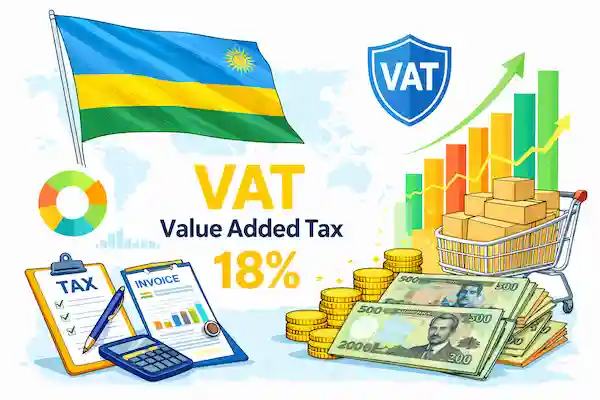
Rwanda VAT compliance is not just a rate question. The rate is simple: Rwanda Revenue Authority says the standard VAT rate is 18% for ordinary taxable goods and services supplied in Rwanda or imported. The working complexity sits around registration timing, filing frequency, Electronic Billing Machine invoices, purchase annexures, and the consumer VAT reward system that pushes buyers to request proper EBM invoices.
This guide uses current RRA pages and EBM manuals checked on June 18, 2026. The important current rules are: VAT registration is required when taxable business activity exceeds Rwf20 million in the previous fiscal year or Rwf5 million in the preceding quarter; registration is due within seven days from the end of that year or quarter; VAT registered businesses need EBM immediately; and VAT returns are filed monthly or quarterly depending on annual turnover.
Use this as an operating map, not as legal advice. If you only need arithmetic, open the Rwanda VAT calculator. If you are comparing Rwanda with other markets, use the VAT rates across Africa guide and the pan-African VAT calculator. If your issue is payroll rather than invoices, see the Rwanda payroll compliance guide.
Rwanda VAT In One View
| Topic | Current RRA position source-checked June 18, 2026 |
|---|---|
| Standard VAT rate | 18% for other goods and services supplied in Rwanda or imported |
| Zero-rated supplies | 0% for goods or services that are zero-rated under the current VAT law framework listed by RRA |
| VAT registration threshold | Turnover above Rwf20 million in the previous fiscal year or Rwf5 million in the preceding quarter |
| VAT registration timing | Within seven days from the end of the year or quarter that triggers registration |
| EBM requirement | A VAT registered business is legally obliged to acquire an Electronic Billing Machine immediately |
| Quarterly VAT filing | Annual turnover equal to or below FRW 200 million, filed within 15 days after quarter-end |
| Monthly VAT filing | Annual turnover above FRW 200 million, filed within 15 days after month-end |
| VAT reward | Eligible final consumers can receive 10% of VAT shown on eligible EBM invoices |
The headline lesson is that Rwanda VAT has two clocks. The first clock is turnover, which decides whether VAT registration is mandatory and whether filing is monthly or quarterly. The second clock is invoicing, because the sales record should pass through EBM at the transaction level instead of being reconstructed after the fact.
VAT Registration And TIN Workflow
RRA's current business registration page says a person who sets up a taxable business activity should register the business within seven days from the beginning of that activity. For normal company registration, Rwanda Development Board and RRA systems are integrated so a registered business receives a single Taxpayer Identification Number.
The same RRA page gives the VAT trigger. Every taxable business activity with turnover exceeding Rwf20 million in the previous fiscal year or Rwf5 million in the preceding quarter must register for VAT within seven days from the end of the year or quarter. That makes the quarter test important for growing businesses. A business can become registrable before the next full financial-year review if the latest quarter crosses the Rwf5 million line.
RRA also says businesses that do not meet the mandatory threshold may register voluntarily and acquire EBM. That can matter for suppliers that sell to formal buyers, need cleaner invoice trails, or want their tax position to be easier to verify. Voluntary registration still brings filing and invoice obligations, so it should be a deliberate operating decision, not a badge added for appearance.
The operational control is straightforward: track taxable turnover every month, review the quarter-end number, and document whether the previous fiscal year or current quarter has crossed the threshold. If it has, VAT registration is no longer a planning item. It is an active compliance task.
Rates, Filing Frequency And Payment Timing
RRA's VAT declaration page gives the current rate structure. The standard rate is 18%. Zero-rated supplies are charged at 0% where the VAT law provides for that treatment. RRA's About VAT page now lists Law No. 009/2025 amending Law No. 049/2023, so teams should use the current amended VAT framework rather than an old downloaded copy of the 2023 law alone. Exempt items sit outside ordinary charging and input recovery in a different way, so they should not be treated as the same thing as zero-rated supplies.
Filing frequency depends on turnover. RRA says a taxpayer whose annual turnover is equal to or below FRW 200 million declares VAT quarterly within 15 days following the end of each quarter. A taxpayer whose annual turnover is above FRW 200 million declares VAT monthly within 15 days following the end of the month. RRA also says a taxpayer at or below FRW 200 million can opt into monthly VAT declaration.
Payment starts after declaration. RRA's payment page says the VAT to be declared should be paid within 15 days following the month or quarter to be declared. The taxpayer first submits the declaration and receives the RRA reference number, also called the Doc ID, then pays through e-payment, mobile money, or a registered commercial bank.
| Annual turnover band | Default filing frequency | Deadline | Control to keep |
|---|---|---|---|
| FRW 200 million or below | Quarterly | Within 15 days after quarter-end | Quarter-end sales, purchase annexures and EBM sync status |
| Above FRW 200 million | Monthly | Within 15 days after month-end | Monthly close file, invoice reconciliation and Doc ID payment proof |
| FRW 200 million or below, monthly option chosen | Monthly | Within 15 days after month-end | Written internal choice and consistent month-end calendar |
The 15-day deadline is short. A business that waits until the end of the filing window to clean invoices, map customers, and resolve unmatched purchase invoices is creating avoidable pressure. The better habit is to close invoice exceptions weekly.
EBM Invoices And Sales Controls
RRA's EBM service page describes EBM as a system that records transactions accurately, helps businesses comply with tax regulations, and improves operational efficiency. RRA's business registration page is more direct for VAT registered businesses: after VAT registration, a business is legally obliged to acquire an Electronic Billing Machine with immediate effect because issuing any other invoice attracts penalties.
RRA's EBM 2.1 mobile guide says a person carrying out any taxable activity must issue an invoice generated by an electronic invoicing system certified by RRA. The guide explains that the EBM mobile app is part of RRA's EBM for all program. The computer and tablet manual adds useful context: EBM started with VAT registered taxpayers and was extended to non-VAT registered taxpayers from October 2020.
That history matters because EBM is now broader than a narrow VAT device. RRA's computer and tablet manual says the EBM software can be used by large, medium and small taxpayers, both VAT and non-VAT registered taxpayers, and other taxpayers who may apply for it. It also shows why the system is operationally useful: the software has modules for user management, item management, customer management, sales management, purchase management, imports and stock.
For a finance team, the minimum EBM controls are practical:
- Confirm every selling location or sales channel has an approved EBM or electronic invoicing setup.
- Keep company details, branch details and receipt information current.
- Set item codes and unit prices consistently so VAT and stock records do not drift.
- Reconcile daily EBM sales to bank, mobile money and cash records.
- Review unmatched purchase invoices before the VAT return is prepared.
RRA's VAT declaration page also says taxpayers preparing VAT declarations should record all transactions into annexures and connect EBM to the internet with access to its back office and E-Tax so information can synchronize. If an invoice is not recognized when uploading the purchase annexure, RRA says that invoice is recorded and saved in the system and can be used in the next tax period while the issue is resolved. That is a useful fallback, not a reason to leave invoice checks until deadline week.
VAT Reward And Buyer Behavior
Rwanda's VAT reward system changes buyer behavior. RRA's VAT information page says a VAT reward scheme has been adopted to encourage consumers to request EBM invoices. It says consumers can register by dialing *800# or through MyRRA.
RRA's 2025 VAT reward update gives the mechanics. It says a final consumer purchasing goods or services for personal use can receive a reward equal to 10% of the VAT amount indicated on the issued invoice, with the reward deposited quarterly after eligibility checks. The same update says nearly 70,000 consumers had enrolled, submitting more than 2.5 million invoices, with the total taxable amount from those invoices surpassing Frw143.3 billion and VAT of Frw21.8 billion.
For sellers, this means invoice discipline is not only an internal finance issue. Customers have a direct incentive to ask for EBM invoices and to report sellers who refuse to issue them. RRA says a buyer reporting a seller who refuses to issue an EBM invoice must provide details such as the trader name, TIN, address, purchase date, proof of payment, invoice evidence if any, quantity and value.
Penalty Risks And Stale Claims
RRA's VAT penalties page gives three high-risk penalty examples. A person carrying out business activities without VAT registration when registration was required is liable to an administrative fine of 50% of the VAT due for the entire period of operation. A person issuing an incorrect VAT invoice with intent to reduce VAT payable or increase input credit is liable to a fine of 100% of the VAT payable. A non-VAT registered person who issues a VAT invoice is liable to a fine of 100% of the VAT imposed and must pay the tax indicated on that invoice.
The same RRA page says noncompliance penalties depend on faults such as late filing, misuse of EBM and understatement of price. So the danger is not limited to a missed return. The invoice system, declared value, VAT status and filing calendar all need to tell the same story.
Three stale Rwanda VAT claims should be removed from internal checklists:
- Stale claim one: EBM is only for VAT registered taxpayers. RRA's EBM manuals show EBM usage has been extended to non-VAT registered taxpayers, although VAT registered businesses still have an immediate legal obligation to acquire EBM.
- Stale claim two: VAT filing is always monthly. RRA says taxpayers at or below FRW 200 million annual turnover file quarterly by default, unless they choose monthly filing.
- Stale claim three: A handwritten or ordinary software invoice is enough after VAT registration. RRA says issuing any invoice other than EBM attracts penalties for a VAT registered business.
- Stale claim four: The 2023 VAT law alone is the whole source set. RRA now lists the 2025 amendment alongside Law No. 049/2023, so current reviews should check both.
Practical Operating Workflow
A small Rwanda business can turn the rules into a simple monthly or quarterly workflow.
- Track turnover weekly. Watch the Rwf5 million quarterly and Rwf20 million annual VAT registration triggers.
- Confirm VAT status before invoicing language changes. Do not issue a VAT invoice unless the business is VAT registered.
- Set up EBM immediately after VAT registration. Use the approved EBM channel that fits the business, whether mobile, computer, tablet, POS or integrated software.
- Keep EBM online and reconciled. RRA expects EBM and E-Tax information to synchronize for declaration work.
- Prepare annexures before the deadline window. Match sales, purchases, imports and customer records while the transaction evidence is still fresh.
- Pay from the Doc ID. After declaration, use the generated RRA reference number for e-payment, mobile money or bank payment.
- Keep proof files. Store declaration acknowledgements, payment confirmations, exception notes, EBM user changes and rejected invoice follow-up.
That workflow is not complicated, but it requires rhythm. Rwanda's VAT system is designed around current digital records, not a late spreadsheet rescue. The earlier a business treats EBM as part of sales operations, the less painful the VAT return becomes.
Need to check a Rwanda VAT amount?
Use the Rwanda VAT calculator to add or remove the current 18% VAT rate, then return to this guide for registration, EBM and filing controls.
Open Rwanda VAT Calculator →Sources Checked on June 18, 2026
The facts in this guide were checked against current Rwanda Revenue Authority sources:
- RRA, Register your business
- RRA, Declare VAT, rates, filing frequency and penalties
- RRA, About VAT and VAT Reward
- RRA, EBM Services
- RRA, EBM 2.1 Mobile Application User Guide
- RRA, EBM 2.1 computer and tablet manual
- RRA, VAT reward disbursement update
If RRA updates VAT thresholds, EBM requirements, filing frequency or the VAT reward rules after June 18, 2026, the later RRA position should override this article.
Frequently Asked Questions
RRA's current VAT declaration page says the standard rate is 18% for other goods and services supplied in Rwanda or imported, with 0% applying to zero-rated supplies provided for by law.
RRA says every taxable business activity with turnover above Rwf20 million in the previous fiscal year or Rwf5 million in the preceding quarter must register for VAT within seven days from the end of the year or quarter.
Yes. RRA says a business registered for VAT is legally obliged to acquire an Electronic Billing Machine immediately, and VAT registered taxpayers should provide EIS invoices for all sales transactions.
RRA says taxpayers with annual turnover equal to or below FRW 200 million file quarterly within 15 days after the quarter, while taxpayers above FRW 200 million file monthly within 15 days after the month.
RRA says final consumers who register for the VAT reward scheme can receive 10% of the VAT amount shown on eligible EBM invoices, with rewards deposited quarterly after verification.