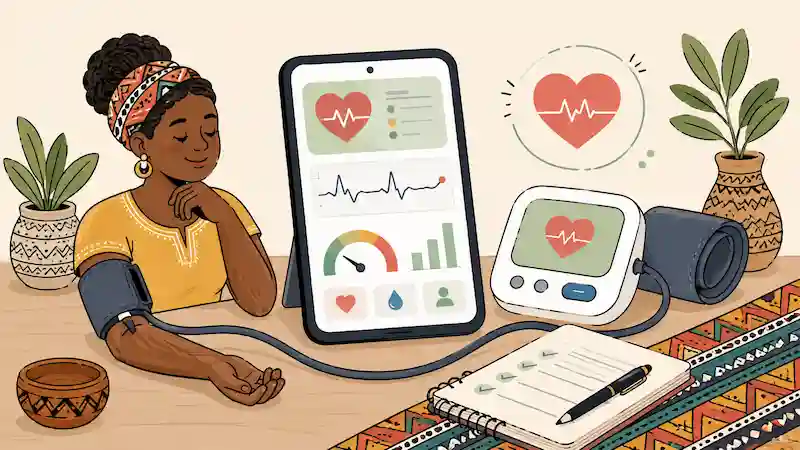
A useful blood pressure record is more than a column of numbers. It should show when each reading was taken, whether the measurement setup was sound, what device and cuff were used, and whether symptoms or a pregnancy-related context change the next step. That evidence helps a clinician separate a repeatable pattern from a reading affected by talking, movement, an unsupported arm or the wrong cuff.
The need is substantial. In its World Hypertension Day message published on May 16, 2026, the World Health Organization Regional Office for Africa said up to 44% of adults aged 30 to 79 in the region are affected, while fewer than half are diagnosed in most countries and fewer than one in five have the condition under control. The message calls for routine measurement, but it also says sustained control depends on primary care, follow-up and long-term support.
This guide was verified on August 16, 2026 against current WHO, African government and clinical-guideline sources. It explains measurement and record preparation, not diagnosis or treatment. Use the AfroTools Blood Pressure Measurement Check to review two adult readings privately and export a starting context card. Add the clinic-record details that the tool does not collect before giving it to a qualified local health professional. Do not change, stop or start medicine because of this article or the tool.
What A Blood Pressure Record Can And Cannot Prove
Blood pressure is written as two numbers in millimetres of mercury, or mmHg. The systolic number is shown first and represents pressure when the heart contracts. The diastolic number is shown second and represents pressure between beats. The device display is a measurement at that moment, not a complete assessment of cardiovascular risk.
WHO's hypertension fact sheet, updated September 25, 2025, states that hypertension is diagnosed when systolic readings of at least 140 mmHg or diastolic readings of at least 90 mmHg are found on two different days. It also says people can measure their own pressure with automated devices, but evaluation by a health professional remains important for risk and associated conditions. A pair of home readings can support that evaluation. It cannot replace the different-day confirmation or clinical assessment described by WHO.
| A good record can show | It cannot establish by itself |
|---|---|
| The exact readings displayed, their dates and local times | A confirmed hypertension diagnosis |
| Whether rest, posture, cuff position and silence were followed | Why a reading was high or low |
| Whether both readings came from the same arm, device and session | Whether a medicine should be started, stopped or changed |
| Symptoms and pregnancy or recent-postpartum context reported by the person | Whether urgent symptoms are harmless |
| A pattern that a clinician can review alongside other evidence | A guarantee that the device is accurate or the condition is controlled |
Choose The Device And Cuff Before You Measure
WHO's 2020 technical specifications focus on automated, non-invasive blood pressure devices with cuffs. The publication highlights the importance of validated devices, especially in lower-resource settings where an inaccurate monitor can obstruct proper care. Start with an automated upper-arm device that has been validated for its intended users. Check the model against a recognised validation listing or ask a clinician, pharmacist or medical-device service for the current local route.
Read the manufacturer's instructions instead of assuming every monitor works the same way. Confirm that the cuff's stated arm-circumference range includes the person being measured. The WHO-supported measurement job aid says the cuff bladder should encircle 80% to 100% of the upper arm and its width should be at least 40% of the arm circumference. The printed cuff range and device manual remain the practical checks for a home user.
A monitor is not proven accurate simply because it powers on. Look for damage to the cuff, tubing, connector, display or power supply. If readings change unexpectedly, the device has been dropped, or the clinic's result differs repeatedly from the home record, ask whether the monitor can be compared with clinic equipment or serviced. Do not alter numbers afterward to make two devices agree.
A Repeatable Blood Pressure Measurement Checklist
The goal is to make each session comparable. WHO measurement material, the South African national hypertension guide and the existing AfroTools tool use the same core controls: preparation, supported posture, the correct cuff, a quiet measurement and an exact record.
- Choose a consistent time that matches the clinician's plan. If a health professional has asked for readings at particular times or in relation to medicine, follow that instruction and record the timing. Do not invent a new medicine schedule.
- Avoid short-term measurement disruptors where practical. The WHO job aid says to avoid exercise, tea or coffee, and tobacco for 30 minutes before a reading. Empty the bladder and allow the body to settle.
- Rest quietly for at least five minutes. Do not use the rest period to walk around, make a call or complete chores.
- Sit with the back supported. Keep both feet supported, legs uncrossed and the body relaxed. A bed edge or unsupported stool makes the position harder to reproduce.
- Use the arm identified for follow-up. If a clinician has identified a higher-reading arm, use it. Otherwise ask which arm to use. Keep the arm unchanged within the paired session, support it so the cuff is at heart level, and record it rather than relying on memory.
- Place the correct cuff on bare skin. Do not bunch a sleeve under the cuff or fasten it outside the marked size range. Follow the device's artery marker and placement instructions.
- Stay still and silent. Do not speak, text, watch an upsetting clip or answer questions while the monitor is running.
- Keep the exact result. Write both numbers and the pulse if the clinician asked for it. Do not round, discard the first result solely because it is higher, or copy yesterday's time.
- Take the paired reading correctly. The AfroTools tool accepts two readings taken at least one minute apart. Keep the posture, arm and cuff unchanged between them, and preserve both values.
If the setup was poor, record the problem and repeat only after restoring the correct conditions. Do not erase the first entry in a way that hides why another measurement was taken. A short note such as "talked during first reading" or "cuff was over sleeve" gives the clinician useful context without pretending the earlier number never existed.
What To Put In The Record
A plain paper sheet, clinic passport, local spreadsheet or private export can all work. The format matters less than completeness and consistency. Nigeria's Federal Ministry of Health and Social Welfare said in May 2026 that routine checks and primary-health-care follow-up are central to early detection and management. A record designed for follow-up should make the next review easier.
| Record field | Why it matters |
|---|---|
| Date and local time | Places the reading in sequence and prevents morning and evening entries from being mixed. |
| Reading 1 and reading 2 | Preserves the pair instead of selecting only the preferred number. |
| Arm used | Helps keep later sessions comparable. |
| Device model and cuff range | Lets the reviewer identify a validation or sizing question. |
| Rest, posture, bare-arm cuff and silence checks | Shows whether technique may have affected interpretation. |
| Pregnant, within six weeks after birth, or neither | Flags a context that uses separate clinical safety boundaries. |
| Symptoms present at the time | Prevents a number-only record from hiding urgent clinical context. |
| Clinician-requested timing notes | Connects the reading to an existing care plan without changing it. |
Keep the record factual. Avoid writing a diagnosis in the notes unless a qualified professional has made it. Do not label one ordinary activity as the cause of a reading without clinical evidence. If a value looks unusual, record what you directly observed and let the reviewer assess the pattern.
Health readings are sensitive information. Store the record where other people cannot casually access it. If you export a PDF or TXT file, review the content before sharing, confirm the destination, and remove unrelated identifiers that the recipient does not need. A clinic may require a patient name or number to match the file, but that decision belongs in the clinic's secure workflow rather than a public link or group chat.
Common Measurement And Record Errors
| Observed problem | Smallest safe correction |
|---|---|
| No five-minute rest | Sit quietly, restart the rest period, then label any new reading with its real time. |
| Feet unsupported or legs crossed | Use a chair and foot support that allow a stable repeated posture. |
| Arm hanging below heart level | Support it on a table or cushion at the correct height. |
| Cuff over thick clothing | Move it to bare skin without rolling a tight sleeve above the arm. |
| Cuff range does not include the arm | Stop relying on that setup and obtain a compatible cuff or clinical measurement. |
| Talking or phone use | Repeat after a quiet pause and note the first session's problem. |
| Only the lower result was saved | Keep both exact readings and let the clinician decide how to use the pair. |
| Dates or arms were mixed | Start a new clearly labelled entry rather than guessing missing details. |
When The Record Needs Clinical Follow-Up
A measurement record should support contact with care, not delay it. WHO says most people with hypertension have no symptoms, which is why reliable measurement matters. It also lists very high pressure, usually 180/120 mmHg or higher, with symptoms such as chest pain, difficulty breathing, confusion, severe headache or vision change as a reason to seek care immediately. Local emergency instructions and a person's existing clinical plan take priority over an online guide.
Symptoms can matter more than the arithmetic average. Seek local emergency help for chest pain, trouble breathing, new weakness or numbness, trouble speaking, seizure, fainting or another severe sudden symptom. Do not wait for a second reading or for an export to finish.
Pregnancy and the first six weeks after birth require a separate maternity safety pathway. The AfroTools tool applies pregnancy-specific prompts and lists severe or persistent headache, major vision change, pain below the ribs, vomiting, sudden swelling, seizure and other severe symptoms as urgent warning signs. Contact the maternity team or local emergency service according to the care plan. A general adult threshold must not be used to dismiss a pregnancy-related concern.
For non-emergency follow-up, take the record, monitor, cuff and medicine list if the clinic asks for them. Ask which arm, times, number of days and follow-up interval the clinician wants. The South African National Department of Health user guide is written for primary-care professionals and covers screening, detection, management, monitoring and referral. That reinforces the correct boundary: the home record is an input to care, not the entire care process.
Use The AfroTools Two-Reading Check Privately
The Blood Pressure Measurement Check gives the record a structured starting point:
- Select the adult, pregnant or recent-postpartum context.
- Enter two readings taken at least one minute apart.
- Confirm the rest, posture, cuff and quiet-measurement controls.
- Flag urgent symptoms instead of hiding them in a note.
- Review the arithmetic average and the non-diagnostic follow-up prompt.
- Download a TXT or PDF copy only when you choose to export.
The export is a starting context card, not the complete clinic record described above. Before clinical review, add the date and local time, arm used, device model and cuff range, any specific setup problem, and the actual symptom details. The tool records only the entered readings, selected context, overall setup confirmation and whether urgent symptoms were flagged.
The tool states that readings, context and symptom choices remain in the page's memory. They are not written to browser storage, placed in the URL, sent to an account, analytics service or API. The exports are created locally, but they contain health information after download, so the user still controls safe storage and sharing.
Prepare Two Readings For Review
Check measurement setup, keep both values and export a private starting card without turning the result into a diagnosis.
Open Blood Pressure Measurement Check →Common Questions
Can one home blood pressure reading diagnose hypertension?
No. WHO says qualifying readings on two different days are part of diagnosis, and a health professional assesses risk and related conditions. One home session is useful evidence, not a complete diagnosis.
What should a blood pressure record include?
Keep the date, local time, arm, device, cuff range, two exact readings, measurement setup, symptoms, pregnancy or postpartum context and any timing instruction already given by the clinician.
Why does cuff size matter?
The device and cuff are designed for a stated arm range. If the arm is outside that range, the result may be less reliable. Check the marking and instructions rather than tightening or loosening an incompatible cuff until it appears to fit.
Should I round a reading?
No. Record the exact display. Rounding or keeping only the lower value removes information from the clinical record.
Does the AfroTools tool save my health data?
No. The tool states that its inputs remain in page memory and are not saved or sent. A locally created export becomes a sensitive file, so review and protect it before sharing.
Primary And Technical Sources Checked August 16, 2026
- WHO Regional Office for Africa, World Hypertension Day 2026, published May 16, 2026: regional burden, routine measurement and primary-care follow-up.
- Nigeria Federal Ministry of Health and Social Welfare, hypertension policy and early-detection update, published May 23, 2026: regular checks, primary care and adherence to professional treatment.
- WHO hypertension fact sheet, updated September 25, 2025: definitions, different-day diagnosis, symptoms and professional evaluation.
- American Heart Association, home blood pressure monitoring, last reviewed August 14, 2025: device and cuff choice, preparation, phone avoidance, paired readings and adult emergency symptoms.
- NICE NG133, hypertension in pregnancy, last updated April 17, 2023: pregnancy-specific blood pressure assessment and clinical care boundaries.
- American College of Obstetricians and Gynecologists, seven things to know about preeclampsia, published and reviewed June 2026: warning symptoms and the risk of postpartum preeclampsia up to six weeks after birth.
- NHS, pre-eclampsia, last reviewed March 23, 2026: pregnancy and post-birth warning symptoms and urgent maternity contact.
- WHO technical specifications for automated non-invasive blood pressure devices with cuff, published April 20, 2020: validated automated devices, procurement and accuracy controls.
- WHO-supported hypertension measurement job aid: five-minute rest, supported position, silence, exact recording and cuff-size controls.
- South Africa National Department of Health hypertension user guide, 2021: primary-care screening, monitoring and referral scope.
Technical measurement principles are relatively stable, but device validation, local referral routes and a person's care plan can change. Recheck the device instructions and current local health guidance before relying on the workflow.