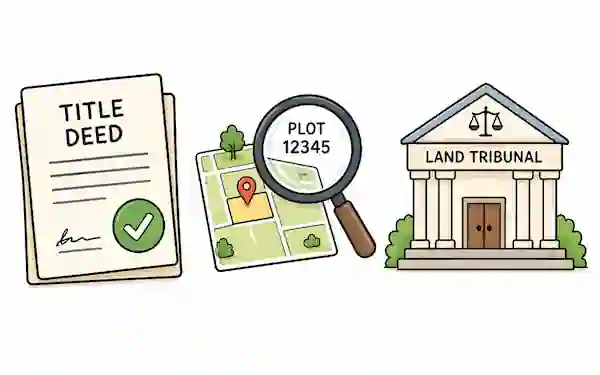
Property transactions fail most painfully when a missing document is discovered after a deposit has moved. A checklist cannot certify ownership, but it can make the evidence gaps visible before the buyer commits.
This guide answers the search for Nigeria land title verification checklist with a working sequence, not a thin list. Its purpose is to separate a persuasive sales pack from evidence that can actually be verified. Start with the Land Title Verification Checklist, then verify every important detail against current documents and the official sources below.
Official sources reviewed: August 2, 2026. This guide is practical planning information, not a title opinion or legal advice. Land systems and required consents vary by state, county, tenure and transaction type.
Quick answer: what to prepare
A complete first-pass file should cover these five control points. The last column is deliberately evidence-focused: a statement such as “the agent confirmed it” is not a durable record.
| # | Control point | Completion evidence |
|---|---|---|
| 1 | seller identity and authority to sell | Owner named, source checked, copy saved |
| 2 | root of title and chain of ownership | Owner named, source checked, copy saved |
| 3 | survey plan coordinates and site match | Owner named, source checked, copy saved |
| 4 | state land-registry or relevant authority search | Owner named, source checked, copy saved |
| 5 | acquisition, encumbrance, litigation and family-consent checks | Owner named, source checked, copy saved |
Assign a person to each missing item and a date for the next check. If an item does not apply, write why. Blank cells invite assumptions; an explicit “not applicable because…” can be reviewed.
Why this checklist matters
Treat every claim as a verification task. Match names across identity documents, the sale agreement, title records and payment instructions. Inspect the site, use qualified local professionals, and obtain searches from the relevant public authority instead of accepting screenshots supplied by the seller.
The most expensive mistakes rarely begin with difficult arithmetic. They begin with inconsistent names, an old document, a missing page, an unsupported fee, a verbal promise or a payment sent before the other side has completed a basic obligation. A disciplined file slows the decision down just enough to expose those gaps.
It also improves communication. Instead of asking “is everything ready?”, ask for one named document, source, amount, owner and deadline. That makes it possible to distinguish a genuine delay from a fact that nobody has checked.
Step-by-step workflow
- Define the exact task. Write the country, parties, date, transaction or pay period, and the outcome you need. Similar-looking processes can have different requirements.
- Open the primary source. Begin with the issuing authority, regulator, employer record or signed agreement. Search summaries are discovery aids, not the final instruction.
- Collect the five control points. For this guide they are seller identity and authority to sell, root of title and chain of ownership, survey plan coordinates and site match, state land-registry or relevant authority search, and acquisition, encumbrance, litigation and family-consent checks.
- Match names, dates and amounts. Resolve spelling differences, expired records, unexplained balances and changed payment details before moving forward.
- Calculate separately. Keep assumptions, rates, quantities and units visible. Do not type over the original invoice, payslip, quote or official record.
- Record questions and answers. Save written clarifications with the file. If advice is important, note who gave it, their role and the date.
- Run a final stop check. Ask what fact, if wrong, would make you delay payment, signature, submission or purchase. Verify that fact once more through a trusted channel.
Verification before signature or payment
Create a small evidence folder with one subfolder for identity, one for the property or agreement, one for official searches, and one for money. Name files with the date and document type. A clean folder makes contradictions easier to spot and gives a lawyer, agent, registrar or dispute-resolution body something coherent to review.
Never treat a watermark, stamp, QR code or photocopy as proof by itself. Verify through the issuing authority or an appropriately qualified professional. When a representative signs, obtain evidence of authority. When payment details change, confirm them through a previously trusted channel before sending money.
If a material search is pending, write that fact into the transaction timeline and avoid describing the deal as cleared. A useful checklist records both completed checks and unresolved questions.
Common mistakes to avoid
- Using an old screenshot as current truth. Reopen the source and note the date reviewed.
- Confusing a checklist with approval. A complete list does not certify authenticity, eligibility, title, tax or safety.
- Leaving currency, units or periods implicit. State whether an amount is monthly or annual and which currency or measurement applies.
- Accepting changed payment details without verification. Confirm through a contact method already known to be genuine.
- Editing the source record. Keep the original document and perform calculations or annotations on a copy.
- Skipping the close-out. Save the final receipt, issued document, signed agreement, corrected payslip or supplier reconciliation.
Use the AfroTools workflow
Open the Land Title Verification Checklist and enter only the information you can support. Treat any default as a prompt to collect a real figure, not as a recommendation. Export or copy the result, date it, and attach it to the source records. If the situation changes, create a new version instead of silently replacing the old one.
The result is most useful as a conversation document. It helps a family, customer, employee, landlord, buyer, adviser or installer discuss the same facts. It does not replace their confirmation or the relevant authority's decision.
Sources checked on August 2, 2026
These links were selected for primary or practical context. A link being listed does not mean AfroTools is affiliated with the publisher. Recheck the live page because forms, rates, fees, portal paths and service times can change.
Build your Nigeria working checklist
Organise the inputs, surface missing evidence and keep a dated result beside the original records.
Open Land Title Verification Checklist →Related AfroTools guides
Frequently asked questions
Start with the official or original records, then use the checklist to identify missing evidence. The practical goal is to separate a persuasive sales pack from evidence that can actually be verified.
No. AfroTools organises a planning calculation or checklist. The relevant authority, employer, professional, supplier or contracting party must confirm the official or final position.
The source links were reviewed on August 2, 2026. Requirements, prices, rates and portal steps can change, so check the official links again before acting.
Keep the application, agreement or invoice, identity and authority records, calculations, receipts, correspondence, confirmations and the final output. Use filenames with dates so the sequence remains clear.
Use the Land Title Verification Checklist to build a first-pass checklist or estimate, then replace defaults with your own documents and current official information.