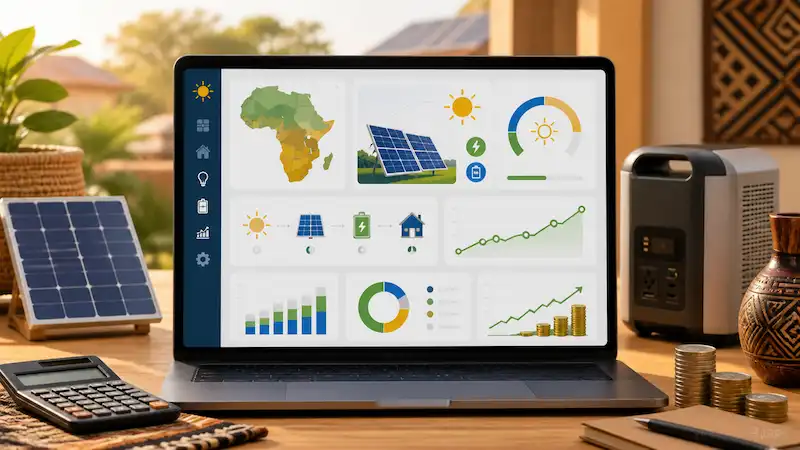
Solar payback in Kenya is not a single national number. It changes with your Kenya Power or distributor bill, monthly kWh use, tariff category, fuel cost adjustment, forex adjustment, outage pattern, roof conditions, battery size, installer quote and finance charges. A household that only wants daytime bill reduction is solving a different problem from a clinic, shop, school, church, cold room or home office that needs backup power when the grid is unavailable.
This guide was checked on July 6, 2026 against official energy and tariff sources from EPRA, the State Department for Energy and Kenya Power context sources, plus the AfroTools solar ROI dataset reviewed on March 1, 2026. It is written as a planning workflow, not an installer quote, official tariff notice, loan recommendation or engineering design.
If you already have a recent electricity bill and a written solar quote, start with the Kenya Solar ROI Calculator. If you are still deciding system size, use the Solar Sizing tool. If your main pain is petrol or diesel backup, compare the quote with Solar vs Generator and the Generator Fuel Calculator.
Kenya Solar ROI 2026 Decision Snapshot
| Decision point | What to use in July 2026 planning |
|---|---|
| Primary tariff authority | EPRA sets, reviews and approves retail electricity tariffs and publishes monthly pass-through cost context. |
| Bill source | Use your own Kenya Power or licensed distributor statement, prepaid receipt or account summary before using an average tariff. |
| Solar policy context | Kenya's net-metering framework exists, but export value still depends on connection approval, meter setup and applicable billing rules. |
| AfroTools planning defaults | The bundled Kenya solar ROI seed uses KES, a country solar yield default and editable tariff, fuel, install-cost and battery assumptions. |
| Best first calculation | Annual avoided grid cost plus avoided generator cost, less maintenance, compared with installed system cost and finance charges. |
| Biggest payback risk | Using a quote without separating panels, inverter, battery, mounting, protection, wiring, labour, warranty, VAT and finance fees. |
| Biggest reliability risk | Buying panels without enough battery, inverter surge capacity, load discipline or safe wiring for the appliances that must run during outages. |
The most useful solar ROI estimate starts with the bill you actually pay. Kenya's retail tariff environment has regulated base tariffs and monthly pass-through elements, while household or SME bills can also include fixed charges, levies and taxes. That means an average cents-per-kWh figure can be useful for early planning, but it is not enough for a purchase decision.
Kenya also has a relatively strong renewable-power grid compared with many African markets, so the decision is not only about replacing dirty or expensive grid power. For many users, the real value is reliability: keeping a fridge, router, laptop, lights, pump, clinic device, point-of-sale terminal or cold storage running without burning fuel every time power is unstable.
Inputs to Collect Before You Trust a Payback Result
Do not begin with the panel size an installer wants to sell. Begin with the load, the bill and the reason for the system. A good Kenya solar quote should be checked against these inputs:
- Three to twelve months of electricity bills or prepaid purchase history.
- Monthly kWh, not only monthly shilling spend.
- Meter type, customer category and supplier shown on the bill.
- Any generator fuel receipts, service costs and average outage hours.
- Essential appliances that must work during an outage.
- Daytime loads that can be shifted to solar hours.
- Usable roof or site area, shade, roof direction and wiring distance.
- Written quote broken into panels, inverter, batteries, mounting, protection devices, labour and warranty.
- Finance terms, deposit, monthly repayment, interest, penalties and ownership date if PayGo or credit is used.
The formula is straightforward, but the inputs are not. Use this structure:
Solar payback period = installed system cost divided by yearly avoided energy cost.
Yearly avoided energy cost = grid kWh replaced by solar multiplied by your current effective tariff, plus generator fuel and maintenance avoided, less solar maintenance, battery replacement provision and finance charges.
This is a formula walkthrough, not a fictional example. Replace every number with your bill, receipt and quote. If the solar system is grid-tied without batteries, the generator line may be zero. If the system is a backup-heavy hybrid, the battery and generator lines become central to the payback result.
Tariffs, Pass-Through Costs and Bill Checks
EPRA's electricity tariff overview describes the regulator's role in setting and reviewing retail electricity tariffs and publishing monthly pass-through costs. EPRA's official reporting also tracks domestic and commercial tariff trends, including the period from July 2023 to December 2025 in its 2025/26 biannual statistics report. Use those regulator sources for context, then use your own current bill for the actual ROI run.
For a Kenyan household, the key mistake is using a single downloaded tariff table and ignoring the bill line items. A proper check separates:
| Bill line | Why it matters for solar ROI |
|---|---|
| Energy use in kWh | This is the amount solar can reduce. Without kWh, shilling spend alone can mislead. |
| Customer category | Domestic, small commercial and larger commercial users can face different pricing structures. |
| Fuel cost charge | This pass-through component can move, which changes the effective value of each kWh saved. |
| Forex adjustment | Currency-linked adjustments can affect the final bill even when base tariff structure is unchanged. |
| Taxes and levies | They affect what you actually pay and should be reflected in a realistic avoided-cost estimate. |
| Fixed charges | Solar may reduce energy units but may not remove fixed monthly account charges. |
The AfroTools Kenya solar ROI page includes editable planning assumptions so you can overwrite defaults with the current bill. The March 1, 2026 dataset labels the Kenya values as planning defaults, not live official feeds. That is intentional. A calculator should make the assumptions visible so you can replace them before making a payment.
For SMEs, bill structure matters even more. A barber shop, cyber cafe, cold room, restaurant, small clinic or school may have daytime loads that make solar self-consumption useful. But if the bill includes demand or capacity charges, a simple "kWh times price" model can overpromise savings. Ask the installer to show which bill lines the solar system will reduce and which lines will remain.
Net Metering and Export Credits
Kenya's current policy environment is more supportive than it used to be, but net metering should still be handled carefully in ROI planning. The State Department for Energy's National Energy Policy 2025 to 2034 draft says the Energy (Net Metering) Regulations, 2024 allow prosumers to connect to the grid and net off excess energy through the distribution system. EPRA's FY 2023/24 reporting also described the June 2024 gazetting of the net-metering regulations as a way for renewable generators to receive credits for excess energy supplied to the grid.
That does not mean every rooftop system should assume export income. Before including export credits in a Kenya solar ROI estimate, verify:
- Whether your customer category and system size are eligible.
- Whether your utility or distributor has approved the interconnection.
- What meter, protection and anti-islanding requirements apply.
- How exported energy is credited and whether credits expire or roll over.
- Whether the installer has included application, inspection and compliance costs.
For many households and small businesses, the safer early model is self-consumption first. That means valuing solar energy when it directly replaces grid units during the day. Export credits can be added as an upside only after the rules and connection path are confirmed for your site.
Battery, Generator and Reliability Choices
A battery changes the purpose of the system. Panels reduce daytime grid units. Batteries store energy for night loads or outages. The battery can be the difference between a useful backup system and a system that only works when the sun is out, but it also raises the quote and can lengthen payback.
Use this split when comparing quotes:
| System type | Best fit | Main caution |
|---|---|---|
| Grid-tied solar without battery | Daytime bill reduction where the grid is usually available and export rules are clear. | It may shut down during outages unless designed and approved with backup capability. |
| Hybrid solar with modest battery | Homes and SMEs that need routers, lights, phones, laptops, fridges or payment devices running. | Essential loads must be separated from heavy loads such as cookers, irons, pumps and large air conditioning. |
| Large battery backup | Clinics, cold rooms, schools, offices and businesses where outage losses are material. | Payback depends on avoided losses and fuel, not only the electricity bill. |
| Solar plus generator | Sites with long outages or high surge loads that still need dispatchable backup. | Fuel use drops only if the system controls, charging settings and load discipline are managed. |
The battery line in a quote should not be vague. Ask for chemistry, rated kWh, usable kWh, cycle life, warranty, battery management system, installation location, ventilation, protection devices and replacement assumptions. A low-cost battery can make the quote look attractive while reducing usable backup or increasing replacement risk.
Generator users should calculate fuel honestly. If your generator runs several evenings a week, solar with battery can save fuel, reduce noise and protect appliances from voltage swings. If you rarely run a generator and only want to reduce a small grid bill, a large battery may be a comfort purchase rather than a fast-payback investment.
A Practical AfroTools Workflow
Use AfroTools in this order when planning a Kenyan solar purchase:
- Open the Electricity Bill Estimator and understand monthly kWh before talking about panels.
- Use Solar Sizing to list appliances, hours and peak loads.
- Use Kenya Solar ROI to enter current bill values, generator costs, system quote, battery cost, maintenance and finance terms.
- Use Solar vs Generator if backup fuel is a major part of the decision.
- Export or copy the planning brief and ask installers to respond to the same assumptions.
The goal is not to make one calculator decide for you. The goal is to force every quote into the same comparison table. If Installer A includes battery, labour and protection devices while Installer B excludes them, the cheaper quote may not be cheaper. If a finance provider lowers the deposit but adds fees, the payback period can change even when the hardware is identical.
For country-hub handoff, Kenyan readers can also use the Kenya tools hub to find salary, tax, business and household calculators that affect the wider monthly budget. Solar ROI should sit inside the household or SME cashflow plan, not outside it.
Sources Checked on July 6, 2026
This article uses official and primary sources for tariff, regulatory and policy context, plus clearly labeled AfroTools planning assumptions for calculator defaults. Always re-check the current bill, EPRA notices and installer quote before paying a deposit.
- EPRA electricity tariff overview
- EPRA electricity tariff regulatory instruments
- EPRA Biannual Energy and Petroleum Statistics Report 2025/26
- EPRA Energy and Petroleum Statistics Report FY 2023/24
- State Department for Energy National Energy Policy 2025 to 2034 draft
- Global Solar Atlas
- AfroTools Kenya Solar ROI Calculator and internal solar ROI assumptions reviewed March 1, 2026
Run a Kenya Solar Payback Check
Enter your Kenya bill, generator spend, battery cost, quote and finance assumptions before comparing installers.
Open Kenya Solar ROI Calculator →Frequently Asked Questions
Start with recent Kenya Power or distributor bills, monthly kWh, generator fuel receipts, outage hours, system quote, battery choice and finance terms. Solar payback is the installed system cost divided by yearly avoided grid, generator and reliability costs after maintenance.
No. EPRA regulates retail tariffs and pass-through charges, but your bill depends on customer category, monthly charges, levies, fuel cost charge, forex adjustment and actual kWh. Use your current bill before trusting a payback result.
Kenya's Energy (Net Metering) Regulations, 2024 created a framework for eligible renewable generators to receive bill credits for exported energy. Confirm current utility connection requirements, meter approval and credit treatment before assuming export revenue.
A battery is mainly a backup and night-load decision. It can improve reliability during outages, but it raises upfront cost and can lengthen payback if the household only wants daytime bill reduction.
Use the Kenya Solar ROI calculator when comparing payback, the Solar Sizing tool when estimating panels, battery and inverter size, and the Solar vs Generator tool when diesel or petrol backup is a major cost.