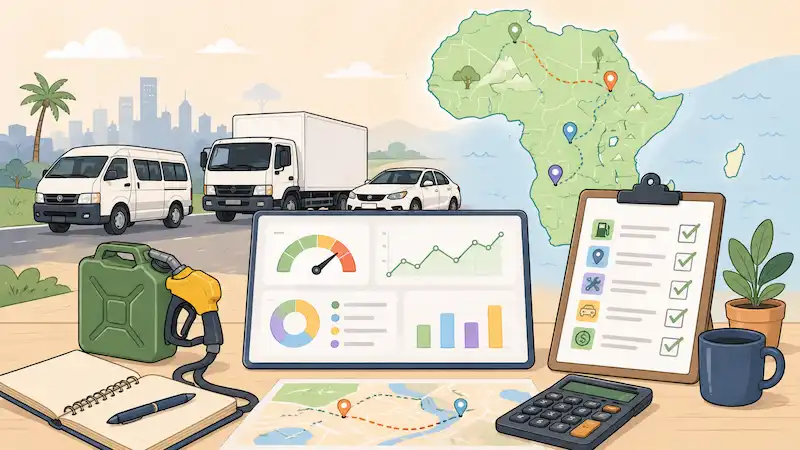
A Ghana fleet fuel budget should be built vehicle by vehicle from planned kilometres, measured consumption and a dated fuel-price assumption. One company average can hide an inefficient route, idling, fuel leakage, load difference or a vehicle that needs maintenance.
Logistics margins disappear when chargeable weight, waiting time, failed delivery, maintenance and paperwork are treated as someone else's problem. A useful estimate exposes those drivers before the shipment or route begins.
This guide targets fleet fuel budget Ghana with a decision-ready workflow. Use the Fleet Fuel Budget Calculator to organise the inputs, then replace every placeholder with your measurements, records and current written terms.
Sources reviewed: August 3, 2026. Carrier divisors, customs procedures, fuel prices and service times change. Confirm the current written rule or quote before committing a customer price or delivery promise.
Quick answer
For each vehicle, forecast kilometres by route or job, multiply by measured litres per kilometre, add separately justified idle or auxiliary fuel, and price the litres using the relevant current NPA window or actual supplier quote. Compare issued fuel and verified kilometres with the budget and investigate variance without assuming fraud from one abnormal trip.
The table below is the minimum evidence pack. A task is not complete merely because somebody says it has been handled. Save the document, measurement, quote, portal acknowledgement or transaction reference that supports the answer.
| # | Input or decision | Evidence to keep |
|---|---|---|
| 1 | Vehicle identity | Registration, class, fuel type and assigned use |
| 2 | Planned activity | Route, jobs, kilometres and load context |
| 3 | Measured efficiency | Litres and odometer from a controlled baseline |
| 4 | Fuel price | Dated NPA context or supplier record |
| 5 | Actual control | Fuel issue, receipts, kilometres and explained variance |
Why this calculation or checklist matters
Separate fixed costs from costs that vary with kilometres, stops, parcels, time or shipment size. Record the carrier rule or official process used, then compare the estimate with the final waybill, customs release or route log. The variance is operational data for the next quote.
Fuel prices change by pricing window and actual retail arrangement. Consumption also changes with load, congestion, road condition, tyre pressure, driver behaviour and maintenance. A budget needs both price and efficiency variance.
A good working file also makes disagreement cheaper. Instead of arguing about a total, the people involved can inspect the quantity, unit, date, source and assumption that produced it. That is the difference between a reusable estimate and a number copied into a message.
Step-by-step workflow
- Step 1. Create a separate row for every vehicle and forecast period.
- Step 2. Plan kilometres from routes, jobs or historical activity instead of applying one percentage increase.
- Step 3. Use measured litres per kilometre for the vehicle and operating context.
- Step 4. Add idle, refrigeration, generator or other auxiliary fuel separately.
- Step 5. Apply a dated fuel-price assumption and calculate budget litres and cost.
- Step 6. Reconcile actual litres, kilometres and work completed, then classify the variance.
Budget litres before budget currency
Calculate physical fuel demand first. This keeps efficiency visible when the market price changes. Budget litres equal planned kilometres multiplied by measured litres per kilometre, plus justified non-distance use.
Use a baseline from enough representative trips. One exceptionally clear or congested route should not become the permanent fleet standard.
- Planned kilometres
- Baseline litres per kilometre
- Idle or auxiliary litres
- Total budget litres
Apply a dated Ghana price assumption
Ghana fuel pricing information is published in windows and marketers may determine margins within the framework. Record the exact date and source used in the budget.
For longer forecasts, use base and high price cases rather than copying today's figure across a year. Replace forecast price with actual transaction records during reconciliation.
- Price window and source
- Fuel type
- Base and pressure price
- Actual purchase price
Investigate variance fairly
Variance can come from route change, load, idling, detour, maintenance, tyre condition, measurement error or misuse. Review work and vehicle evidence before assigning a cause.
Track litres per kilometre alongside absolute fuel cost. A vehicle can be on litre budget but over currency budget because price changed, or the reverse.
- Distance variance
- Efficiency variance
- Price variance
- Operational explanation and action
Build an evidence pack another person can audit
Close the job with an operations receipt: final dimensions or kilometres, actual route or clearance time, fuel or carrier charge, failed stops or queries, official references and customer delivery evidence. Compare the receipt with the estimate without rewriting the original. Classify each meaningful variance as volume, price, time, process, vehicle, customer or external control.
Use short filenames that begin with the date and describe the record. Keep the original source separate from calculations and annotations. Where a file contains identity, financial, health or commercial data, share the minimum necessary information and use the official or trusted channel. A checklist should reduce exposure, not create another uncontrolled copy of sensitive material.
Set the decision gate
Use repeated variance, not one difficult shipment, to change packaging, route design, service zones or pricing. Assign an owner and a measurable next action. Where the estimate depends on a carrier or authority rule, retain the dated rule and recheck it before the next booking instead of assuming the old divisor, fee, process or timeline still applies.
Write a clear stop condition before commitment. A stop condition might be a missing official search, an unverified payment account, an unresolved name mismatch, an unaffordable pressure case, an unapproved safety specification or a supplier quote that excludes essential scope. When it appears, pause and resolve the evidence rather than pushing the same uncertain assumption into the final output. Record who made the final decision, the date and the evidence they reviewed so a later update has an honest starting point.
Stress-test the result
Model a normal run, a delay or low-density run, and a consolidated run. Change one driver at a time, such as chargeable weight, clearance days, failed stops, kilometres or fuel price. This shows whether the best improvement is packaging, documentation, route density, scheduling or price.
Increase fuel price, kilometres and idle time while worsening efficiency for the highest-use vehicle. If the reserve disappears, consolidate trips, revise routes, schedule maintenance or adjust customer pricing based on evidence.
Write the decision beside the scenario. Examples include delaying a purchase, collecting a larger deposit, reducing scope, changing packaging, adding route density, choosing a different loan, or asking a qualified adviser to verify an exception. A scenario without a decision is only another spreadsheet column.
Common mistakes to avoid
- Budgeting only currency without physical litres.
- Using one efficiency figure for every vehicle and route.
- Copying one pump price across a long forecast.
- Ignoring idle or auxiliary fuel.
- Calling every adverse variance theft without operational review.
One final check catches many errors: ask whether a different person could reproduce the answer from the saved inputs. If not, label the missing assumption before using the result in a quote, purchase, application or public promise.
Use the AfroTools workflow
Open the Fleet Fuel Budget Calculator and enter the dated inputs from your evidence pack. Keep units and currencies consistent. Save or export the result where the tool supports it, then give the version a descriptive filename that includes the date and scenario.
Enter each vehicle, planned kilometres, measured consumption and dated price. Save base and pressure cases. The tool does not connect to fuel cards, GPS, NPA systems or vehicle diagnostics.
AfroTools does not submit the application, certify the document, approve the budget, select the supplier or guarantee the outcome. The output is a private planning aid that helps you ask better questions and keep a reviewable record.
Sources checked on August 3, 2026
Primary authorities and practical technical references were preferred. Reopen the live source before acting because forms, fees, product specifications, thresholds and portal steps can change.
- Ghana National Petroleum Authority price build-up
- Ghana NPA ex-pump prices
- Ghana DVLA vehicle roadworthiness services
- World Bank vehicle operating cost components
Build a Ghana vehicle-by-vehicle fuel budget
Turn the evidence into a dated calculation or checklist before you commit money, time or documents.
Open Fleet Fuel Budget Calculator →Related AfroTools guides
Frequently asked questions
Forecast kilometres by vehicle, multiply by measured litres per kilometre, add justified non-distance fuel and apply a dated price assumption.
No. Measure by vehicle and operating context because type, load, route and condition differ.
Use current National Petroleum Authority information and actual supplier or transaction records.
Separate distance, efficiency and price variance, then review route, load, idling, maintenance and data quality.
No. It calculates from user-entered plans and records and does not connect to fleet systems.