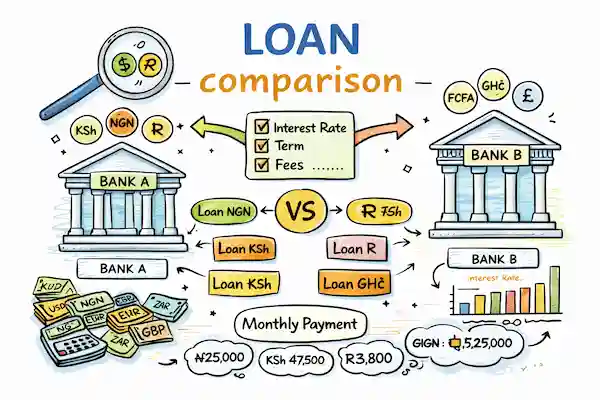
Two Nigerian loan offers can display the same annual percentage but produce different repayments. A flat-rate calculation applies interest to the original principal for the stated period, while a reducing-balance calculation applies interest to the outstanding principal as it falls. Fees and cash deducted upfront widen the difference.
Small-business records work best when each document has one clear job. Quotes explain an offer, invoices request payment, receipts prove payment, forecasts expose timing gaps, and loan comparisons put competing offers on the same basis.
This guide targets flat rate vs reducing balance loan Nigeria with a decision-ready workflow. Use the Loan Comparison Tool to organise the inputs, then replace every placeholder with your measurements, records and current written terms.
Sources reviewed: August 3, 2026. This article provides record-keeping and planning guidance. It is not accounting, tax, credit or legal advice, and it does not turn an informal record into an official tax document.
Quick answer
Do not compare headline rates alone. For each written offer, record the amount requested, cash actually received after deductions, rate method, repayment frequency, number of payments, instalment amount, total fees, insurance, late-payment terms and total repayment. Compare total borrowing cost and cash-flow fit on the same time basis.
The table below is the minimum evidence pack. A task is not complete merely because somebody says it has been handled. Save the document, measurement, quote, portal acknowledgement or transaction reference that supports the answer.
| # | Input or decision | Evidence to keep |
|---|---|---|
| 1 | Cash received | Disbursement record after all upfront deductions |
| 2 | Rate method | Written statement of flat, reducing, effective or other method |
| 3 | Payment schedule | Number, frequency, dates and instalment amounts |
| 4 | Fees and insurance | Every compulsory charge and when it is paid |
| 5 | Total and exceptions | Total repayment, early settlement and late-payment terms |
Why this calculation or checklist matters
Build the record from the underlying transaction. Keep the customer or lender identity, dates, currency, tax treatment, payment reference and approval trail visible. A polished document cannot repair unsupported figures, so reconcile the numbers before exporting it.
A borrower spends the cash received, not the nominal amount printed at the top of the offer. If fees are deducted before disbursement, the effective cost rises. A lower monthly payment may also come from a longer term and create a higher total repayment.
A good working file also makes disagreement cheaper. Instead of arguing about a total, the people involved can inspect the quantity, unit, date, source and assumption that produced it. That is the difference between a reusable estimate and a number copied into a message.
Step-by-step workflow
- Step 1. Collect the lender's written offer and repayment schedule before entering any figure.
- Step 2. Separate nominal principal from the net cash that will reach the borrower.
- Step 3. Identify the rate method and whether the quoted period is monthly, annual or for the full term.
- Step 4. Add compulsory fees, insurance and account charges to the comparison.
- Step 5. Compare total repayment, total borrowing cost and the highest periodic payment across offers.
- Step 6. Check affordability under a lower-income month and ask the lender to explain every mismatch in writing.
How flat and reducing calculations differ
With a flat rate, the interest base normally remains the original principal throughout the stated calculation. With a reducing balance, each principal repayment lowers the amount on which future interest is computed.
The exact schedule still depends on timing, frequency, rounding and contract terms. Use the lender's schedule rather than trying to infer the method from a marketing label.
- Original principal
- Outstanding principal after each payment
- Interest charged each period
- Principal portion and closing balance
Compare cash received with cash repaid
Write the net disbursement after application fees, management fees, insurance or other deductions. Then sum every required repayment and any charges paid separately.
Total borrowing cost equals total cash paid by the borrower minus cash actually received, subject to how refundable deposits or contingent charges are treated. This plain comparison often reveals more than the headline percentage.
- Net disbursement
- Scheduled instalments
- Upfront cash fees
- End-of-term or balloon payment
Affordability and contract questions
The cheapest offer can still be unsafe if the payment date conflicts with income timing. Test the instalment against a weak month, not only the average month.
Ask about early settlement, late payment, variable-rate changes, debit-order failure, collateral and complaint channels. Do not rely on a salesperson's verbal summary when the written contract says something different.
- Payment-to-income buffer
- Early settlement calculation
- Late-payment consequence
- Regulated complaint route
Build an evidence pack another person can audit
Open the original offer, invoice, bank record, ledger or loan schedule and compare it with the calculator line by line. Mark every figure as confirmed, estimated or disputed. Confirmed means a dated record supports it. Estimated means the method and source are written down. Disputed means the figure must not be treated as settled. Reconcile totals independently, then ask the customer, lender, accountant or responsible colleague to resolve the disputed lines in writing.
Use short filenames that begin with the date and describe the record. Keep the original source separate from calculations and annotations. Where a file contains identity, financial, health or commercial data, share the minimum necessary information and use the official or trusted channel. A checklist should reduce exposure, not create another uncontrolled copy of sensitive material.
Set the decision gate
Before sending or signing, confirm who owns the next action, when it is due and what evidence will close it. Keep the exported result with the source records and preserve the previous version. If the decision changes price, tax, payment instructions, credit terms or a customer obligation, obtain approval through a trusted channel rather than silently editing the file.
Write a clear stop condition before commitment. A stop condition might be a missing official search, an unverified payment account, an unresolved name mismatch, an unaffordable pressure case, an unapproved safety specification or a supplier quote that excludes essential scope. When it appears, pause and resolve the evidence rather than pushing the same uncertain assumption into the final output. Record who made the final decision, the date and the evidence they reviewed so a later update has an honest starting point.
Stress-test the result
Use three cases when money or timing can move: a base case using the written terms, a pressure case with slower receipts or higher costs, and a recovery case showing the decision that restores a safe cash position. Scenario planning is more honest than hiding uncertainty inside one precise-looking number.
Reduce available monthly income, add one missed-payment fee shown in the contract and compare early settlement halfway through the term. The exercise should reveal whether a longer term merely postpones pressure or genuinely fits the borrower's cash flow.
Write the decision beside the scenario. Examples include delaying a purchase, collecting a larger deposit, reducing scope, changing packaging, adding route density, choosing a different loan, or asking a qualified adviser to verify an exception. A scenario without a decision is only another spreadsheet column.
Common mistakes to avoid
- Comparing percentages without confirming the rate method.
- Treating nominal principal as cash received after upfront deductions.
- Ignoring insurance, management or account fees.
- Choosing the lowest instalment without comparing term and total repayment.
- Entering promotional claims instead of the written offer and schedule.
One final check catches many errors: ask whether a different person could reproduce the answer from the saved inputs. If not, label the missing assumption before using the result in a quote, purchase, application or public promise.
Use the AfroTools workflow
Open the Loan Comparison Tool and enter the dated inputs from your evidence pack. Keep units and currencies consistent. Save or export the result where the tool supports it, then give the version a descriptive filename that includes the date and scenario.
Create one entry for each written offer and preserve the schedule used. The tool compares user-entered terms locally; it does not recommend a lender, verify licensing, assess creditworthiness or predict approval.
AfroTools does not submit the application, certify the document, approve the budget, select the supplier or guarantee the outcome. The output is a private planning aid that helps you ask better questions and keep a reviewable record.
Sources checked on August 3, 2026
Primary authorities and practical technical references were preferred. Reopen the live source before acting because forms, fees, product specifications, thresholds and portal steps can change.
Put every loan offer on the same basis
Turn the evidence into a dated calculation or checklist before you commit money, time or documents.
Open Loan Comparison Tool →Related AfroTools guides
Frequently asked questions
Not automatically in every contract, but applying a rate to the original principal can produce a higher effective cost than the same headline rate on a reducing balance.
Compare net cash received, total cash repaid and the timing of each payment, then inspect fees and exceptions.
An exact comparison needs the full schedule, payment timing, fees and rounding rules. Use written lender data.
Separate optional products from compulsory charges and compare both the required offer and any chosen add-on.
No. The tool compares the written figures you enter and does not rank, endorse or verify providers.