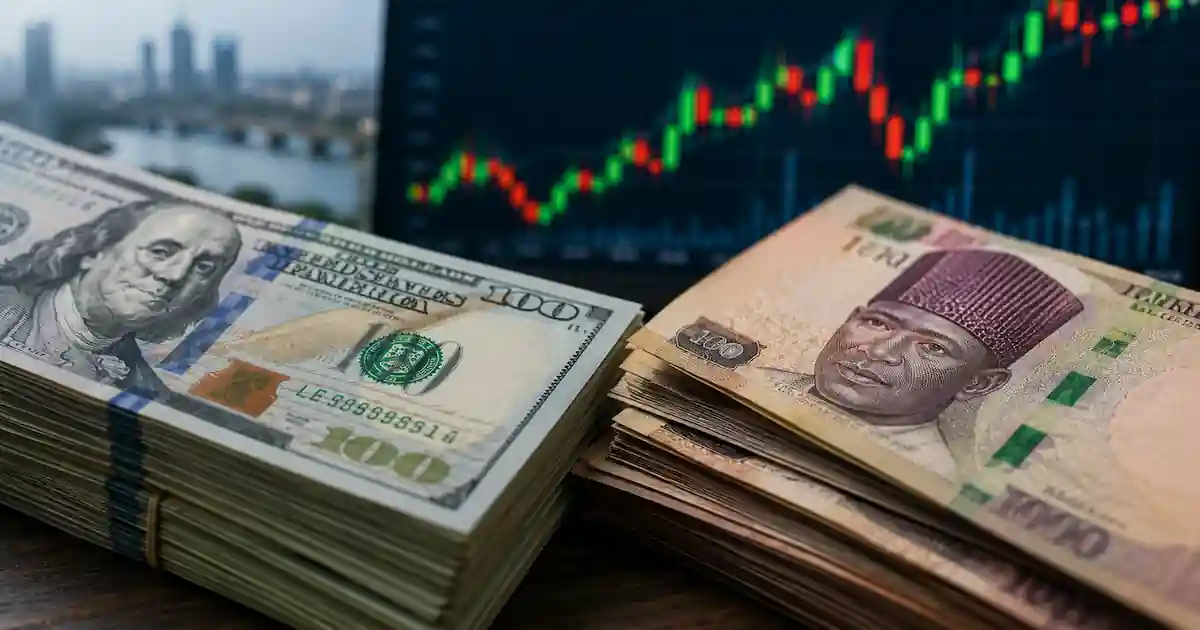
If you check the dollar to naira rate often, you are usually not doing it out of curiosity. You are about to pay school fees, price an import, receive client money, top up a domiciliary account, or decide whether to convert today or wait.
The useful question is not just "what is the rate?" It is "which rate, through which channel, and at what time today?" Nigeria's official NFEM reference, bank quotes, BDC prices, and informal market quotes can all diverge on the same day. For a live starting point, use the AfroTools Currency Converter.
How Does the USD/NGN Exchange Rate Work?
The exchange rate between the United States dollar (USD) and the Nigerian naira (NGN) represents how many naira are needed to purchase one US dollar. Nigeria operates a managed float exchange rate system, meaning the Central Bank of Nigeria (CBN) allows the naira to move within a band but intervenes when volatility becomes excessive.
Since the foreign exchange reforms of June 2023, Nigeria has moved toward a more market-driven exchange rate regime. The CBN collapsed the multiple exchange rate windows into a single Investors' and Exporters' (I&E) window, now formally known as the Nigerian Autonomous Foreign Exchange Market (NAFEM). This unification was a landmark policy shift aimed at attracting foreign investment and eliminating the arbitrage opportunities that had long plagued the system.
The Official Rate (NAFEM)
The NAFEM rate is the primary official rate determined by supply and demand among authorized dealers, including commercial banks, institutional investors, and exporters. This rate is published daily by the CBN and is used for official transactions, trade finance, and reporting purposes. Since the unification, the NAFEM rate has been significantly more responsive to market conditions, trading in a range that more closely reflects the naira's true value.
The Parallel Market Rate
Despite the reforms, a parallel (commonly called "black market") exchange rate continues to exist. This is the rate at which foreign currency is traded informally through Bureau de Change (BDC) operators, street traders, and peer-to-peer platforms. The parallel market premium, the gap between the official and parallel rates, has historically ranged from 5% to over 70%, depending on dollar liquidity and market confidence.
The parallel market persists for several reasons: limited dollar supply through official channels, documentation requirements that many individuals and small businesses cannot meet, and the sheer size of Nigeria's informal economy. While the CBN has worked to narrow the gap, the parallel market remains a reality for millions of Nigerians.
What Does the Recent USD/NGN Trend Actually Tell You?
A static blog post is a poor place to hard-code a "today" rate table, because the naira can move intraday and official closes change every business day. What matters more is the pattern: the official NFEM rate and the street or BDC quote can narrow or widen depending on liquidity, policy signals, and demand.
If you are budgeting a real transaction, use a live quote for the day you will actually convert, then compare it against the official reference and the all-in rate your bank or provider offers. Yesterday's average is useful for context, but it is not the number that decides whether your payment clears comfortably.
What Factors Affect the Dollar to Naira Rate?
Understanding what drives the exchange rate helps you anticipate movements and plan your currency conversions. Here are the most significant factors:
1. Crude Oil Prices and Export Revenue
Nigeria remains heavily dependent on crude oil exports, which account for roughly 90% of foreign exchange earnings and over 50% of government revenue. When global oil prices rise, dollar inflows increase, strengthening the naira. Conversely, falling oil prices reduce dollar supply and put downward pressure on the currency. The country's oil production output also matters, pipeline vandalism, maintenance shutdowns, and OPEC+ production quotas all affect how much revenue Nigeria actually earns.
2. CBN Monetary Policy
The Central Bank of Nigeria uses several tools to manage the exchange rate. These include setting interest rates (the Monetary Policy Rate, currently at elevated levels to combat inflation), managing foreign reserves, conducting direct dollar sales through NAFEM, and adjusting cash reserve ratios for commercial banks. Tighter monetary policy tends to attract foreign portfolio investment, increasing dollar supply and supporting the naira.
3. Inflation and Purchasing Power
Nigeria's inflation rate significantly exceeds that of the United States. According to the Central Bank of Nigeria, consumer price inflation has been a persistent challenge. When inflation is high domestically, the real value of the naira erodes, leading to depreciation pressure. The interest rate differential between Nigerian and US government bonds also influences capital flows.
4. Foreign Direct Investment (FDI) and Portfolio Flows
Foreign investment brings dollars into Nigeria. A favorable business environment, stable policies, and competitive returns attract investment, strengthening the naira. Political uncertainty, regulatory changes, or capital controls can reverse these flows. The ease with which investors can repatriate profits (a long-standing concern in Nigeria) also plays a role.
5. Diaspora Remittances
Nigerians living abroad send billions of dollars home annually, making remittances one of the largest sources of foreign exchange after oil exports. The World Bank estimates that Nigeria consistently ranks among the top remittance-receiving countries in Africa. Changes in diaspora income levels, transfer costs, and the availability of formal versus informal channels all affect how much foreign currency reaches the Nigerian economy through this route.
6. Government Fiscal Policy
Large government budget deficits financed by domestic borrowing can increase money supply and fuel inflation, indirectly weakening the naira. Conversely, fiscal discipline, subsidy reforms (such as the fuel subsidy removal in 2023), and efforts to diversify revenue sources beyond oil can stabilize the currency over the medium term.
CBN Official Rate vs Parallel Market: Which One Applies to You?
This is one of the most common questions Nigerians have about exchange rates. The answer depends on the nature of your transaction:
When You May Access a Bank-Led Official Reference Rate
- Documented education and medical payments: Banks may process qualifying school-fee or medical transactions close to official market references, subject to current rules and paperwork.
- Approved business trade flows: Import and trade-related transactions can move through authorised banking channels when the underlying documents are in place.
- Travel-related FX access: Travel allowances and similar bank-led channels depend on current policy, bank process, and actual liquidity on the day.
The key point is that "official rate access" is never just about the headline number. It is about documentation, channel eligibility, your bank's process, and whether liquidity is available when you apply.
When You Likely Pay the Parallel Rate
- Cash dollar purchases for undocumented purposes
- Small-scale informal imports without Form M
- Peer-to-peer transfers outside the banking system
- Dollar purchases from BDC operators or street traders
- Transactions exceeding PTA/BTA limits
For most everyday Nigerians, the parallel market rate is the rate they encounter in practice. Even when transacting through banks, the actual rate offered may include spreads and fees that bring it closer to the parallel rate. This is why tracking both rates is essential.
How to Use USD/NGN Rates Without Getting Burned
If you are converting real money, the goal is not to guess the perfect market turn. It is to avoid using the wrong benchmark and ending up short when the payment is due.
1. Start with the rate you can actually access
A bank-led transaction, a remittance payout, and a cash-market quote are not the same product. Compare the channel you will really use.
2. Ask for the all-in number
Fees, provider spread, and settlement timing can change the result more than the headline rate itself. Always compare the amount that will finally be delivered or received.
3. Keep formal-bank paperwork ready
If you are relying on a documented bank channel for school fees, medical payments, travel, or trade, missing paperwork can matter as much as the market level. Confirm the bank's requirements before you budget around the official reference.
4. Build a buffer into urgent payments
For tuition, import deposits, or rent deadlines, do not budget to the midpoint you saw on social media. Add room for spreads and same-day moves so you are not forced into a worse rate at the last minute.
5. Separate speculation from cash flow
If the payment date is fixed, protecting the transaction usually matters more than squeezing out one last improvement. A slightly worse rate today can be cheaper than a missed deadline tomorrow.
Convert USD to NGN Instantly
Use the free AfroTools Currency Converter for live exchange rates. No sign-up required. Supports 150+ currencies.
Open Currency Converter →What Is the Naira Outlook for 2026?
No static article can call the next leg of USD/NGN with confidence. The practical way to think about the outlook is to watch four things together: oil-related inflows, CBN policy, inflation pressure, and how easily dollars are actually available through formal channels.
If you have a transaction coming up, the safest move is usually not to rely on a blog prediction. Use a live quote, compare channels on the day, and decide based on your real deadline rather than a one-line market forecast.
How to Use the AfroTools Currency Converter
The AfroTools Currency Converter is designed to give you quick, accurate conversions between USD and NGN (and over 150 other currencies). Here is how to use it:
- Work through to /tools/currency-converter/ or click the link above.
- Select USD as the source currency and NGN as the target (or vice versa).
- Enter the amount you want to convert.
- The tool displays the converted amount using live market data.
- You can swap currencies with one click and convert between any supported pairs.
The tool is completely free, works on any device, and does not require you to create an account or provide any personal information.
Frequently Asked Questions
What is the dollar to naira rate today?
There is no single dollar-to-naira number that covers every real transaction. The CBN NFEM reference, bank quotes, BDC prices, and provider payout rates can differ on the same day. Use the AfroTools Currency Converter as a live benchmark, then compare the exact channel you plan to use.
Why is the CBN rate different from the black market rate?
The formal reference rate comes from the authorised market, while cash and informal demand can price above it when access, paperwork, or liquidity are tighter than the market wants. That is why the headline reference and the rate on the street do not always match.
What factors affect the naira exchange rate?
The biggest drivers are oil-related inflows, CBN policy, inflation pressure, reserve conditions, foreign capital flows, and how easily dollars are available through formal channels. In practice, the mix matters more than any single headline.
Can I buy dollars at the CBN official rate?
Access to bank-led official reference pricing usually depends on current policy, documentation, and actual liquidity through authorised channels. If your use case is documented education, medical, trade, or travel-related FX, confirm the current process with your bank before assuming the headline daily reference is directly available to you.
How can I convert dollars to naira online?
Use the free AfroTools Currency Converter at /tools/currency-converter/ as a live benchmark, then compare the executable quote from your bank or transfer provider on the exact amount you need to move.