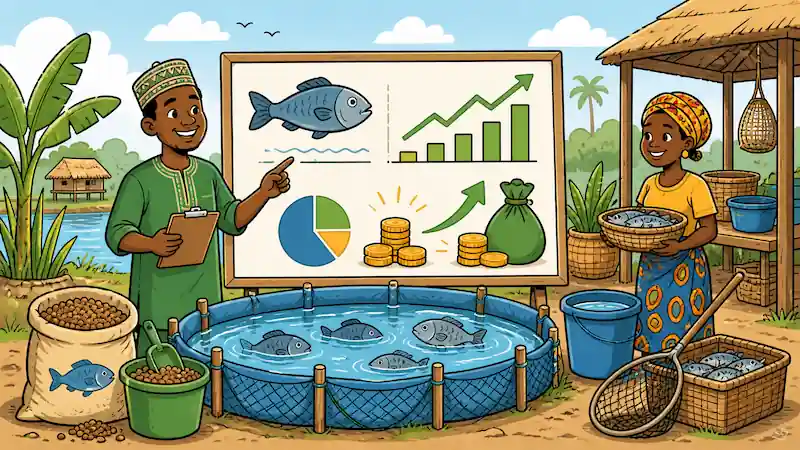
A Nigerian catfish feed budget should follow biomass, not only the number of juveniles stocked. Survival, starting weight, target harvest weight, feed conversion, feed size, water quality and grading all affect how many kilograms are consumed and when the farm needs cash.
Farm budgets become more useful when biological quantities and cash prices are kept separate. The crop or animal needs a physical input first; the market price, pack size, mortality, wastage and timing then determine the budget.
This guide targets catfish feed budget Nigeria with a decision-ready workflow. Use the Nigeria Fish Farming ROI Calculator to organise the inputs, then replace every placeholder with your measurements, records and current written terms.
Sources reviewed: August 3, 2026. This is a planning estimate, not a farm prescription. Soil, water quality, breed, age, climate, health and local extension advice can materially change the correct input.
Quick answer
Record fish stocked, average starting weight, expected survival, target harvest weight, planned feed conversion ratio, feed stages, bag weight and dated price. Estimate biomass gain for saleable fish, multiply by the planning feed-conversion assumption, add only justified losses, and schedule feed purchases across the cycle. Verify feeding and health decisions with an aquaculture professional.
The table below is the minimum evidence pack. A task is not complete merely because somebody says it has been handled. Save the document, measurement, quote, portal acknowledgement or transaction reference that supports the answer.
| # | Input or decision | Evidence to keep |
|---|---|---|
| 1 | Stocking record | Fish count, source, date and average starting weight |
| 2 | Survival assumption | Base and stress survival with mortality log |
| 3 | Growth target | Harvest weight, culture period and grading plan |
| 4 | Feed assumption | Stage, feed conversion, bag size and supplier specification |
| 5 | Market basis | Saleable kilograms, buyer terms and dated price evidence |
Why this calculation or checklist matters
Start with field area, flock or stock count, production stage and a locally appropriate technical recommendation. Convert the recommendation into the units actually sold, add realistic losses, and collect dated supplier quotes. Never promote a national average as a guaranteed farm result.
A budget based only on bags per thousand fish can miss the effect of mortality and target weight. It may also front-load or understate cash because smaller feed and later grow-out feed can have different prices and purchase timing.
A good working file also makes disagreement cheaper. Instead of arguing about a total, the people involved can inspect the quantity, unit, date, source and assumption that produced it. That is the difference between a reusable estimate and a number copied into a message.
Step-by-step workflow
- Step 1. Record the actual stocked count and sample starting weight rather than relying on the supplier label alone.
- Step 2. Estimate saleable fish under base and stress survival cases.
- Step 3. Calculate starting and target biomass so the model focuses on weight gained.
- Step 4. Apply a planning feed-conversion assumption and separate feed types or pellet sizes by stage.
- Step 5. Price each bag from current supplier quotes and schedule when the cash will be needed.
- Step 6. Compare actual sampled biomass and cumulative feed with the forecast throughout the cycle.
From fish count to biomass gain
Multiply fish count by average weight to estimate biomass. The feed plan should support the increase from starting biomass to expected harvest biomass, subject to the production system and professional advice.
Sample consistently and record the method. A few unusually large fish can make the average misleading, while poor grading can increase size variation and cannibalism risk.
- Fish sampled
- Average sample weight
- Estimated fish alive
- Estimated biomass and date
Use feed conversion as a scenario, not a promise
Feed conversion ratio compares feed used with biomass gained. It is affected by feed quality, temperature, water conditions, stocking density, health, wastage and measurement accuracy.
Run more than one ratio and do not backsolve an optimistic result merely to make the venture profitable. Actual cumulative feed and sampled biomass should replace the forecast over time.
- Feed issued
- Feed remaining or wasted
- Biomass gain
- Observed versus forecast conversion
Schedule the cash, harvest and buyer
A profitable full-cycle estimate can still fail if the farm cannot fund feed near the end of grow-out. Break the total into purchase periods and preserve a reserve for delayed harvest.
Confirm whether buyers pay by live weight, processed weight, size band or piece. Use the same sale basis in the revenue side of the model and record transport, smoking, processing or market fees separately.
- Feed reorder dates
- Cash needed by period
- Buyer weight and quality basis
- Harvest and transport cost
Build an evidence pack another person can audit
Create one field or production log for the cycle. Record the area or stock, input delivered, input used, timing, weather or water conditions, losses, sampled growth and saleable output. Keep supplier labels and batch details where they affect the recommendation. A dated log allows an extension officer, agronomist, veterinarian or nutritionist to review the same evidence instead of reconstructing the season from memory.
Use short filenames that begin with the date and describe the record. Keep the original source separate from calculations and annotations. Where a file contains identity, financial, health or commercial data, share the minimum necessary information and use the official or trusted channel. A checklist should reduce exposure, not create another uncontrolled copy of sensitive material.
Set the decision gate
Do not change an agronomic, feeding, health or irrigation programme only because the cheapest calculator scenario looks attractive. Take the draft to an appropriately qualified local adviser, show the source and assumptions, and record any adjustment they recommend. Use the approved quantity for procurement, then track actual use separately so leftover material is not applied automatically.
Write a clear stop condition before commitment. A stop condition might be a missing official search, an unverified payment account, an unresolved name mismatch, an unaffordable pressure case, an unapproved safety specification or a supplier quote that excludes essential scope. When it appears, pause and resolve the evidence rather than pushing the same uncertain assumption into the final output. Record who made the final decision, the date and the evidence they reviewed so a later update has an honest starting point.
Stress-test the result
Run at least three farm cases. The base case uses the most likely survival, yield or intake. The stress case raises feed, fertiliser, water or veterinary cost while lowering saleable output. The upside case should change only assumptions the farmer can explain. Keep each version dated so actual performance can be compared later.
Lower survival, worsen feed conversion, raise the later-stage feed price and delay harvest. If the farm cannot finance the pressure case, reduce stocking, stage production, secure a buyer or revisit the system with an aquaculture adviser.
Write the decision beside the scenario. Examples include delaying a purchase, collecting a larger deposit, reducing scope, changing packaging, adding route density, choosing a different loan, or asking a qualified adviser to verify an exception. A scenario without a decision is only another spreadsheet column.
Common mistakes to avoid
- Budgeting bags per thousand fish without tracking biomass.
- Using one optimistic feed-conversion value as a guarantee.
- Ignoring feed-stage price differences and late-cycle cash needs.
- Calculating revenue from stocked fish rather than saleable harvest weight.
- Changing the feed or health programme based only on a budget result.
One final check catches many errors: ask whether a different person could reproduce the answer from the saved inputs. If not, label the missing assumption before using the result in a quote, purchase, application or public promise.
Use the AfroTools workflow
Open the Nigeria Fish Farming ROI Calculator and enter the dated inputs from your evidence pack. Keep units and currencies consistent. Save or export the result where the tool supports it, then give the version a descriptive filename that includes the date and scenario.
Enter Nigeria-specific feed, juvenile and sale assumptions, then save the base and stress cases. Update the model with sampled biomass and actual feed issued. The tool does not prescribe feeding, diagnose fish health or guarantee survival.
AfroTools does not submit the application, certify the document, approve the budget, select the supplier or guarantee the outcome. The output is a private planning aid that helps you ask better questions and keep a reviewable record.
Sources checked on August 3, 2026
Primary authorities and practical technical references were preferred. Reopen the live source before acting because forms, fees, product specifications, thresholds and portal steps can change.
- Nigerian Institute for Oceanography and Marine Research, catfish training
- FAO cultured species profile for African catfish
- FAO aquaculture feed-management guidance
Plan the Nigerian catfish feed bill
Turn the evidence into a dated calculation or checklist before you commit money, time or documents.
Open Nigeria Fish Farming ROI Calculator →Related AfroTools guides
Frequently asked questions
There is no responsible universal answer. Stock size, survival, target weight, feed conversion, system and bag size all matter.
It compares feed used with biomass gained. Use it as a measured planning indicator, not a guaranteed biological outcome.
Update the estimated fish alive and biomass, while recording the mortality and investigating health or water-quality causes professionally.
Use a dated buyer quote on the exact live, processed, size or weight basis that will apply at harvest.
No. Use qualified aquaculture, veterinary and feed-supplier guidance for the production decision.